

Audio By Carbonatix
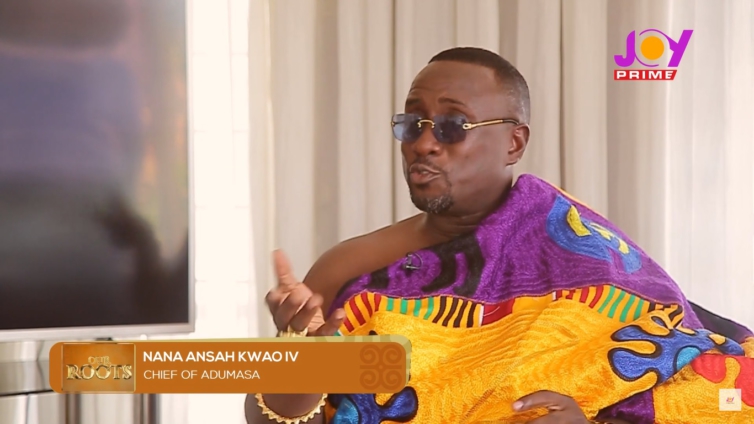
The Chief of Adumasa in the Eastern Region, Nana Ansah Kwao IV has revealed that Akan chiefs wield authority and not power.
According to him, the traditional rulers in an Akan setting do not practice a dictatorial style of leadership. Instead, power and authority are shared such that the chief works hand in hand with the council of ministers to ensure peaceful rulership and development in the society.
Nana Ansah Kwao IV mentioned that the forefathers thought it wise to give authority to chiefs and power to the council of ministers because they realised that absolute power is corrupt.
Hence, chiefs in the Akan society do not have the power to use their authority, and the council of elders also does not have the authority to use their power.
"So as a chief, I have 99% of the authority but almost no power. The power, however, is split up in small pieces among my ministers, but they don’t have authority. So they don’t have the authority to use their power, and I don’t have the power to use my authority. At any given time, before a chief makes a move, he has to consult his ministers," he said.
This, according to him, eliminates dictatorship and helps chiefs be directly accountable to the people. This also promotes good governance in society and paves the way for development to take place.
Nana Ansah Kwao pointed out that though the system of governance in Ghana has changed, the roles of chiefs in the country have not been curtailed. He explained that, currently, the roles of chiefs in Ghana have increased.
According to him, in recent times, chiefs have found themselves stepping in to help curb and solve issues that the government sometimes fails to solve in the community, aside from the roles originally set up for them to follow.
"The role and responsibility of the chief are way greater than they used to be. People will come and complain about problems they face in their schools, hospitals, and many more places. So the role and responsibilities of chiefs now are unenviable. Everything falls under the jurisdiction of the chief."
Ansah Kwao IV apologised to the youth of Ghana, who, by no fault of theirs, have become ignorant about the culture and its practices.
He also pointed out that the rites performed in stooling a chief have no spiritual hands involved and asked youths not to believe the myths that say otherwise.
He however encouraged the youth to go back to their community of origin and learn more to help them stay abreast with their culture, keep it alive, and pass it down to future generations.
Latest Stories
-
She Captures Humanity supports mothers at Pentecost Hospital in Madina
4 hours -
Agogoman pays tribute to Nana Kwame Akuoko Sarpong
4 hours -
‘People are playing political games with Sedina’s whereabouts’ – Edem Senanu
4 hours -
Which records prove Sedina is in prison? – Baffour Awuah asks Interior Minister
4 hours -
Data Science Analytics expert urges Africa to use data science to solve its problems
4 hours -
Interior Minister’s explanation on Sedina raises more questions than answers – Baffour Awuah
5 hours -
Jewellery firm sues Donewell Insurance over alleged failure to honour US$3m burglary insurance claim
5 hours -
Sedina serving her sentence in prison custody, not receiving special treatment – Interior Minister
5 hours -
‘I’m not afraid of death,’ Akamba says as he alleges threats
6 hours -
Gov’t awaits BoG licence to operationalise Women’s Development Bank – Ampem Nyarko
6 hours -
‘Go back and save them’ – Upper West NACOC boss charges school counsellors to tackle drug abuse
6 hours -
Over 2,000 firearms to be destroyed under Gun Amnesty Programme – Deputy Interior Minister
6 hours -
Gov’t moves Republic holiday to Friday, July 3
6 hours -
Drivers block Shama–Nyankrom road over deteriorating condition, undertake self-help repairs
6 hours -
Over 1,000 gold-buying companies licensed by GoldBod – Deputy Finance Minister
7 hours