

Audio By Carbonatix
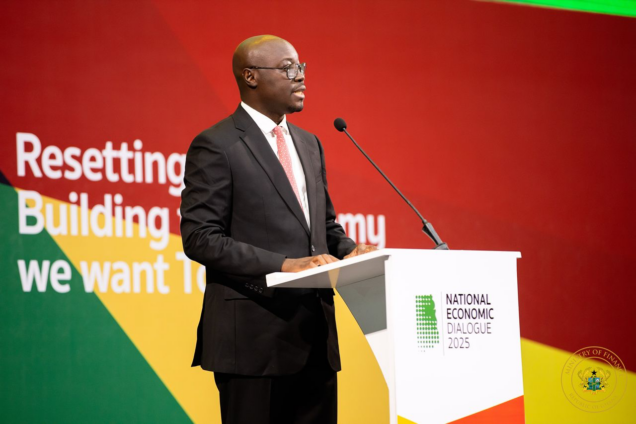
Dr Cassiel Ato Baah Forson, the Minister of Finance, Monday unveiled what he says is a comprehensive strategy aimed at resetting Ghana’s economy through rigorous structural reforms.
The Minister emphasised the urgent need for fiscal discipline and sustainable growth, describing the current macroeconomic situation as “very fragile.”
The announcement was made during the inaugural day of the National Economic Dialogue held at the Accra International Conference.
In a detailed presentation, the Minister outlined seven key focus areas designed to address the nation’s economic challenges.
These included enhanced domestic revenue mobilisation, which would involve strategies to broaden the tax base and improve collection efficiency, ensuring a balance between equity, simplicity, and efficiency.
The Minster said the government also planned to achieve quantitative fiscal consolidation through controlled borrowing and reduced costs, allowing for increased investment in national development.
“Ensuring compliance with public financial arrangements and public procurement rules is another critical area, with a focus on strengthening financial governance and promoting transparency in public spending,” he said.
“Additionally, the Government aims to enhance the efficiency of public spending and social programmes by optimising resource allocation to maximise value for money and ensure fiscal adjustment.”
Dr Forson announced plans to phase out costly, regressive, and ineffective subsidies in the energy sector, transitioning towards targeted social programmes to protect vulnerable populations while reducing fiscal strain.
“Reforming state-owned enterprises (SOEs) is another priority, with specific attention given to addressing contingent liabilities and reducing fiscal burdens in entities like Cocoa Board and the Electricity Company of Ghana,” he said.
He revealed government’s decision to working on strengthening Ghana’s fiscal framework by redesigning fiscal rules and enhancing automatic stabilizers to contain budget fragilities and address revenue year market issues.
The Minister stressed the importance of discipline and a long-term perspective, urging citizens to recognise that “short-term benefits we gain today have long-term consequences for our future.”
He acknowledged the ineffectiveness of fiscal policy over the past eight years and called for a “momentum for reforms,” emphasising that the “quality of adjustment will be key to support growth and protect the poor and most vulnerable.”
“The new reforms are intended to address the current economic climate, particularly the high cost of borrowing and the need to channel dividends to support national development,” he said.
Latest Stories
-
Morocco and Senegal set for defining AFCON final under Rabat lights today
1 hour -
Trump tariff threat over Greenland ‘unacceptable’, European leaders say
2 hours -
Evalue-Ajomoro-Gwira MP kicks against VALCO sale
2 hours -
Mercy Johnson withdraws alleged defamation case against TikToker
3 hours -
Ghana accepted Trump’s deported West Africans and forced them back to their native countries
3 hours -
No evidence of theft in Unibank Case – A‑G explains withdrawal of charges against Dr Duffour
4 hours -
Labourer remanded for threatening to kill mother
4 hours -
Court remands farmer over GH¢110,000 car fraud
4 hours -
Tension mounts at Akyem Akroso over ‘sale’ of royal cemetery
4 hours -
Poor planning fueling transport crisis—Prof. Beyuo
5 hours -
Ahiagbah slams Prof. Frimpong-Boateng over “fake” party slur
5 hours -
Family traumatised as body of Presby steward goes ‘missing’ at mortuary
6 hours -
Why Ghana must maintain the NPA’s price floor in the petroleum market
6 hours -
Serwaa Amihere apologises to PRESEC community over ‘homosexual breeding ground’ comment
7 hours -
Dr Arthur Kennedy slams NPP’s “dubious” plot to expel Prof Frimpong-Boateng
7 hours