


Audio By Carbonatix
Smoke from the massive bushfires in Australia will soon circle the Earth back to the nation, says Nasa.Massive infernos have raged along the nation's east coast for months, pushing smoke across the Pacific.Nasa said plumes from blazes around New Year's Day had crossed South America, turning skies there hazy, and moved "halfway around Earth" by 8 January."The smoke is expected to make at least one full circuit around the globe," the US space agency said.Hundreds of bushfires have burnt across Australia, killing at least 28 people and destroying more than 2,000 homes.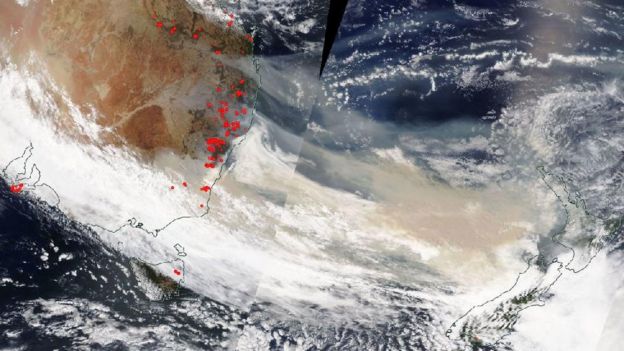 A satellite image showing smoke travelling towards New Zealand on 5 JanuaryThe agency said it was studying the effects of smoke at this altitude and whether it provided "a net atmospheric cooling or warming".
Bushfire smoke as seen near the International Space StationThe unprecedented scale and intensity of the fires has been exacerbated by climate change, experts say.A fleet of NASA satellites ðŸ›°ï¸ working together has been analyzing the aerosols and smoke from the massive fires burning in Australia.https://t.co/93geNvCBnU pic.twitter.com/ZedZ199lvJ
— NASA Goddard (@NASAGoddard) January 9, 2020
How has the smoke travelled around the world?
Nasa said recent blazes had been so big they had produced an "unusually large" number of pyrocumulonimbus events - or fire-generated thunderstorms.These had sent smoke soaring into the stratosphere, with some recorded as high as 17.7km (11 miles)."Once in the stratosphere, the smoke can travel thousands of miles from its source, affecting atmospheric conditions globally," Nasa said.
A satellite image showing smoke travelling towards New Zealand on 5 JanuaryThe agency said it was studying the effects of smoke at this altitude and whether it provided "a net atmospheric cooling or warming".What has been the smoke's impact closer to ground?
Nasa noted the smoke had changed the colour of skies in South America, and dramatically affected New Zealand, where it was "causing severe air quality issues" and "visibly darkening mountaintop snow".Large Australian cities including Sydney, Melbourne, Canberra, and Adelaide have also endured dangerous air quality levels due to smoke from nearby bushfires.On Tuesday, Melbourne residents were enduring a second consecutive day of "hazardous" air quality, prompting concerns about public health.More than 100 fires continue to burn in the nation's east, however cooler conditions in recent days and forecast rain have aided firefighting efforts.DISCLAIMER: The Views, Comments, Opinions, Contributions and Statements made by Readers and Contributors on this platform do not necessarily represent the views or policy of Multimedia Group Limited.
Tags:
DISCLAIMER: The Views, Comments, Opinions, Contributions and Statements made by Readers and Contributors on this platform do not necessarily represent the views or policy of Multimedia Group Limited.
Latest Stories
-
Mahama should reset his stance on LGBTQ -Clinton Baffour
1 minute -
Rising sachet water costs should spark a bigger conversation on plastic waste
5 minutes -
Two-week ceasefire takes effect as US and Iran prepare for talks in Pakistan
8 minutes -
Dr. Amoakohene debunks claims Sewua and other Agenda 111 hospitals are ready for operationalisation
16 minutes -
AMA rolls out new shift system for street sweepers to improve sanitation
19 minutes -
Focus on capacity, not connections in Damang lease decision – Paa Kwesi Schandorf
30 minutes -
Teen defender Eric Mensah undergoes trial at Malaga CF after standout ROC Cup display
32 minutes -
Journalism out loud: Why silence is no longer an option
32 minutes -
5,000 miners stranded in Ahafo-Ano North as alleged NAIMOS operatives take over site
39 minutes -
GMTFcare rollout begins at Komfo Anokye Teaching Hospital to transform patient support
46 minutes -
Leicester lose appeal against points deduction
55 minutes -
Telecel hosts Women 100 Power Connect 2026 on reciprocity in leadership
1 hour -
Ken Ofori-Atta released from ICE detention after judicial order — Lawyer confirms
1 hour -
Women in PR Ghana unveils Top 10 PR Women for 2025
1 hour -
Tourism Minister advocates expansion of Vodza Regatta in Volta region to boost coastal tourism
1 hour