


Audio By Carbonatix
Banks in Ghana remain in a solid position despite Ghana’s challenging economic environment and the ongoing efforts of the Domestic Debt Exchange Programme (DDEP), Fitch Solutions has stated in its new report dubbed “Ghana’s New CRRs To Have Muted Impact On Loan Growth And Weigh On Profits”.
According to the London-based firm, the banking sector has reported strong growth in balance sheet items despite unfavourable conditions.
It added that capital levels, which had fallen close to the minimum requirement, are beginning to improve again, and banks are recording robust profits.
However, it explained that the recently introduced linking of banks’ cash reserve ratio (CRR) requirement to their loan-to-deposit ratio (LDR) will have several unfavourable consequences.
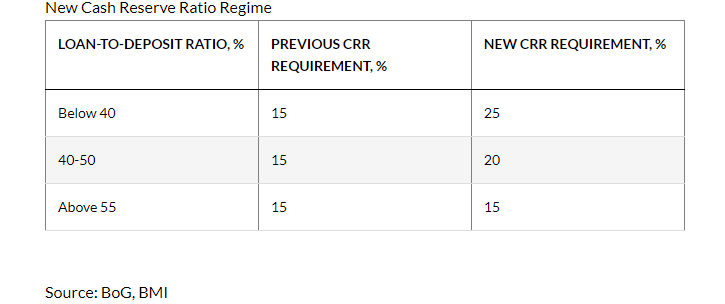
On March 25 2024, the Bank of Ghana (BoG) introduced a new regime aiming to boost lending and reduce excess local-currency liquidity to control inflation by linking the CRR to the LDR. “While we believe this will compel some banks to extend more credit, very poor loan quality will keep lending too risky for others, who will instead prefer to hold high cedi cash reserves at the central bank”, it stressed.
The table below shows the new requirements, which took effect at the end of April 204.
CRR to spur loan growth
Furthermore, Fitch Solutions said “We believe this new regime will support loan growth for some banks”.
Institutions with currently low ratios of non-performing loans (NPLs) to total loans, will have room to increase their lending and, therefore, their LDR, which will boost industry credit growth in 2024. For instance, Zenith Bank, Access Bank, and GTBank – the seventh, eighth, and ninth largest banks in Ghana, respectively – recorded NPL ratios between 2-4% in quarter one 2024.
It said, this will allow them to increase lending, with an average LDR of 20.2% for the same period.
The growth will be supported by an improving economic environment characterised by interest rate cuts, falling inflation, and strong economic growth, which will boost credit demand. Additionally, these diminishing headwinds will make it easier for households and businesses to repay their debts, improving banks' loan quality and incentivising further credit extension.
Latest Stories
-
GPL 2025/26: Dreams FC stage stunning comeback to hammer Eleven Wonders
53 minutes -
Livestream: The Probe examines Kumasi’s looming water crisis
56 minutes -
MTN Ghana gears up to lead Africa’s AI revolution
57 minutes -
Philanthropist Alhaji FuZak donates Da’wah bus to Ambariya Sunni community
1 hour -
GUTA calls for suspension of Publican AI system over trade disruptions
1 hour -
TTAG raises alarm over proposed recruitment of 7,000 teachers, demands national posting roadmap
2 hours -
Civilians feared killed after reports of air strike on Nigerian market
2 hours -
Bishop Simon Kofi Appiah installed as new Jasikan Diocese Bishop
2 hours -
Trump’s Strait of Hormuz blockade threat raises risks and leaves predicaments unchanged
2 hours -
US Court backs extradition of former MASLOC CEO Sedina Tamakloe-Attionu to Ghana
2 hours -
Seven arrested as NAIMOS dismantles illegal mining camp, seizes firearms at Boin River
2 hours -
Fire erupts at Madina Ritz Junction, destroys multiple wooden structures and containers
2 hours -
Daniel-Kofi Kyereh returns from long-term injury, registers assist for Freiburg U23
3 hours -
Knifeman calling himself ‘Lucifer’ slashes three at NYC’s Grand Central
3 hours -
Brands are built from within to without
3 hours