

Audio By Carbonatix
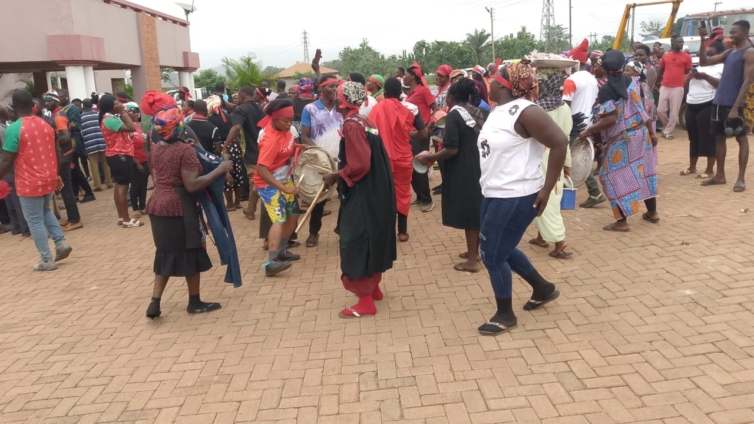
Residents and traders of Barekase in the Atwima Nwabiagya North District of the Ashanti Region have staged a demonstration against plans to site a proposed 24-hour economy market at Asuofua, instead of Barekase, the district capital.
The protestors described the decision as unfair, insisting that Barekase remains the most suitable location for the project due to the availability of vast tracts of land and its strategic importance as the administrative centre of the district.
Leading the demonstration, Dickson Amankwa said the action was jointly organised by traders and members of the opposition National Democratic Congress (NDC), who are demanding what they describe as equitable development for Barekase.
“We cannot allow our DCE to take the development of Barekase for granted by relocating such an important project to Asuofua,” he said. “We are calling on President John Dramani Mahama to intervene because Barekase also deserves its fair share of development.”
According to the demonstrators, situating the market at Barekase would boost local trading activities and help decongest roadsides, where many traders currently operate.
They also argued that Barekase has long been sidelined in terms of major infrastructure projects, despite its status as a district capital.
Mr Amankwa noted that since Barekase was carved out from Nkawie, several key public facilities — including a police station, fire service station and a hospital — have all been sited at Nkawie, leaving Barekase underserved.
“Now that we are a district capital, it is only right that key infrastructure projects are brought here,” he added.
The protesters marched through parts of the town before presenting a petition to the District Chief Executive of Atwima Nwabiagya North. The petition was received on his behalf by the District Coordinating Director, Solomon Kwaku Adjei.
Mr Adjei assured the demonstrators that their concerns would be forwarded to the appropriate authorities for consideration.
The proposed 24-hour economy markets form part of a broader national conversation around boosting local commerce, improving access to trading spaces, and creating jobs through round-the-clock economic activity — a policy direction that has gained prominence in recent political discourse.
Latest Stories
-
Knights and Ladies of Marshall group backs Catholic Bishops’ stance on anti-LGBTQ+
26 minutes -
Bright Simons writes: All the Filla in the Ibrahim Mahama/E&P – Gold Fields Saga
51 minutes -
Monetise Idiocy In Ghana
58 minutes -
The Ghanaian prophet and the mysterious death of his scottish wife Charmain Speirs
2 hours -
Nearly 400 sentenced in Nigeria for links to militant Islamists
2 hours -
Ghana’s recovery supported by gold strength despite global oil price pressures – Standard Bank Research
2 hours -
Methodist Church hails Mfantsipim@150; calls for “fresh consecration” to excellence
3 hours -
‘Excellence is our inheritance’ – Nana Sam Brew-Butler hails Mfantsipim’s 150-year reign in leadership
3 hours -
Kwaku Azar writes: A-G vs OSP
3 hours -
Mfantsipim–Adisadel rivalry built excellence, not division – Sam Jonah
3 hours -
Vice President launches Mfantsipim’s 150 years of shaping Ghana’s greatest mind
3 hours -
I assure Otumfuo, Mahama will join him to commission KNUST Teaching Hospital by end of this year – Haruna Iddrisu
4 hours -
Barcelona dominate derby to extend La Liga lead
4 hours -
Gov’t to roll out free special education for persons with disabilities from July 1 – Education Minister
4 hours -
Importers and Exporters Association declares full support for Publican AI port system
5 hours