

Audio By Carbonatix
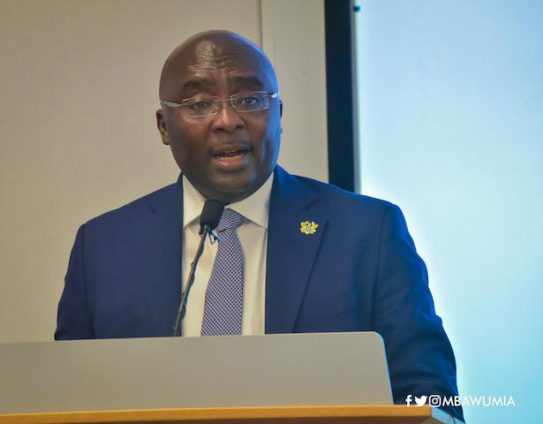
Vice President Mahamudu Bawumia Thursday launched the commercial operations of the Pan-African Payment and Settlement System (PAPSS) with a charge on African central bank governors to connect their national payment switches to PAPSS.
PAPSS is a cross-border financial market infrastructure, instantly connecting payment transactions across Africa. Its implementation is expected to save Africa five billion dollars in transaction costs annually.
It is designed to enable leading-edge technology African banks, payment service providers, and other financial market infrastructure to make instant and secure payments between African countries.
The system was designed and facilitated by the Africa Export-Import Bank (Afreximbank), the African Union Commission, and the African Continental Free Trade Area (AfCFTA) Secretariat as well as Africa Central Banks.
It allows for instant payments by both originators and recipients to transfer and receive cash in their local currencies anywhere in Africa.
Vice President Bawumia, delivering the keynote address at the launch of PAPSS in Accra on the theme: "Connecting Payments, Accelerating Africa's Trade," said the successful implementation of PAPSS would enhance intra-African trade and ensure an efficient and transparent payment system.
It would simplify the historical complexities and costs of making payments across Africa's borders and provide operational efficiencies that open up vast economic opportunities for African economies.
The event attracted high profile personalities including the former President of Niger and AfCFTA Champion, President Mahamadou Issoufou, Olusegun Obasanjo, former President of Nigeria, and Chairman of the Intra-African Trade Fair Advisory Council, and Mr Wamkele Mene, the Secretary-General of AfCFTA.
Others were Mr Mike Ogbalu, the Chief Executive Officer of PAPSS, Professor Benedict Oramah, the President of Afreximbank, representatives of the President of African Union and heads of state, CEOs of banks, and governors of African central banks, and captains of industry.
Vice President Bawumia said PAPSS was expected to benefit all stakeholders from governments, banks, and payment providers to the end customers, corporates, small enterprises, and individuals.
The speed, simplicity, and security of the PAPSS process would greatly improve the capabilities of the participating countries, increasing access to new African markets with less costly foreign exchange complications.
The Vice President said 55 African countries had 42 currencies and four exchange rate systems, characterised by lack of currency convertibility and ill-liquidity, which often discouraged intra-African trade.
The African Union's annual trade report for 2020 indicates an average of 13 percent Intra Africa import and 20 percent intra-Africa export over the past seven years. Vice President Bawumia expressed the belief that with the rolling out of PAPSS, governments and African central banks would witness less pressure on foreign exchange liquidity and greater transparency of cross-border transactions.
They would also experience an increase in potential to generate revenue as well as ease in customers' burden and enhanced trade facilitation.
"As you are all aware, the underlying motive behind our integration scheme is the expectation that, through collaborative efforts, participating countries in the integration programmes would generate maximum socio-economic benefits for their citizens in the sub-region,” he said.
"Regional integration, undoubtedly, is an efficient tool for overcoming the constraints imposed by the nature and size of individual national markets."
He observed that if the production of goods and services were carried out in an enlarged regional economic space, there was a greater chance of achieving substantial economic benefits.
Over the years, there had been tremendous emphasis by the Africa central banks to develop domestic payments systems such as Real-Time Gross Settlement, Automated Clearing House, Securities Settlement System, Automated Check Processing System and a National Switch.
However, he said, there was less focus on cross-border or intra-African payments. Notwithstanding their significance, intra-African payments faced various challenges, including cost, access, speed, and transparency. "On a related note, we have also witnessed the negative effects of the Covid-19 pandemic on the economies across the globe and more especially on the African economies,” Vice President Bawumia said.
Latest Stories
-
World Cup visa scandal: Mahama will act on corruption allegations – Abass Nurudeen
1 minute -
Abass Nurudeen accuses Minority of ‘scandal scavenging’ over World Cup visa controversy
3 minutes -
US Embassy recognised NSA, GFA and GTA as separate entities for visa applications – Sports Minister’s aide
9 minutes -
Only 30% of Ghanaian teachers satisfied with their jobs – CAPCOE data reveals
20 minutes -
Communities affected by construction of Akosombo Dam urge government to speed up compensation process
42 minutes -
World Cup visa scandal: Sports Ministry not shielding anyone – Sports Minister’s special aide
1 hour -
World Cup visa scandal: Over 30 people misrepresented as GTA board members to US Embassy – Vincent Assafuah alleges
1 hour -
Fire destroys wooden structure near Yesu Mo Villa at Bush Road
1 hour -
NDC threatens sanctions over oversized campaign posters, gives aspirants 5 days to comply
2 hours -
Star Oil paid GH¢2.7bn in taxes, levies in nine months of 2026
2 hours -
Samson’s Take: The rule of law is cheaper before the bulldozer
2 hours -
GRA blames system failure for delay in issuing receipt over passenger’s customs duty
3 hours -
Livestream: Newsfile discusses World Cup visa scandal, beach demolitions, education strikes, BRICS bid
3 hours -
NC-PTAs welcomes end of teachers’ strike, urges parents to prepare children for Monday
3 hours -
Government procures over 2,000 transformers as Ghana’s electricity access hits 89.13% – Energy Minister
3 hours