

Audio By Carbonatix
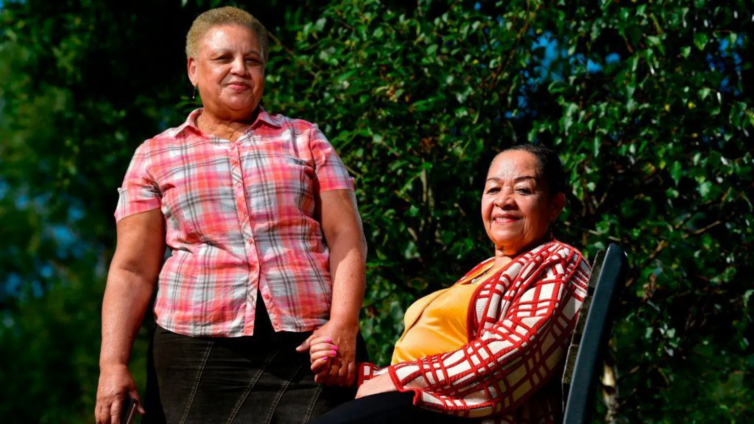
A Belgium court has ordered the government to pay reparations to five mixed-race women who were forcibly removed from their families in the colonial-era Belgian Congo.
The women, now in their 70s, were taken from their mothers when they were young children and placed in orphanages under a state policy.
The court said the government had a "plan to systematically search for and abduct children born to a black mother and a white father".
On Monday judges called this a crime against humanity and said the kidnappings were "an inhumane act of persecution".
The Belgium government in 2019 issued a formal apology to an estimated 20,000 victims of forced family separations in DR Congo, as well as Burundi and Rwanda.
DR Congo was governed by Belgium as a colony from 1908 to 1960.
Monique Bitu Bingi, Léa Tavares Mujinga, Noëlle Verbeken, Simone Ngalula and Marie-José Loshi launched a legal case for compensation in 2021.
They were all taken by the state under the age of seven and placed in orphanages mainly managed by the Catholic Church.
Bitu Bingi had previously told AFP news agency: "We were destroyed. Apologies are easy, but when you do something you have to take responsibility for it."

Their legal fight succeeded on Monday in the Brussels Court of Appeal which overturned an earlier court's ruling which found too much time had passed for them to be eligible for reparations.
As the court ruled the state's actions a crime against humanity, this removed any statute of limitations.
"The court orders the Belgian State to compensate the appellants for the moral damage resulting from the loss of their connection to their mother and the damage to their identity and their connection to their original environment," the judges said.
The women had asked for an initial payment of €50,000 (£41,400).
This is the first case in Belgium to have highlighted the estimated 20,000 children born to white settlers and local black women who were forcibly removed from their families during the 1940s and 1950s.
Most white fathers refused to recognise their mixed-race children or acknowledge paternity, and the children also did not automatically receive Belgian nationality.
As such they were taken into state care and placed in Church-run orphanages, where in many cases they endured further abuse.
In 2017, the Catholic church apologised to the victims for its part in the scandal.
And in 2019, the Belgian government apologised for its involvement as part of a "step towards awareness and recognition of this part of our national history".
Latest Stories
-
[Watch Live] Shatta Wale, Kofi Kinaata, and others ignite the grand finale of Gomoa Easter Carnival
2 hours -
Berekum Chelsea edge Aduana FC in Bono derby to boost survival hopes
5 hours -
‘They can’t control the team’ – Ernest Thompson doubts local coaches for Black Stars role
6 hours -
Ghana-born midfielder Seidu realises ‘dream’ with Atlético Madrid debut
6 hours -
GPL 2025/26: Bubakari strikes late to hand All Blacks vital win over Dreams FC
6 hours -
Fatal crash on Kintampo–Tamale highway claims four lives
6 hours -
2025–26 FA Cup Semifinal Draw: Chelsea, Man City Learn Wembley Opponents
6 hours -
GPL 25/26: Gold Stars back on top after beating Nations FC
7 hours -
GPL 2025/26: Heart of Lions roar back with victory over Vision FC in Kpando
8 hours -
Solomon Agbasi: Hearts keeper in stable condition after concussion
8 hours -
GPL 2025/26: Late Salim Adams penalty earns Medeama draw at Bechem
8 hours -
Hearts pip Young Apostles 1-0 to end 5-game winless run
8 hours -
Boakye Agyarko marks Easter Sunday with a call for Godly leadership ahead of nationwide campaign tour
9 hours -
Pepsi withdraws as UK festival sponsor after Kanye West backlash
9 hours -
Pope Leo calls for global leaders to choose peace in his first Easter Mass
10 hours