

Audio By Carbonatix
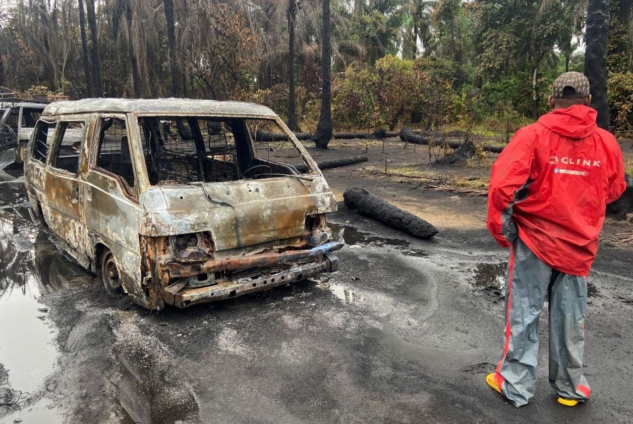
Charred bodies were left scattered among burnt palms, cars and vans on Sunday after a weekend explosion which killed more than 100 people at an illegal oil refining depot on the border of Nigeria's Rivers and Imo states.
Flip flops, bags and clothing belonging to those who died littered the ground, which was blackened by oil and soot while still emitting smoke in some places despite overnight rain.
"There are so many people that died here. I'm pleading to the government to look into this," Uche Woke, a commercial bike rider, told Reuters at the scene of the blast on Saturday night.
The Nigerian Red Cross Society was on the scene on Sunday to assess the blast, which destroyed a section of the Abaezi forest, which straddles the border of the Ohaji-Egbema Local Government Area of Imo state with Rivers state.
Nigerian President Muhammadu Buhari said in a statement that he would intensify the clampdown on illegal refineries after what he described as a "catastrophe" and "national disaster".
Unemployment and poverty in the oil producing Niger Delta have made illegal refining attractive, but with often deadly consequences. Crude oil is tapped from a web of pipelines owned by major oil companies and refined in makeshift tanks.
The process has led to fatal accidents and polluted a region already blighted by oil spills in farmland, creeks and lagoons.
The Youths and Environmental Advocacy Centre said several vehicles that were in a queue to buy illegal fuel were burnt.
"The fire outbreak occurred at an illegal bunkering site and it affected over 100 people," Goodluck Opiah, the state commissioner for petroleum resources, said of the accident.
The border location is a reaction to a recent crackdown in Rivers on illegal refining in an effort to reduce worsening air pollution.
"In the last month or two, there were several raids and some security agents involved were tackled," Ledum Mitee, former president of the Movement for the Survival of the Ogoni People (MOSOP), said.
At least 25 people, including some children, were killed in an explosion and fire at another illegal refinery in Rivers state in October.
In February, local authorities said they had started a crackdown on the refining of stolen crude, but with little apparent success.
Government officials estimate that Nigeria, Africa's biggest oil producer and exporter, loses an average of 200,000 barrels of oil per day, more than 10% of production, to illegal tapping or vandalising of pipelines.
That has forced oil firms to regularly declare force majeure on oil and gas exports.
Latest Stories
-
Diaspora Nasara Caucus congratulates Mohammed Ali Suraj, new NPP executives
3 minutes -
Dr Antwi-Boasiako’s cybersecurity book showcased at UN crime prevention congress
5 minutes -
We will empower the grassroots and protect every vote – NPP’s 1st Vice Chair Kojo Bamba
15 minutes -
I do not see myself as better than anyone – NPP’s 1st Vice Chair Kojo Bamba
44 minutes -
Police blur the line between invitations and arrests – Reindorf Twumasi Ankrah
1 hour -
Turning invitations into arrests is making citizens reluctant to assist police – Twumasi Ankrah
2 hours -
The Traffitech-GH SMS spot-fine system: The good, the sad, and the funny – Bright Simons writes
2 hours -
Hawa Koomson pledges experienced and mature leadership of NPP women’s wing
3 hours -
Young woman found dead at Kasoa Peace Town
4 hours -
Playback: The Law examined lawful arrest in Ghana
4 hours -
Mahama urges African governments to treat healthcare as an investment, not budget cost
5 hours -
Bawumia congratulates John Boadu and new NPP executives, pledges support ahead of 2028
5 hours -
Aksa Energy delegation pays courtesy call on GRA Commissioner-General
5 hours -
‘No talent should be left out’ – Bawumia pledges inclusive NPP campaign for 2028
5 hours -
Prof. Mike Oquaye recounts how he blocked the Special Prosecutor’s attempt to arrest Bawku Central MP
5 hours