

Audio By Carbonatix
In a region where government data often remains inaccessible to ordinary citizens, Nigerian civic education leader, Iyanuoluwa Bolarinwa, introduces a practical approach to drive the civic education revolution that is reshaping how Ghanaians engage with public information.
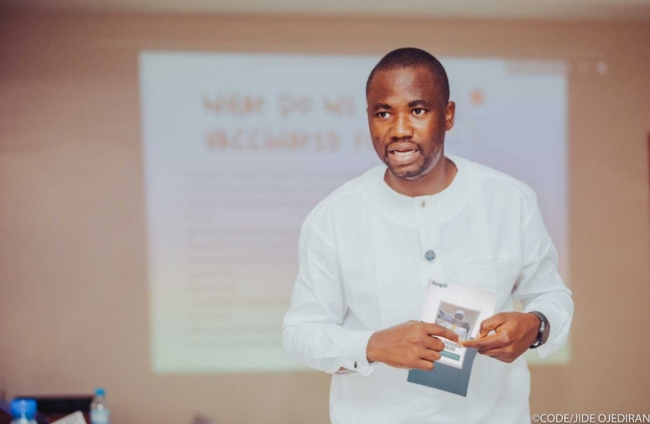
Bolarinwa, who is newly appointed at Nigerian civic organization BudgIT as Head of Open Government and Institutional Partnerships, spoke at the Open Government Partnership summit this week in Accra, Ghana, where he presented a success appraisal of the Civic Education Manual, which he co-developed as a top researcher with the organization.
This material has been adopted by many educational institutions across Ghana, from universities in Accra to secondary schools in rural communities, since it was first introduced five years ago in the country.
"Traditional textbooks teach theoretical governance, but the manual equips students with practical tools to engage with actual government data," he shared while speaking with our correspondent. "This resource has filled a critical gap in our civic education curriculum. With my involvement in Open Government, I want our youths to adopt this project as a practical approach that bridges the knowledge gained through the manual to practical adaptability in our everyday lives as Ghanaians, even as we are replicating this all over Africa.”
The manual, developed through rigorous research and field testing, stands out for its remarkable accessibility designed specifically to make government data understandable across every literacy level using infographics, interactive formats, and simplified language.
"Before this manual reached our classes, public finance was taught as an abstract concept," explains Professor Mensah of the University of Ghana. "Now our students don't just understand budgets, they actively track implementation in their communities."
The impact extends beyond higher education into Ghana's secondary school system, where students are learning to analyze government spending in ways previously restricted to professionals and specialists.
"By translating government data into formats that resonate with young Ghanaians, Bolarinwa’s material has essentially democratized information that was previously available only to economic and political elites," says Kofi Bentil, Vice President of IMANI Ghana.
The manual is part of a broader West African initiative that has reached over 5 million people across Ghana, Nigeria, Sierra Leone, and Liberia. Its adoption by more than 100 educational institutions demonstrates its significant impact on civic education across the region.
For Ghana's education sector, the manual with Bolarinwa’s practical approach has proven particularly valuable in bridging theoretical knowledge with practical civic engagement. Digital versions accessible through mobile applications have allowed the content to reach students even in areas with limited resources.
As Ghana continues to strengthen its democratic institutions, Iyanuoluwa Bolarinwa's innovative approach to civic education represents a promising model for empowering the next generation of engaged citizens through technology and accessible information.Bolarinwa’s Lead Civic Education Project to transform Ghana’s civic education landscape
In a region where government data often remains inaccessible to ordinary citizens, Nigerian civic education leader, Iyanuoluwa Bolarinwa, introduces a practical approach to drive the civic education revolution that is reshaping how Ghanaians engage with public information.
Bolarinwa, who is newly appointed at Nigerian civic organization BudgIT as Head of Open Government and Institutional Partnerships, spoke at the Open Government Partnership summit this week in Accra, Ghana, where he presented a success appraisal of the Civic Education Manual, which he co-developed as a top researcher with the organization.
This material has been adopted by many educational institutions across Ghana, from universities in Accra to secondary schools in rural communities, since it was first introduced five years ago in the country.
"Traditional textbooks teach theoretical governance, but the manual equips students with practical tools to engage with actual government data," he shared while speaking with our correspondent. "This resource has filled a critical gap in our civic education curriculum. With my involvement in Open Government, I want our youths to adopt this project as a practical approach that bridges the knowledge gained through the manual to practical adaptability in our everyday lives as Ghanaians, even as we are replicating this all over Africa.”
The manual, developed through rigorous research and field testing, stands out for its remarkable accessibility designed specifically to make government data understandable across every literacy level using infographics, interactive formats, and simplified language.
"Before this manual reached our classes, public finance was taught as an abstract concept," explains Professor Mensah of the University of Ghana. "Now our students don't just understand budgets, they actively track implementation in their communities."
The impact extends beyond higher education into Ghana's secondary school system, where students are learning to analyze government spending in ways previously restricted to professionals and specialists.
"By translating government data into formats that resonate with young Ghanaians, Bolarinwa’s material has essentially democratized information that was previously available only to economic and political elites," says Kofi Bentil, Vice President of IMANI Ghana.
The manual is part of a broader West African initiative that has reached over 5 million people across Ghana, Nigeria, Sierra Leone, and Liberia. Its adoption by more than 100 educational institutions demonstrates its significant impact on civic education across the region.
For Ghana's education sector, the manual with Bolarinwa’s practical approach has proven particularly valuable in bridging theoretical knowledge with practical civic engagement. Digital versions accessible through mobile applications have allowed the content to reach students even in areas with limited resources.
As Ghana continues to strengthen its democratic institutions, Iyanuoluwa Bolarinwa's innovative approach to civic education represents a promising model for empowering the next generation of engaged citizens through technology and accessible information.
Latest Stories
-
Netherlands Fire Chief in Ghana to support fire safety reforms and market fire prevention efforts
4 hours -
Mason goes on remand for stealing
4 hours -
Gov’t cuts fuel taxes, deploys buses to curb impact of rising fuel prices
5 hours -
Interior Minister calls for intelligence-driven strategy as Ghana strengthens counter-terrorism efforts
5 hours -
Adenta Circuit Court remands Pastor William Gyimah over viral threats against Vice President
6 hours -
“We’ve implemented changes to prevent a repeat of the AFCON final” – CAF President Motsepe
6 hours -
Gov’t orders deployment of Metro Mass buses to cushion commuters amid fuel price hike
7 hours -
Key Indian state polls begin in test for Modi’s party
7 hours -
Playback: Gomoa Easter Carnival in photos
7 hours -
Gov’t orders removal of fuel taxes to ease pump price hikes
7 hours -
“Whatever the decision of CAS, we will respect it” – CAF President Motsepe after AFCON final meetings in Morocco
7 hours -
Emma Ankrah: When waiting becomes part of treatment – Reflections on hospital care
7 hours -
Ghana urges travellers to prepare for new EU border system roll-out
7 hours -
Mahama enforces fuel coupon ban for ministers as cabinet moves to slash fuel taxes
7 hours -
Task force probes strange fish deaths in Tema
8 hours