


Audio By Carbonatix
Director at the Institute of Health Research at the University of Health and Allied Sciences (UHAS), Prof. Alexander Manu, has revealed that three major factors - breathing difficulties, prematurity, and infections—are responsible for a majority of newborn deaths in Ghana and across the continent.
Speaking during the JoyNews National Dialogue on Investment in Newborn Health: Giving Preterm Babies a Strong Start, held on Thursday, Prof. Manu stated that between seven to nine out of every 10 newborn deaths are linked to these three causes.
“Difficulty in breathing, being born too early, and germs or infections are responsible for the majority of deaths that occur in newborns,” he explained. “We are talking about between seven to nine out of every ten newborns that are dying—they are from just these three causes: how they can breathe, because they’ve come too early, and because they have infections.”
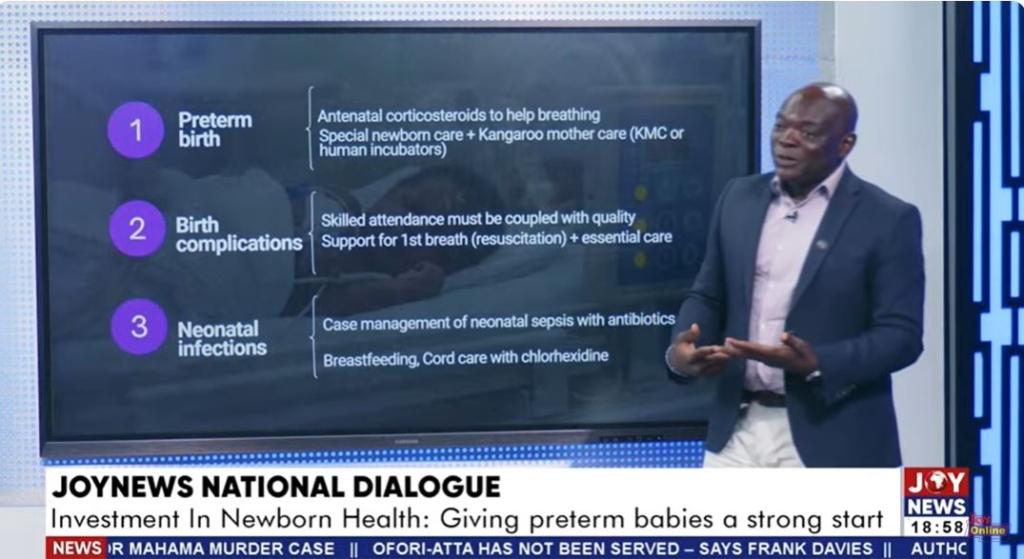
Despite the alarming statistics, Prof. Manu stressed that the situation is far from hopeless. He highlighted a global intervention framework known as the “three-by-two plan”, which outlines practical measures health systems can adopt to save preterm babies.
He explained that early identification and proper preparation are crucial, particularly when signs indicate that a mother may deliver before term.
“Our preparation as a health system to be able to receive this baby becomes paramount,” he said. “We can give steroids, and these steroids help the lungs to mature and open so air can go in, so the baby can breathe.”
Prof. Manu emphasised the importance of keeping preterm babies warm immediately after birth, describing it as a low-cost but highly effective intervention. He also underscored breastfeeding, especially early initiation—as essential for newborn survival.
Using a vivid analogy, he said: “If a preterm baby or any baby is born and they take in the first breast milk, and it’s from the mother’s warm body—imagine yourself early morning in the cold Harmattan season and someone brings you warm Hausa Koko. That is how the newborn feels when they get that first breast milk, and it keeps them warm.”
Prof. Manu added that for babies born with complications such as difficulty in breathing, skilled personnel must be available to provide immediate support to stabilise and protect the newborn.
He stressed that strengthening the health workforce, improving preparedness, and promoting proven interventions can significantly reduce newborn deaths in Ghana.
Latest Stories
-
Cocoa price reduction: Clerks cry over attacks by cocoa farmers, describes reduction as scam
20 seconds -
Cedi recovers modestly on external tailwinds; one dollar equals to GH¢11.70 at forex bureaus
5 minutes -
Acute water shortages hit Kumasi as power outages cripple Barekese, Owabi plants
12 minutes -
Accra Mayor calls on businesses to prioritise PWDs and youth in recruitment
13 minutes -
40 Ghanaian languages at risk as GhLA calls for urgent preservation
16 minutes -
Ghana Energy Awards opens 10th anniversary activities with courtesy call on Ministry
18 minutes -
Medikal’s “Beyond Kontrol” concert at Accra Sports Stadium earns IRAWMA nomination
20 minutes -
Daily Insight for CEOs: Leadership Resilience under Pressure
21 minutes -
First British baby born using transplanted womb from dead donor
24 minutes -
GRIDCo investigates fault that caused power outage in parts of Tema
30 minutes -
Ahanta West Assembly members dissociate from petition against MCE
31 minutes -
“Success must be seen on the grounds, not just in policy documents” – Sports Fund chairperson
33 minutes -
GIPC CEO rallies investors to back oil palm expansion at Birim Oil Mills
43 minutes -
Resetting Sovereignty: Mahama’s Foreign Policy and the Constitutional Revival of NKRUMAHISM 60 years after the 1966 Coup
43 minutes -
Public problems, private solutions; our national tragedy
54 minutes