

Audio By Carbonatix
The rise in the cost of living and global economic instability over the past few years has caused significant financial strain for many individuals and businesses.
In Ghana, the fluctuating currency value and increasing inflation are driving up the cost of goods and services faster than wages can keep up.
The pressing question is: how can individuals and businesses build resilience to withstand these economic shocks and maintain financial stability?
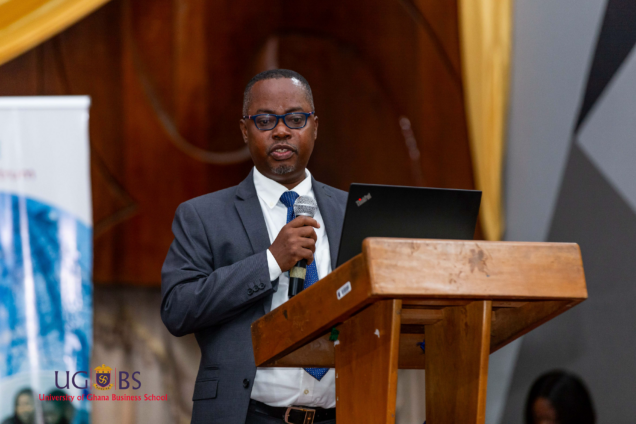
Addressing students and industry stakeholders at the University of Ghana Business School’s 44th Management Week celebration, Telecel Ghana's Director of Mobile Financial Services and Digital Transformation, Philip Amoateng, shared insights on how financial technology (FinTech) can bolster financial resilience for individuals and households amid the current economic climate.
Defining financial resilience as the ability to manage unexpected expenses while maintaining financial stability, Mr Amoateng identified key challenges facing Ghana’s financial sector.
These include the large informal sector, limited access to traditional banking services, the banking sector crisis, the aftermath of the domestic debt exchange program, and overall economic volatility.
FinTech has provided a gateway for unbanked individuals to access formal financial services. Mobile money services have increased the convenience of transactions and improved access to savings and loan products, helping users achieve their financial goals.
Between 2020 and 2021, Ghana saw a remarkable 58.5% growth in mobile money and digital financial services, highlighting FinTech’s role in bridging the financial services gap.
Mr Amoateng credited this growth to the Bank of Ghana's proactive policies promoting financial inclusion.
"By integrating advanced technology with financial services, FinTech has democratised access to financial transactions, monetary advice, and risk management strategies," said Mr. Amoateng.
"It continues to help consumers navigate turbulent times with greater resilience, a privilege once reserved for the affluent and privileged few."
Mr Amoateng elaborated on specific ways FinTech enhances financial resilience. Mobile money services like Telecel Cash facilitate easy savings and payments, reducing reliance on cash and lowering transaction costs.

Digital banking platforms broaden access to savings accounts, financial literacy apps, and loan guidance.
"FinTech is fostering a culture of saving through automated savings apps and provides access to low-cost investment options like mutual funds and government bonds," he added.
"Microloans offered via mobile platforms provide vital lifelines for emergencies and business needs, while peer-to-peer lending platforms offer community-based support."
Another promising area for FinTech is insurance. Microinsurance products offer affordable health, life, and property coverage, while InsurTech innovations streamline the purchasing and claiming of policies.
Mr Amoateng presented a compelling case study of Telecel Cash, revealing that the platform processes over GH¢3 billion in monthly transactions for individuals and businesses, covering everything from service payments to remittances.
In 2023 alone, Telecel Cash paid over GH¢30 million in interest income to approximately 2.6 million registered customers and facilitated over GH¢500 million in direct international money transfers.
“These benefits significantly enhance the financial resilience of individuals and households. This is the kind of resilience a digital finance overlay on technology can bring to individuals and households in Ghana,” Amoateng said.
Looking ahead, Amoateng emphasised the need to expand rural access to FinTech services for equitable distribution, integrate the technology within sectors like agriculture and healthcare, and leverage these tools for personal financial well-being.
He concluded with a call for addressing the challenges facing FinTech, including cybersecurity threats, social engineering schemes, overburdening taxes, and infrastructure vandalism, which collectively stifle the sector's growth.
Latest Stories
-
Turning invitations into arrests is making citizens reluctant to assist police – Twumasi Ankrah
33 minutes -
The Traffitech-GH SMS spot-fine system: The good, the sad, and the funny – Bright Simons writes
45 minutes -
Hawa Koomson pledges experienced and mature leadership of NPP women’s wing
2 hours -
Young woman found dead at Kasoa Peace Town
2 hours -
Playback: The Law examined lawful arrest in Ghana
3 hours -
Mahama urges African governments to treat healthcare as an investment, not budget cost
3 hours -
Bawumia congratulates John Boadu and new NPP executives, pledges support ahead of 2028
3 hours -
Aksa Energy delegation pays courtesy call on GRA Commissioner-General
3 hours -
‘No talent should be left out’ – Bawumia pledges inclusive NPP campaign for 2028
4 hours -
Prof. Mike Oquaye recounts how he blocked the Special Prosecutor’s attempt to arrest Bawku Central MP
4 hours -
Make health sovereignty a priority for Africa – Mahama
4 hours -
Dorimon Naa, Wa West DCE lead massive clean-up exercise; threaten sanctions against recalcitrant residents
4 hours -
Photos from Adom FM Y2K Jam
4 hours -
Praye Tiatia steals the show at Adom FM Y2K Jam [Watch]
4 hours -
Boakye Agyarko congratulates John Boadu, pledges support for NPP leadership
5 hours