

Audio By Carbonatix
With every heavy rainfall, the shoreline where the Korle Lagoon meets the sea transforms into a site of frantic activity.
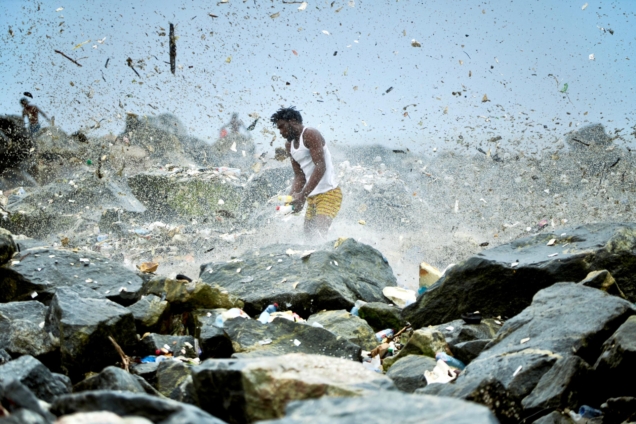
Men, women, and children flock to the polluted coastline to scavenge through mountains of waste deposited by the swollen lagoon.

When the rains pour, the lagoon, choked with plastic, foam, and other refuse, overflows and carries its burden of pollution into the sea. The result is a beach covered in trash, which, for many marginalized families, becomes an opportunity to seek out materials they can sell or repurpose.

Amid the debris, individuals can be seen with sacks, buckets, and improvised tools, sorting through the waste for plastics, metal scraps, or anything of value. For these communities, the dangerous and unsanitary conditions are an everyday reality.
“When the rains come, it’s like a blessing and a curse. There’s more waste to pick, but the waves are stronger and more dangerous,” said a young scavenger.

In one striking moment, captured on camera, a man is seen braving the spray of crashing waves, debris flying around him like projectiles. Others nearby, undeterred by the chaos, continue to rummage through the refuse-laden sand.

The Korle Lagoon, once a vital ecological and cultural asset to Accra, has become a symbol of Ghana’s waste management challenges. Decades of poor waste disposal practices and unchecked urban growth have turned the lagoon into an environmental disaster zone.

Residents in nearby communities, many of whom live in makeshift shelters along the shoreline, bear the brunt of the crisis. “We’ve lived with this problem for years. The government comes and talks, but nothing changes,” lamented a local woman, clutching a bucket of scavenged plastics.

Environmentalists and community leaders have repeatedly called for urgent measures to address the pollution of the Korle Lagoon and the surrounding coastlines. Proposed solutions include better waste collection systems, enforcement of environmental laws, and investment in recycling initiatives.

A Cycle That Must Be Broken
Until sustainable action is taken, the scavenging activities at the Korle Lagoon will continue to reflect the intersection of poverty and environmental degradation. For those who depend on the trash to make ends meet, the rains bring fleeting opportunities amidst a sea of challenges.

As the waves crash and the waste piles up, these images serve as a stark reminder of the cost of inaction and the urgent need for a cleaner, healthier environment for all.

Latest Stories
-
Ghana to benefit from France’s National health platform following Paris talks
7 minutes -
Due process must prevail in Ofori-Atta’s immigration and extradition cases – Lawyer
14 minutes -
Oil palm fund will create coherent ecosystem, boost supply—DBG CEO
16 minutes -
Police arrest man for illegal drug peddling at Pankrono
19 minutes -
Industry collaboration key to solving skills mismatch – NYA CEO Osman Ayariga
26 minutes -
Ghana, Egypt deepen security ties following high-level meeting
32 minutes -
Every neurodivergent child deserves to thrive – AWARE 2026 walk set for North Legon
38 minutes -
Ghana-Russia Centre, ATF donate to Princess Marie Louise Children’s Hospital
42 minutes -
NPP increases polling station coverage per election committee from 10 to 25
46 minutes -
Ghana card cannot be used for financial transactions – NIA debunks false reports
47 minutes -
Successful conviction secured for illegal fish processing operation in Watford
52 minutes -
Bowen: Ceasefire means respite for civilians, but it might not last long
53 minutes -
Ofori-Atta not yet formally notified of any charges – Frank Davies
53 minutes -
Asanko Gold supports road rehabilitation to ease transport challenges in Amansie West
1 hour -
Serial killer pleads guilty to eight murders in case that haunted Long Island, New York
1 hour