

Audio By Carbonatix
The Ghana cedi and three other currencies are the worst-performing currencies in Sub-Saharan Africa (SSA) in 2024, the World Bank’s October 2024 Africa Pulse Report has revealed.
According to the report, the cedi has lost about 24% value to the US dollar, placing it as the 4th weakest in SSA.
South Sudan’s pound (over 60%), Ethiopia's birr (51%) and Nigeria’s naira (over 40%) are the worst-performing currencies in Sub-Saharan Africa in 2024.
Interestingly, the Kenya shilling is the best-performing currency in Africa this year with a year-to-date gain of about 21% as of August 2024.
“Ethiopia, Ghana, and Nigeria are among the worst performing in Africa this year, and their currencies continue weakening while demand for foreign exchange remains pressing”, the report said.
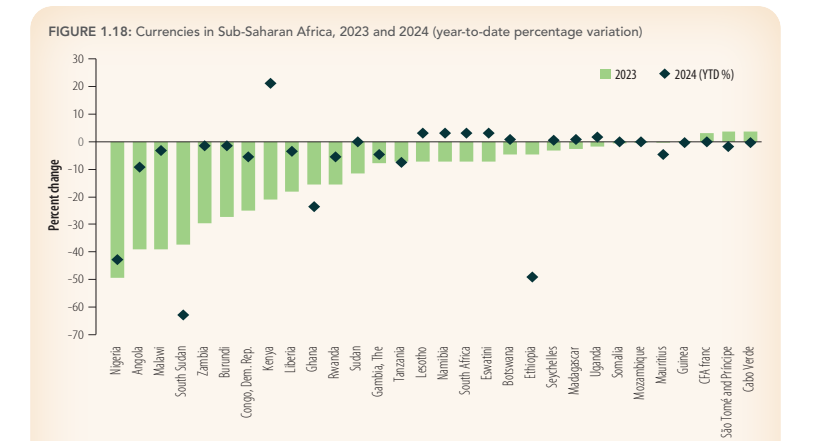
It added “By end-August 2024, the Ethiopian birr, Nigerian naira, and South Sudanese pound were among the worst performers in the region. The Nigerian naira continued losing value, with a year-to-date depreciation of about 43% as of the end of August. Surges in demand for US dollars in the parallel market, driven by financial institutions, money managers, and non-financial end-users, combined with limited dollar inflows and slow foreign exchange disbursements to currency exchange bureaus by the central bank explain the weakening of the naira”.
In contrast, the report said some currencies that weakened in 2023 have stabilised or strengthened this year.
“The Kenyan shilling is the best-performing currency in Sub-Saharan Africa this year: it appreciated by 21 per cent year-to-date by end-August 2024. The South African rand and currencies pegged to it have strengthened by 3.1% so far this year, after losing value in the past year”.
Although most currencies are stabilising, the October 2024 Africa Pulse Report pointed out that the exchange rate pressures and shortages of foreign exchange remain a concern for African policymakers.
“From a sample of 30 countries and two currency unions (the Economic and Monetary Community of Central Africa and WAEMU), more than one-third of the countries in the region are set to have less than three months of imports in international reserves by end-2024”.
Latest Stories
-
Knights and Ladies of Marshall group backs Catholic Bishops’ stance on anti-LGBTQ+
16 minutes -
Bright Simons writes: All the Filla in the Ibrahim Mahama/E&P – Gold Fields Saga
40 minutes -
Monetise Idiocy In Ghana
47 minutes -
The Ghanaian prophet and the mysterious death of his scottish wife Charmain Speirs
2 hours -
Nearly 400 sentenced in Nigeria for links to militant Islamists
2 hours -
Ghana’s recovery supported by gold strength despite global oil price pressures – Standard Bank Research
2 hours -
‘Excellence is our inheritance’ – Nana Sam Brew-Butler hails Mfantsipim’s 150-year reign in leadership
2 hours -
Kwaku Azar writes: A-G vs OSP
3 hours -
Mfantsipim–Adisadel rivalry built excellence, not division – Sam Jonah
3 hours -
Vice President launches Mfantsipim’s 150 years of shaping Ghana’s greatest mind
3 hours -
I assure Otumfuo, Mahama will join him to commission KNUST Teaching Hospital by end of this year – Haruna Iddrisu
4 hours -
Barcelona dominate derby to extend La Liga lead
4 hours -
Gov’t to roll out free special education for persons with disabilities from July 1 – Education Minister
4 hours -
Importers and Exporters Association declares full support for Publican AI port system
5 hours -
“We used it to test our officiating officials’ readiness” – Bawah Fuseini after CAA Athletics event
5 hours