

Audio By Carbonatix
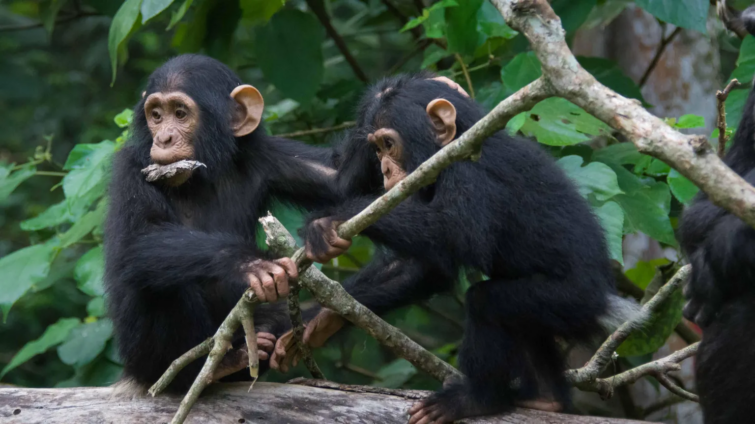
Like humans, wild chimpanzees engage in snappy, turn-taking conversations, where they wait just a fraction of a second for their turn to 'speak'.
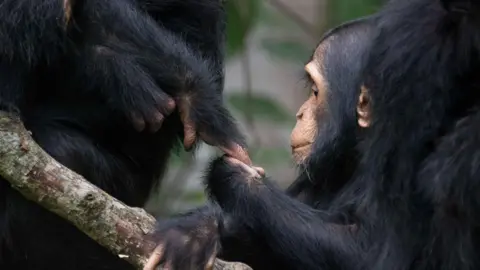
The animals communicate mostly with gestures including hand movements and facial expressions.
Scientists who studied their chats in detail found that they took "fast-paced turns" when they exchanged information and also occasionally interrupted one another.
The revelation suggests "deep evolutionary similarities [with humans] in how face-to-face conversations are structured," Prof Cat Hobaiter from the University of St Andrews told BBC News.
The findings are published in the journal Current Biology.
This fast turn-taking is a hallmark of human conversation, explained Prof Hobaiter, who studies primate communication. "We all take around 200 milliseconds between turns and show some interesting small cultural variations. Some cultures are ‘fast talkers’."
A millisecond is a thousandth of a second.
One 2009 linguistics study timed these differences - showing that, on average, Japanese speakers took seven milliseconds to respond while Danish speakers took about 470 milliseconds to intervene.
By examining thousands of instances of wild chimpanzees communicating with each other, Prof Hobaiter and her colleagues were able to time the animals' conversations.
“It’s amazing to see how close the chimpanzee and human timings were," she said.
Chimps had a bigger range in their conversational timings. "The gaps ranged from interrupting the signaller 1,600 milliseconds before they finished their gesture, to taking 8,600 milliseconds to respond," explained Prof Hobaiter.
“This could be because the chimps were in a natural setting, so they could express a wider range of behaviour - sometimes interrupting each other and other times taking a long time to respond."
As part of investigating the evolutionary origins of communication, the researchers have spent decades observing and recording the behaviour of five communities of wild chimpanzees in the forests of Uganda and Tanzania.
They have logged and translated more than 8,000 gestures from over 250 individual animals.
Lead researcher Dr Gal Badihi, also at the University of St Andrews, explained that gestures allowed the chimpanzees to avoid conflict and coordinate with each other.
“So one chimpanzee could gesture to another that they want food, and the other might give them food or, if they feel less generous, respond by gesturing for them to go away.
"They might come to an agreement about how or where to groom. It’s fascinating, and done in just a few short gesture exchanges.”
He said that future studies looking at communication in other primate species more distantly related to us will give us a more complete evolutionary picture of why we adopted this fast turn-taking chat.
"It will be a great way to better understand when and why our conversational rules evolved," he said.
Latest Stories
-
Italy arrests Burundi man over 2014 murders of three Catholic nuns
3 hours -
‘We should be doing more’ – Former CJ Sophia Akuffo challenges think tanks to step up
3 hours -
Singer D4vd confirmed as ‘target’ of investigation into murder of teen
3 hours -
Police vow crackdown as court bans ‘Stop Galamsey’ protest on SONA day
3 hours -
US aims to bring in 4,500 white South Africans per month as refugees, document says
4 hours -
A new chapter begins: MotoGP roars into 2026
4 hours -
Netflix declines to raise offer for Warner Bros
4 hours -
Chamber of chaos: Chicago braces for a WrestleMania-defining night
4 hours -
Russia and Ukraine exchange more than 1,000 soldiers’ bodies
4 hours -
First writing may be 40,000 years earlier than thought
4 hours -
Daniel Etim Effiong says rustication from school led him to acting breakthrough
4 hours -
Real Madrid condemn fan for alleged Nazi salute
4 hours -
Ronaldo becomes co-owner of Spanish side Almeria
5 hours -
Fans of richest English Premier League clubs pay £74 per match as ticket revenue soars
5 hours -
Palace see off Zrinjski to reach Conference League last 16
5 hours