

Audio By Carbonatix
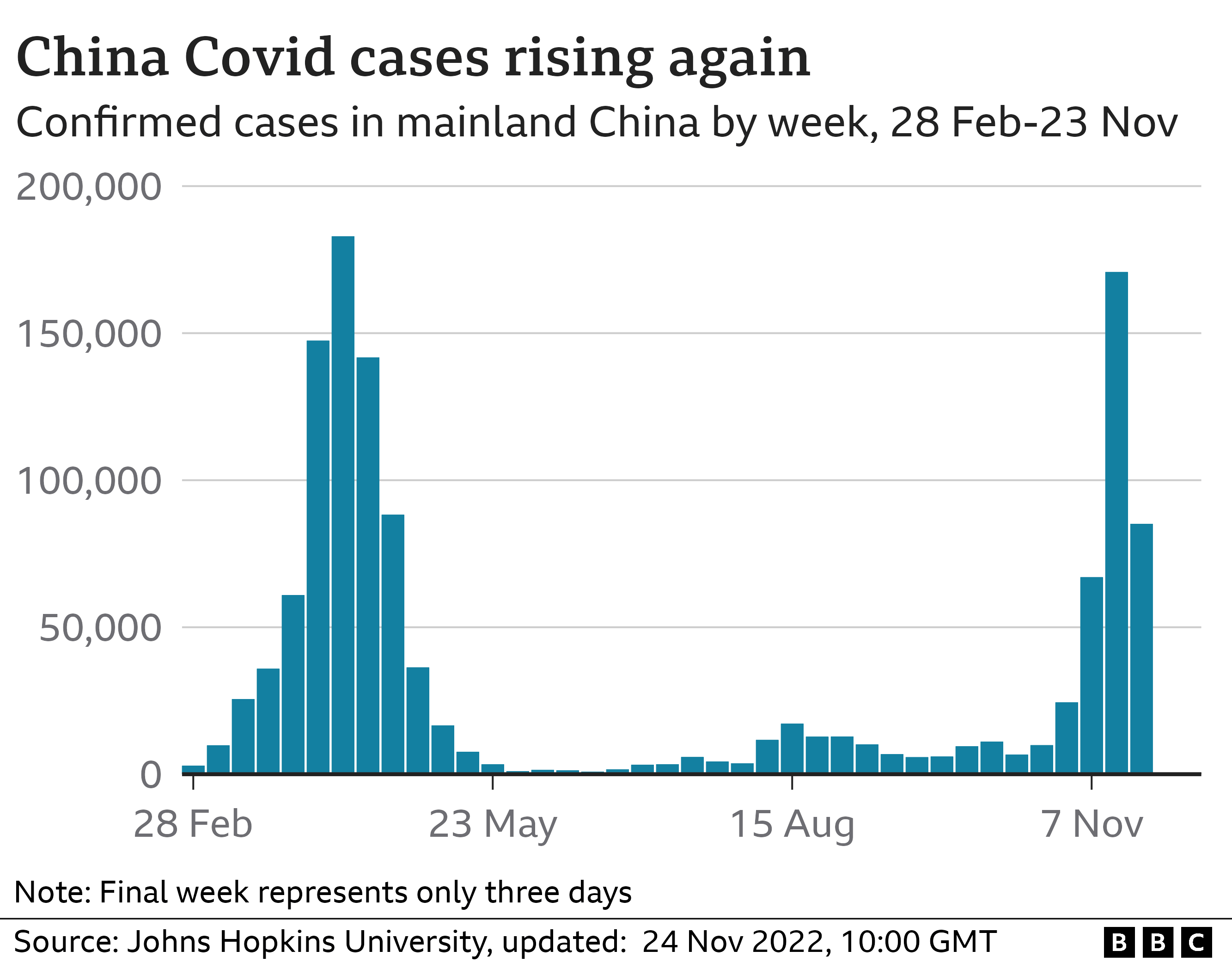
China has recorded its highest number of daily Covid cases since the pandemic began, despite stringent measures designed to eliminate the virus.
Several major cities including the capital Beijing and southern trade hub Guangzhou are experiencing outbreaks.
Wednesday saw 31,527 cases recorded compared with an April peak of 28,000.
The numbers are still tiny for a country of 1.4 billion people and officially just over 5,200 have died since the pandemic began.
That equates to three Covid deaths in every million in China, compared with 3,000 per million in the US and 2,400 per million in the UK, although direct comparisons between countries are difficult.
While China's zero-Covid policy has clearly saved lives, it has also dealt a punishing blow to the economy and ordinary people's lives.
The country slightly relaxed some of those restrictions a few weeks ago.
It cut quarantine for close contacts from seven days in a state facility to five days and three days at home, and stopped recording secondary contacts which allowed many more people to avoid having to quarantine.
Officials have also sought to avoid enforcing blanket lockdowns of the kind endured by the largest city, Shanghai, earlier this year.
But faced with a renewed surge in cases in Beijing, as well as the first deaths from the virus in months, officials have already implemented some restrictions in several districts, with shops, schools and restaurants closed.
The central city of Zhengzhou is also to enforce an effective lockdown for 6 million residents from Friday, officials announced.
It follows violent protests at a vast industrial complex belonging to iPhone manufacturer Foxconn. The firm has apologised for a "technical error" in its payment systems.
Other stories of suffering and desperation have been shared online where they have fuelled public resentment.
Last week, reports that a baby in Zhengzhou died because her medical care was delayed by Covid restrictions prompted a huge outcry.
Among some of the most severe responses to Covid this year:
- In January, in the tourist hub city of Xi'an, population 13 million, some residents were forced out of their homes in a midnight eviction and bussed to quarantine facilities, while disturbing claims surfaced of people unable to get crucial medical attention
- In March, the lockdown announced in Shanghai was meant to last less than a week but its 25 million residents stayed home for two months
- In September, residents in locked down Chengdu found themselves trapped in their apartments during an earthquake. Elsewhere, rescue workers were required to do a Covid test before they could save anyone.
Worn out by the pandemic

The word came suddenly last night that our housing compound would be locked down with all residents confined to their homes.
This is not a surprise in China anymore. At any point, a single infection or being linked to an infection can mean not being allowed out.
Beijing is in the middle of a major Covid outbreak but, even before then, visiting a shopping mall or a building where an infected person had been meant going into home quarantine.
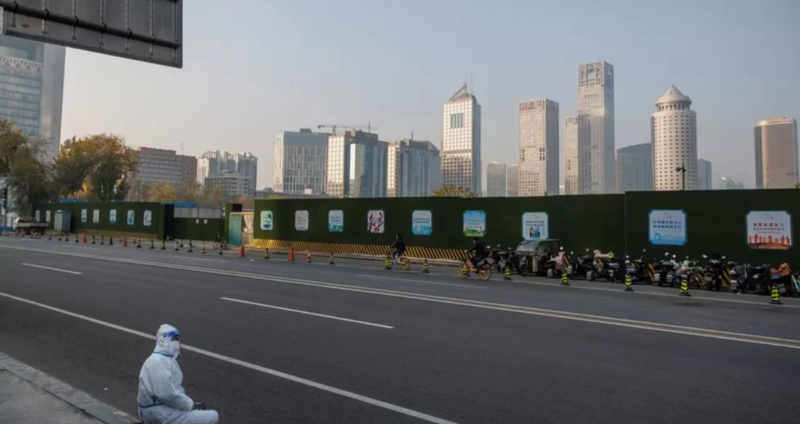
Right now, in the capital's vast Chaoyang district most businesses are closed. In thousands of tower blocks, all residents have been ordered to remain indoors for the next few days initially.
Then consider that this is being replicated in cities right across the country.
In the regions of Xinjiang and Tibet, the lockdowns have gone on for months.
At the beginning of 2023, this country will be heading into its fourth year of this crisis and, whether it is true or not, zero-Covid has a never-ending feeling to it.
People are completely worn out by the pandemic and the government's economy-destroying response to it.
That officials have not explained where the off ramp is, has only added to the uncertainty.
Scientists here can also see that China's vaccination rates are way too low, especially amongst vulnerable groups. What is more, not enough resources have been diverted into expanding medical facilities to cope with a massive influx of patients following any opening-up.
In the short term though, my compound has now told me that, after several rounds of mass testing, we are allowed to leave.
For most residents this will not make much difference though because hardly anything outside is open, including their workplaces.

China is the last major economy still pursuing a Covid eradication process with mass testing and lockdown rules, and virus cases are being recorded in 31 provinces.
Part of the reason is that vaccination levels are lower than in other developed nations, and only half of people aged over 80 have their primary vaccinations.
China has refused to import vaccines despite evidence that its homemade jabs have not proved as effective.
President Xi Jinping argues that strict curbs are needed to protect the country's large elderly population.
Zero-Covid has come to define his rule and the authoritarian bureaucracy at his disposal like almost no other policy.
It projects a veneer of control and stability in the run-up to March when China's equivalent of a parliament will convene to choose Mr Xi as president for a third time.
"Lockdowns prevent Covid outbreaks from spreading," William Hurst, professor of Chinese development at Cambridge University, told BBC News recently. "But they also exert incredibly strict social control."
Latest Stories
-
Video: Immunity should be exercised without creating classism – Inusah Fuseini on cocaine bust
4 minutes -
Ghana Air Force passes out 293 recruits after six months of intensive training
12 minutes -
EOCO vrs Baffour Awuah: EOCO should have secured warrant before arrest attempt at court – Inusah Fuseini
16 minutes -
Triple fibre cuts disrupt telecom services across Northern, Oti regions – Sam George
19 minutes -
Politicisation could undermine parliamentary probe into cocaine seizures – Dr Osae-Kwapong
25 minutes -
EOCO chases MP: Can Section 41 cure lacuna in EOCO Act? – Inusah Fuseini asks
28 minutes -
GNFS, GWL inspect fire hydrants in Ministries enclave; 23 found faulty
34 minutes -
Gov’t directs release of 50,000 bags of grain to ECOWAS
36 minutes -
Ghana, Germany deepen cooperation on railways, labour mobility
41 minutes -
Huge crowds greet Pope in Paris for open-air Mass
52 minutes -
‘I never said I’ll declare a state of emergency’ – President Mahama on galamsey
2 hours -
Bobby Banson condemns EOCO’s attempted arrest of Nana Agyei Baffour Awuah
2 hours -
When Kumasi begins to look like somebody is in charge
2 hours -
Parliamentary probe into cocaine seizure would be a waste of time – Inusah Fuseini
2 hours -
Cocaine seizure: Focus on Ghana’s reputation, not partisan blame – Osae-Kwapong
2 hours