

Audio By Carbonatix
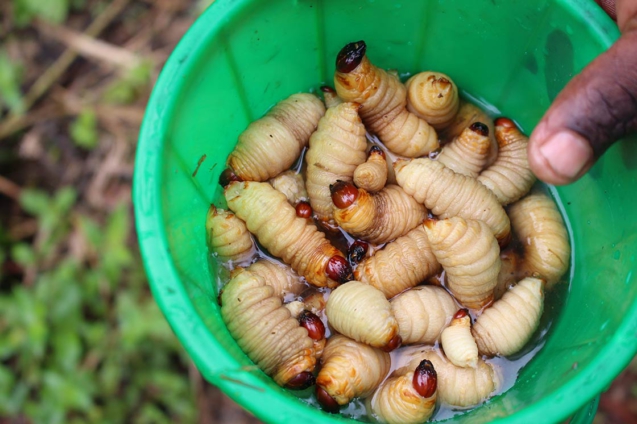
An entomologist with the University of Energy and Natural Resources (UNER) is raising public awareness about the consumption of African Palm Weevil larvae known as 'Akokono' in the Akan language.
According to Dr. Jacob Paarechuga Anankware, the Coordinator of the HealthInsect Project, the insect is highly nourishing for the body and has the potential to protect the environment because it generates little or no greenhouse gases.
The HealthInsect Project farm in Sunyani is about 10 feet square, but it contains 300 rearing bins. Each female adult at his insect farm can lay up to 300 eggs.
"So these bins you are seeing right here have either the larvae or adult stages of the African palm larvae which is officially known as “Akokono” in the Akan language. So we use very simple agricultural products and sometimes agricultural waste to produce these nutritious edible things," Dr Anankware said.
In terms of goods and labor, palm weevil farming is a low-cost operation.
Dr. Anankware says the larvae grow between 21 and 28 days before harvesting.
“Once these ones hatch and grow up to 21 to 28 days, they are often ready for the market,"
The larvae have a high rate of reproduction. According to Dr. Anankware, one bin can harvest 150-180 larvae weighing around 1kg depending on size.
“So 150 – 180 will be a kilogram depending on the sizes. Each bin has a minimum of one kilogram. Some have two kilograms and others have as high as five kilograms and all this depend on the adult I have put in there. Some have just three pairs, some two pairs, but if you have five pairs you’re getting a lot of larvae, because each female can lay as much as 300 eggs."
In developing countries, insects caught in the wild are already widely consumed. Now a study says farming them on a wide scale for food will cause significantly less environmental impact than cattle production.
Scientists analyzed methane and nitrous oxide emissions from animals and insects, which have a larger warming effect than carbon dioxide. They also assessed ammonia production, which acidifies soil and water and affects the environment.
They reared palm weevil larvae, mealworms, locusts, and crickets, all of which are consumed globally, as well as sun beetles and cockroaches, which are not consumed despite their promise as a protein source, while measuring the amount of gas created per kilogram of insect growth.
In comparison to cattle, insects generated 80 times less methane – a gas having a 25-fold greater influence on global temperature levels than carbon dioxide. Crickets, on the other hand, produced 8-12 times less ammonia than pigs.
Akokono contains 19 of the 21 essential amino acids as well as high levels of protein and iron.
“They have 19 out of the 21 essential amino acids and they have superior protein and iron content that I will share with you at a different point in time, so if you come and look at this there are two bins containing adults we inoculated three weeks ago. These are the adult stages, they are dead now."
Edible insects, such as the Akokono, emit no or very little greenhouse emissions.
According to Dr. Anankware, eating insects such as Akokono could help with both food insecurity and climate change.
“These insects do not emit greenhouse gases. Only a few groups of insects emit greenhouse gases and if you also look at the amount of vegetation you need as the palm larvae you need just little space. Look at this little space I’m using and I’m producing several kilos per week."
Currently, 1kg of palm larva costs between 70 and 100 cedis. Few individuals make it, but many people require it.
“We produce and we are not able to meet the quantities that people are purchasing. Because if I tell you the number of people who place orders and the class in society that place orders you will be shocked. That’s why the prices have gone up to about 70-100 cedis per kilo and why it’s expensive because we are not so many just a few people are producing."
Dr. Anankware refuses to share his trade secret, but he claims that production is straightforward and cost-effective.
According to the entomologist, Ghana must push for innovation to encourage the growth of insects in order to help the economy grow and protect the environment.
Latest Stories
-
Mobile Money Fintech LTD, UMB train hairdressers and beauticians
2 hours -
Asylum votes show people want help, says Kemi Badenoch
3 hours -
Badenoch welcomes expanded grooming gangs inquiry
3 hours -
GACL MD sues Samuel Buabeng over alleged Facebook defamation
3 hours -
Christa Pike in critical condition after surviving two lethal injections, lawyer says
3 hours -
Kemi Badenoch backs face covering ban at protest
4 hours -
Man City not ‘above the rules’, says No 10 after backlash to Burnham remarks
4 hours -
Real Madrid submit ‘substantial’ dossier in Barca payments case
4 hours -
Messi completes purchase of second Spanish club
4 hours -
Government must engage horticulturists on tomato crisis – GhIH
4 hours -
King Promise’s ‘Can’t Tame Us’ becomes official Chelsea anthem
4 hours -
Afenyo-Markin demands Baffour Awuah’s release from EOCO’s custody, end to alleged political intimidation
4 hours -
Rapper Rick Ross arrested on domestic violence charges
4 hours -
Minority demands security review of Ghana-Colombia visa waiver and port deals
5 hours -
Pursue drug kingpins, not persecute political opponents – Afenyo-Markin tells EOCO
5 hours