

Audio By Carbonatix
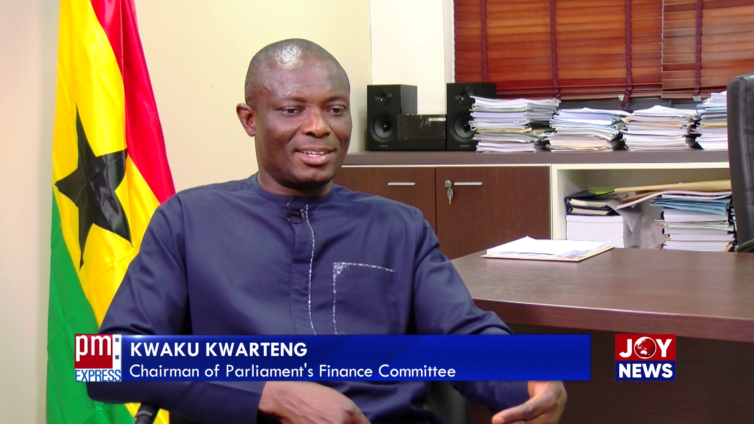
The Chairman of the Finance Committee, Kwaku Kwarteng, has attributed the country’s current economic crisis to decades of reckless public expenditure and economic mismanagement.
Acknowledging the adverse impacts of the Covid-19 pandemic and the ongoing Russian war, Mr Kwarteng refuted the notion that these global events were the sole cause of the crisis.
“I am not with the school of thought that we were not going to experience a financial crisis but for these [Covid-19 and Russia-Ukraine War].
“The country was always going to have some financial crisis. It might have been delayed a little bit if Covid-19 and the Russia-Ukraine war had not happened but the fact remains that with the path we were walking, we were definitely going to get here,” he said.
Mr Kwarteng who doubles as MP for Obuasi West made this assertion during an interview on JoyNews’ PM Express on Thursday.
Highlighting a pervasive culture of overspending and a lack of fiscal discipline, Mr Kwarteng also noted that Ghana's current predicament is not solely a result of recent economic management but rather the culmination of decades of bad politics and economic mismanagement.
“Overruns and reckless expenditure have become a culture," he told George Wiafe. A practice, he expressed grave concern.
According to him, unless there is a fundamental change in mindset and a commitment to fiscal responsibility, Ghana risks becoming a failed state.
He therefore called for an honest and straight-forward discussion about these negative cultural practices that have led to the current crisis and find sustainable solutions to them.
The Obuasi West legislator observed that due to the pervasiveness of these negative cultural practices, it makes laws and institutions established to clump down on economic mismanagement ineffective.
“We have the laws and we’ve set up institutions that should help us deal with these, but no amount of legislation, no amount of institutional arrangements can stop a people determined to destroy themselves.”
Mr Kwarteng's remarks come at a critical time as the country grapples with the dual challenges of external shocks and domestic economic vulnerabilities such as skyrocketing inflation rate, high unemployment rate among others.
Latest Stories
-
Nearly 2,000 displaced, schools damaged as windstorm wreaks havoc in Gushegu
3 minutes -
Ghana’s Derrick Kohn to work under Marie-Louise Eta as she becomes first woman to coach men’s Bundesliga team
7 minutes -
Accra Open Championships conclude with strong performances ahead of African Championships
15 minutes -
Ghana to begin camping with 12 athletes after Accra Open Championships – Bawa Fuseni
36 minutes -
Anthony Joshua declines showdown with Tyson Fury but admits they ‘probably’ clash next
49 minutes -
Tyson Fury dominates Makhmudov, calls out Joshua next
1 hour -
I have supported highway authority financially to fix roads in my constituency – A Plus
2 hours -
US, Iran fail to reach peace agreement after marathon talks in Pakistan
3 hours -
ECG kicks off Phase Two of transformer upgrades at Lashibi; brief outages expected
3 hours -
Port crises loom as 11,000 drivers threaten four-day strike
4 hours -
A source of excellence across generations – Vice President Opoku-Agyemang lauds Mfantsipim
5 hours -
(Photos) Mfantsipim School launches historic 150th anniversary
5 hours -
Knights and Ladies of Marshall group backs Catholic Bishops’ stance on anti-LGBTQ+
6 hours -
Bright Simons: All the Filla in the Ibrahim Mahama/E&P – Gold Fields Saga
7 hours -
Monetise Idiocy In Ghana
7 hours