


Audio By Carbonatix
The number of sick and disabled people out of work is putting the UK at risk of an "economic inactivity crisis" that threatens the country's prosperity, according to a new report.
There were 800,000 more people out of work now than in 2019 due to health conditions, costing employers £85bn a year, according to the review by former John Lewis boss Sir Charlie Mayfield.
The problem could worsen without intervention, but Sir Charlie, who will lead a taskforce aimed at helping people return to work, said this was "not inevitable".
The move has been broadly welcomed, but some business groups said Labour's Employment Rights Bill included some disincentives to hiring people with existing illnesses.
One in five working-age people were out of work, and not seeking work, according to the report, which was commissioned by the Department for Work and Pensions by produced independently.
Without intervention, another 600,000 people could leave work due to health reasons by the end of the decade.
Sir Charlie said sickness costs employers £85bn a year through issues including lost productivity and sick pay, but it also costs the broader economy.
"For employers, sickness and staff turnover bring disruption, cost and lost experience," he said. "For the country, it means weaker growth, higher welfare spending and greater pressure on the NHS".
Speaking to the BBC, he said that "on the whole, work and health are mutually reinforcing".
"So keeping people in work, keeping them active, actually helps them to stay healthier."
The state spends £212bn per year on illness-related inactivity, or nearly 70% of income tax, through lost output, increased welfare payments and additional burdens on the NHS.
People could be encouraged to stay in work if health is viewed as "a shared responsibility between employers, employees and health services", he said.
'I want to find a job'
Loz Sandom has mental and physical health conditions, which have made it difficult to find a job, and the last time they worked was a year ago.
"I am willing to do the work, and I want to. I want to find a job," said the 28-year-old, who has a degree in illustration and has previously worked as a digital marketing executive.
They said that part of the challenge was that employers did not realise they had "a duty to provide reasonable adjustments."
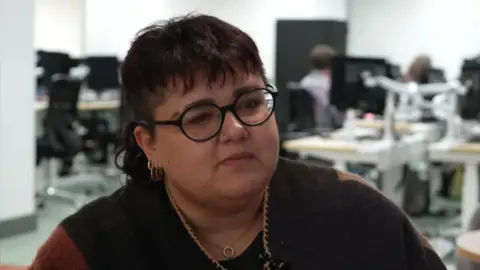
"It's such a shame because they're missing out on so many fantastic disabled people who can do fabulous jobs.
"And I'm not blaming employers entirely. They need support as well," Loz added. "There are things that can be put in place to help employers, help save people."
Responding to the report, the government announced a major partnership with over 60 companies, many of them large employers, to "tackle the rising tide of ill-health that is pushing people out of work".
The companies include Tesco, Google UK, Nando's and John Lewis.
Over the next three years, they will "develop and refine workplace health approaches" which aim to "reduce sickness absence, improve return-to-work rates, and increase disability employment rate".
The government is aiming to develop these changes into a voluntary certified standard by 2029.
Speaking to the BBC, Work and Pensions Secretary Pat McFadden said the report was a "win-win for employees and employers because its' aimed at keeping people with sickness issues or developing disability issues in work".
"That's in the interests of employers because these are good experienced staff and it's in the interests of employees too because most people want to stay in work if they possibly can."
The Resolution Foundation think tank's chief executive Ruth Curtice said: "The review has accurately identified a culture of fear, a dearth of support and structural barriers to work as key challenges to overcome in turning the tide for Britain's economic inactivity problem – which is currently trending in the wrong direction."
The CIPD, which represents HR professionals, welcomed the government's vision for a preventative approach to illness in the workplace.
But its chief executive, Peter Cheese, said: "The report's success will depend on the extent to which these recommendations are understood by business in driving positive outcomes and backed by policy makers at a national and regional level."
The report comes as the government tries to move ahead with its Employment Rights Bill, which some businesses say will stifle growth.
The proposed new law includes a right to guaranteed hours and cracks down on zero-hour contracts without the offer of work.
As well as that bill, Chancellor Rachel Reeves is aiming to guarantee paid work to young people who have been out of a job for 18 months.
Those who do not take up the offer could face being stripped of their benefits.
Latest Stories
-
‘Cockroach’ group leaders among hundreds detained in Delhi protest
3 minutes -
Don’t let speed of information become your judgement – CJ tells new lawyers
41 minutes -
World Cup visa scandal: People have leveraged public office to facilitate fraud – Senyo Hosi
46 minutes -
Glut! Farmers count losses as prices crash, customers happy
1 hour -
GSA postpones auction of unserviceable vehicles
1 hour -
Man charged with attempted murder after stabbing
1 hour -
World Cup visa scandal: Senyo Hosi says issue goes beyond calls for Sports Minister’s resignation
1 hour -
Yaw Ampofo Ankrah hasn’t taken or received any money to facilitate visas – Lawyer insists
2 hours -
World Cup visa scandal: Senyo Hosi urges focus on constitutional accountability
2 hours -
La Beach demolition: Senyo Hosi condemns lack of consultation
2 hours -
Russian glide bomb attack on Zaporizhzhia kills at least 15 people
2 hours -
Jinapor warns underperforming energy sector CEOs of consequences, says no protection for failure
2 hours -
Fire destroys head of tipper truck on Lower Volta Bridge
2 hours -
Palmer signs new Chelsea contract until 2034
2 hours -
World Cup visa scandal: Mahama will act on corruption allegations – Abass Nurudeen
2 hours