

Audio By Carbonatix
Levels of positive tests are rising in London and could be on the up in the East of England, according to data from the Office for National Statistics.
Figures for the week to 5 December, as England's second lockdown was ending, suggest infection levels continued to fall in other regions.
Infection rates are still highest in children of secondary school age, the ONS says.
Across the UK, the picture is mixed, with Wales seeing rising infections.
In Northern Ireland, the percentage of people testing positive continues to fall - while in Scotland it has stayed the same.
The R number - or reproduction number - of the virus is now between 0.9 and 1.0 for the UK - slightly up from 0.8-1.0 last week. But in some regions in the south and east it could be above 1, indicating infections are likely to be growing there.
The ONS figures are one source of data used by the government's scientific advisers to judge the spread of the virus, and take decisions on restrictions on people's daily lives.
They are based on swab tests of thousands of people in households, whether they have symptoms or not. The estimates are thought to give a more accurate picture of how many people are infected with the virus than data on positive tests alone.
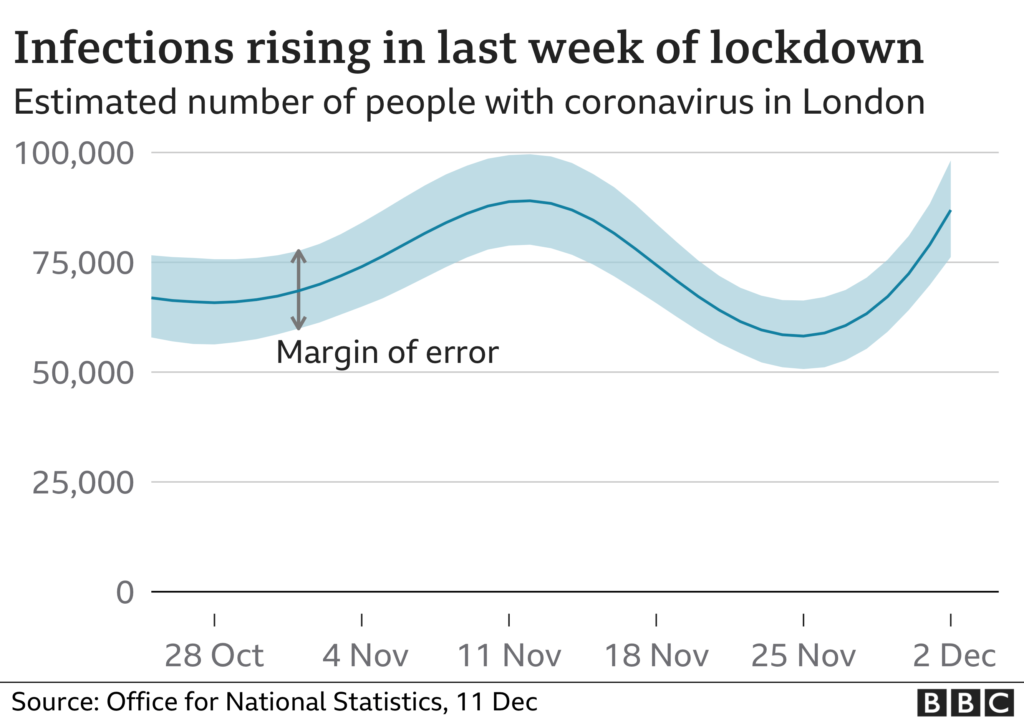
Infection levels in London started to rise sharply before the end of lockdown, according to the ONS, after falling in late November.
In all other regions, including the North West and North East, and Yorkshire and the Humber, the percentage of people testing positive is decreasing.
But there are "early signs" rates may be increasing in the east of England, the ONS says.
It estimates:
- one in 115 people have the virus in England
- one in 120 in Scotland
- one in 120 in Wales
- one in 235 in Northern Ireland
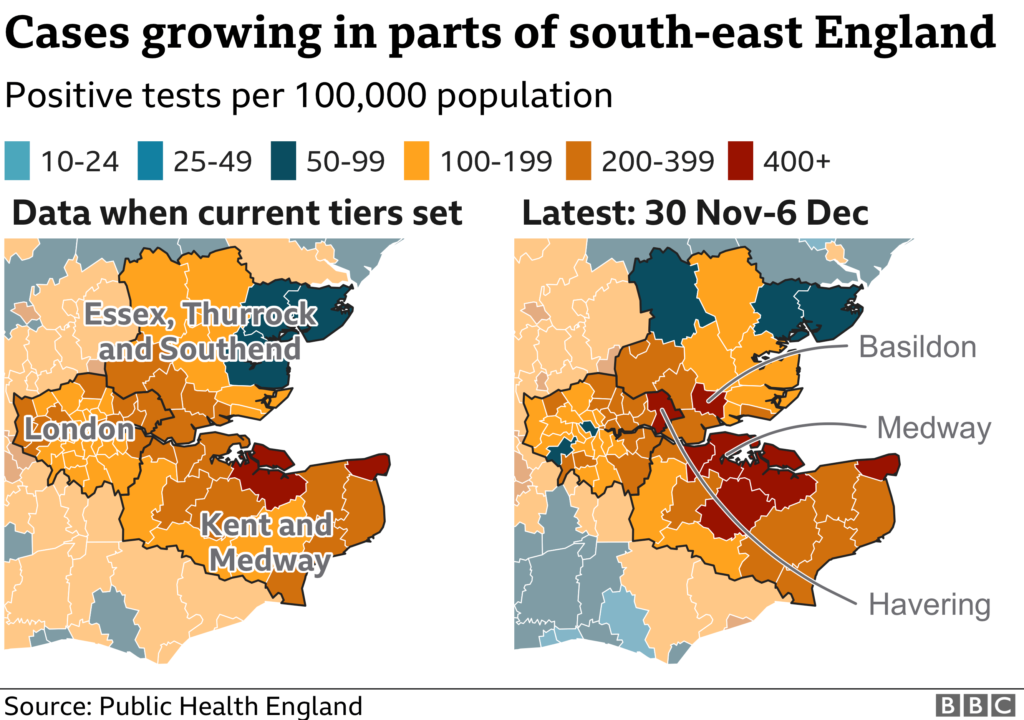
Data on cases - or confirmed positive tests, from Public Health England - also suggests the epidemic is growing in parts of London and the south-east of England.
Areas such as Basildon, Medway and Havering are now experiencing more than 400 cases per 100,000 people.
England's tiers system is due to be reviewed on 16 December and there have been suggestions that London should be moved from tier two to tier three to avoid a spike in deaths over Christmas.
Kent is already in tier three while Essex is in tier two.
Latest Stories
-
[Watch Live] Obrafour, Kwaw Kese, Tinny, Keche and others thrill fans at Gomoa Easter Carnival
32 minutes -
After more than 14 years at Atletico Madrid, what next for Simeone?
1 hour -
Conquering the World – Building on the foundations laid by Otto Addo
1 hour -
Gomoa Easter Carnival: Experts charge indigenes to own festival to ensure sustainability
3 hours -
Gomoa Easter Carnival: Edem Agbana and Joy Prime fans shower festival with huge endorsements
4 hours -
Gov’t to overhaul free zones into manufacturing hubs for local production – Trade Minister
5 hours -
Ghana losing $2.5bn yearly from raw exports – Trade Minister reveals
5 hours -
Mahama unveils plans for Kwahu Airport, Convention Centre
5 hours -
World’s oldest leader, Paul Biya to get a deputy for first time in 43-year rule
5 hours -
Search for missing US airman continues as Trump threatens ‘hell’ if Iran does not reach deal
5 hours -
US says it has arrested relatives of late Iranian general Qasem Soleimani
5 hours -
La Liga: Real Madrid’s title hopes hang in the balance as Mallorca snatch stoppage-time winner
6 hours -
FA Cup: Haaland hat-trick powers Man City past Liverpool into semi-finals
6 hours -
FA Cup: Chelsea thrash Port Vale to reach Wembley semi-final
6 hours -
Gov’t to boost tourism in coastal communities through infrastructure, sanitation – Vice President
6 hours