

Audio By Carbonatix
The Ghana Statistical Service (GSS) has revealed that total value of informal trade in the fourth quarter of 2024 is estimated at GH₵ 7.4 billion. This was captured in the GSS’ maiden Informal Cross-Border Trade (ICBT) Report.
The report breaks down the numbers behind the transaction of goods and services between Ghana and its neighbouring countries.
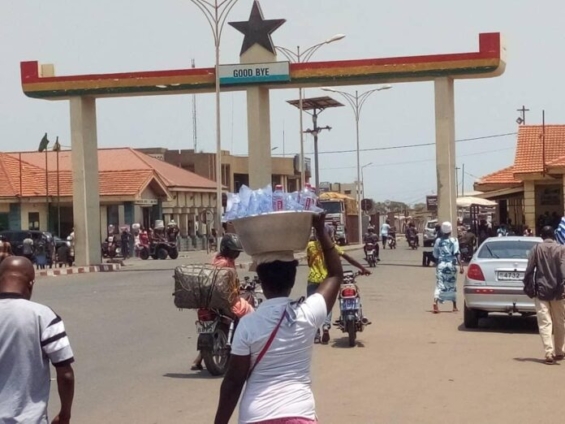
According to the GSS, the items captured in the report are mainly goods and services usually carried by truck, or often carted on foot but remain invisible on official data.
Speaking at a press briefing to break down the figures, Government Statistician, Dr. Alhassan Iddrisu said the figure, which accounts for about 4.3% of the total trade volume in the same period is largely dominated by food items such as alcoholic beverages, cooking oil, livestock and other beverages.
"The total value of cross-border informal trade amounted to GH₵7.4 billion. During the same period Ghana's formal trade stood at GH₵165.3 billion"
With 102 field officers employed across 321 border points, the survey covered 10 out of 16 administrative regions of the country.
Volta Region recorded the highest number of border points of 76, followed by Western North and the Upper regions with 45 and 44 respectively.
Trade with Togo remains the most informal out of the 3 neighbouring countries. Ghana's east-African neighbours led the ICBT trade with the highest import of GH₵1.8bn, while Burkina Faso recorded the highest exports of GH₵1.7bn
Also imports from Togo was about thrice that from Cote D'ivoire which amounted to GH₵600 million.
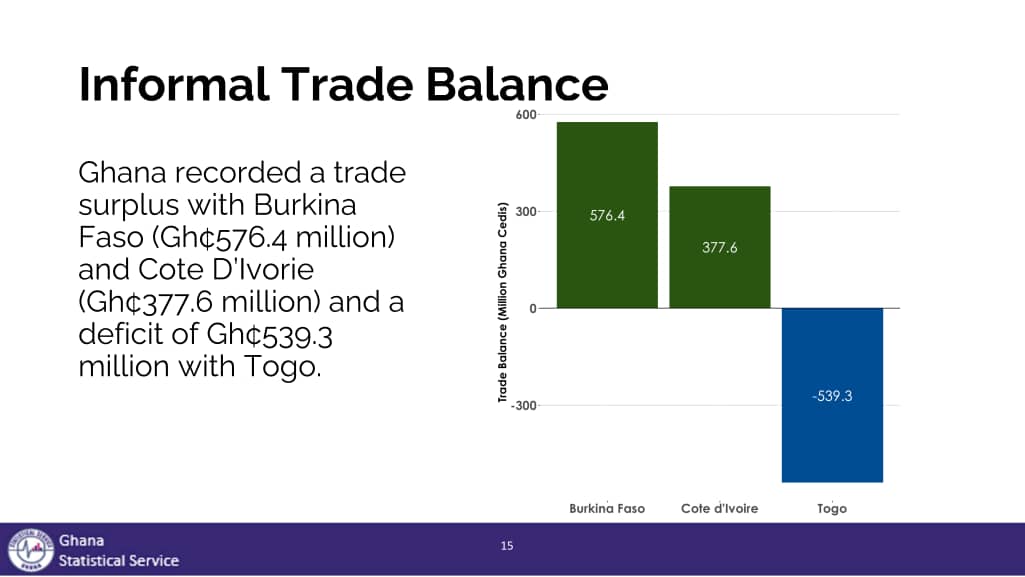
Ghana recorded a trade surplus with Burkina Faso (GH₵571m) and Cote D'ivoire (GH₵374.6). Meanwhile, a deficit of GH₵538.9 was recorded with Togo.
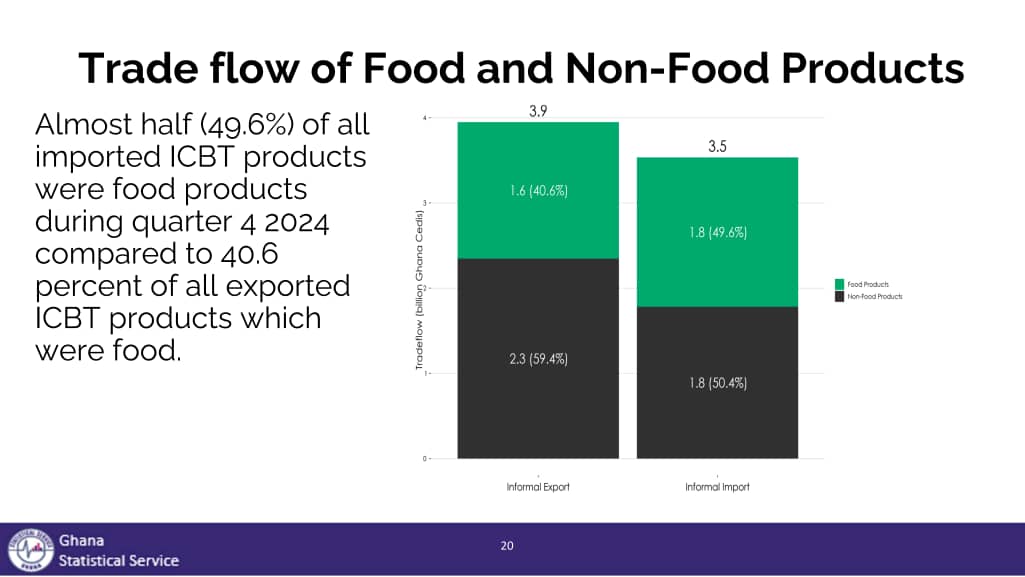
The survey revealed that more than two-thirds of formal imports representing 74.6%, which come from the 3 neighbours are food products compared to almost half (49.5%) for informal imports.
“Import on livestock was about twice that of that of export. Over GH₵300 million worth of livestock was imported, however exports hovered around GH₵177 million.” The report added.
On the recommendations, Dr. Iddrisu called for reforms geared towards formalising the informal sector. He further urged businesses to consider the production of food items such as cooking oil to reduce the over-reliance on foreign products.
“Boost production of items like cooking oil, mattresses, to cut dependence on imports. We also need to collaborate with neighbouring countries on data sharing to explore how we can work on formalizing the informal trade.
“Improvement on border infrastructure and the simplification for customs procedures will also be crucial,” he noted.
Latest Stories
-
Knights and Ladies of Marshall group backs Catholic Bishops’ stance on anti-LGBTQ+
8 minutes -
Bright Simons writes: All the Filla in the Ibrahim Mahama/E&P – Gold Fields Saga
32 minutes -
Monetise Idiocy In Ghana
39 minutes -
The Ghanaian prophet and the mysterious death of his scottish wife Charmain Speirs
1 hour -
Nearly 400 sentenced in Nigeria for links to militant Islamists
2 hours -
Ghana’s recovery supported by gold strength despite global oil price pressures – Standard Bank Research
2 hours -
‘Excellence is our inheritance’ – Nana Sam Brew-Butler hails Mfantsipim’s 150-year reign in leadership
2 hours -
Kwaku Azar writes: A-G vs OSP
2 hours -
Mfantsipim–Adisadel rivalry built excellence, not division – Sam Jonah
3 hours -
Vice President launches Mfantsipim’s 150 years of shaping Ghana’s greatest mind
3 hours -
I assure Otumfuo, Mahama will join him to commission KNUST Teaching Hospital by end of this year – Haruna Iddrisu
4 hours -
Barcelona dominate derby to extend La Liga lead
4 hours -
Gov’t to roll out free special education for persons with disabilities from July 1 – Education Minister
4 hours -
Importers and Exporters Association declares full support for Publican AI port system
4 hours -
“We used it to test our officiating officials’ readiness” – Bawah Fuseini after CAA Athletics event
5 hours