


Audio By Carbonatix
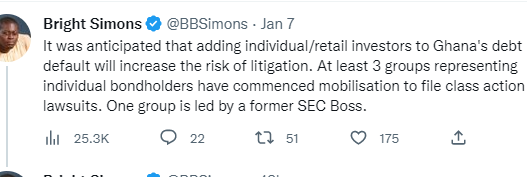
Vice President of IMANI Ghana, Bright Simons, has revealed that three groups representing individual bondholders have commenced mobilisation to file legal suits against the government for including individual bondholders in the Debt Exchange Programme.
According to him, one of such groups is led by a former boss of the Securities and Exchange Commission (SEC).
The Finance Ministry had earlier cautioned individual holders of eligible bonds who refuse to take the Amended and Restated Exchange Memorandum under the Debt Exchange Programme provided by the State that they will find it difficult to obtain a judgement against the Government of Ghana.
Under a caption labelled “Enforcement of Civil Liabilities” in the 58 page Amended and Restated Exchange Memorandum to individual bondholders, Finance Minister, Ken Ofori-Atta emphasised that since Ghana is a sovereign state, any legal action taken by bondholders against the country would be difficult to materialise.
“The Republic of Ghana is a sovereign state. Consequently, it may be difficult for Eligible Holders of Eligible Bonds to obtain or realise awards against the Republic”.
“The Republic has submitted to the jurisdiction of the courts of Ghana and waived any immunity from the jurisdiction (including sovereign immunity) of such courts in connection with any action arising out of or based upon the Invitation to Exchange or any securities issued under the Invitation to Exchange brought by any holder of such securities,” it added.
But in a tweet, Mr. Simons said “it was anticipated that adding individual/retail investors to Ghana’s debt default will increase the risk of litigation. At least 3 groups representing individual bondholders have commenced mobilisation to file class action lawsuits. One group is led by a former SEC boss.”
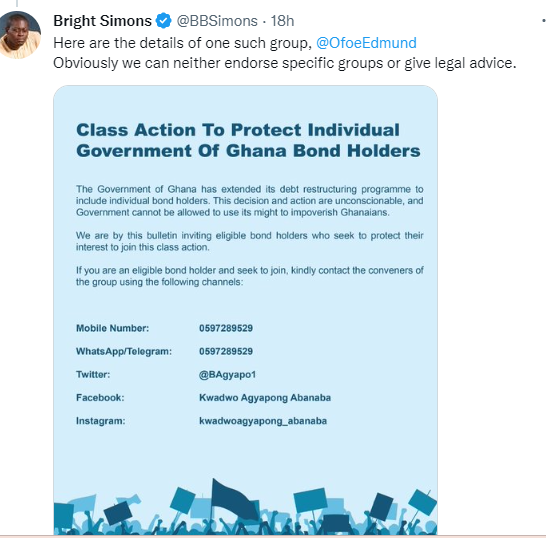
“Here are the details of one such group, @OfoeEdmund. Obviously we can neither endorse specific groups or give legal advice”, he added.
The Finance Minister on December 5, 2022 announced a Domestic Debt Exchange programme to restructure the country's debt which had reached unsustainable levels.
It initially excluded individual bondholders, but after stiff opposition from labour which led to their exclusion, government included retail bondholders.
Latest Stories
-
GPL 2025/26: Dreams FC stage stunning comeback to hammer Eleven Wonders
1 hour -
Livestream: The Probe examines Kumasi’s looming water crisis
1 hour -
MTN Ghana gears up to lead Africa’s AI revolution
1 hour -
Philanthropist Alhaji FuZak donates Da’wah bus to Ambariya Sunni community
2 hours -
GUTA calls for suspension of Publican AI system over trade disruptions
2 hours -
TTAG raises alarm over proposed recruitment of 7,000 teachers, demands national posting roadmap
2 hours -
Civilians feared killed after reports of air strike on Nigerian market
2 hours -
Bishop Simon Kofi Appiah installed as new Jasikan Diocese Bishop
2 hours -
Trump’s Strait of Hormuz blockade threat raises risks and leaves predicaments unchanged
2 hours -
US Court backs extradition of former MASLOC CEO Sedina Tamakloe-Attionu to Ghana
3 hours -
Seven arrested as NAIMOS dismantles illegal mining camp, seizes firearms at Boin River
3 hours -
Fire erupts at Madina Ritz Junction, destroys multiple wooden structures and containers
3 hours -
Daniel-Kofi Kyereh returns from long-term injury, registers assist for Freiburg U23
3 hours -
Knifeman calling himself ‘Lucifer’ slashes three at NYC’s Grand Central
3 hours -
Brands are built from within to without
3 hours