

Audio By Carbonatix
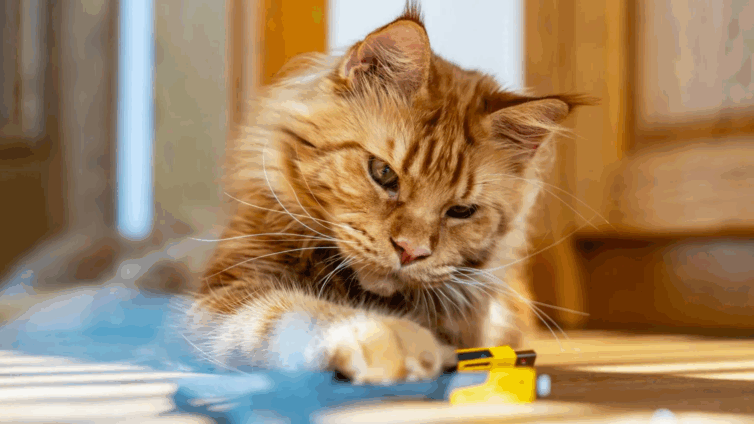
Garfield, Puss in Boots, Aristocats' Toulouse – cultural icons, maybe, ginger most certainly.
And now scientists across two continents have uncovered the DNA mystery that has given our furry friends, particularly males, their notable colour.
They discovered that ginger cats are missing a section of their genetic code, which means the cells responsible for their skin, eye and fur tone produce lighter colours.
The breakthrough has delighted the scientists and the thousands of cat lovers who originally crowdfunded the research.
The scientists hope that solving the puzzle could also help shed light on whether orange coloured cats are at increased risk of certain health conditions.
It has been known for decades that it is genetics that gives orange tabby cats their distinctive colouring, but exactly where in the genetic code has evaded scientists till now.
Two teams of scientists at Kyushu University in Japan and Stanford University in the US have now revealed the mystery in simultaneous papers published on Thursday.
What the teams found was that in the cells responsible for giving a cat its skin, hair follicles and eyes their colour - melanocytes - one gene, ARHGAP36, was much more active.
Genes are made up of pieces of DNA which give instructions to a cat's cells, like other living creatures, on how to function.
By comparing the DNA from dozens of cats with and without orange fur, they found that those with ginger colouring had a section of DNA code missing within the ARHGAP36 gene.
Without this DNA, the activity of the ARHGAP36 is not suppressed, i.e. it is more active. The scientists believe that the gene instructs those melanocytes to produce lighter pigment.
Ginger cats mostly male
For decades, scientists have observed that cats with completely ginger colouring are far more likely to be male. This tallies with the fact that the gene is carried on the X chromosome.
Chromosomes are larger sections of DNA, and male cats, like other mammals, have an X and a Y chromosome, which carry different numbers of genes.
As it is a gene only on the X chromosome, in this case controlling the pigment production, then one missing piece of DNA is enough to turn a cat fully ginger.
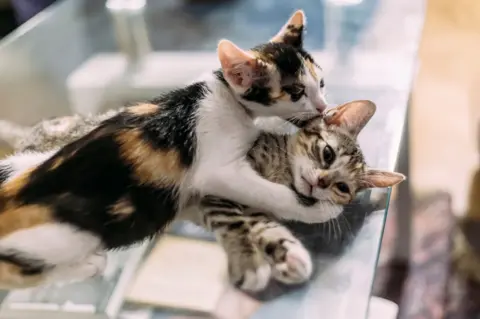
In comparison, female cats have two X chromosomes, so the DNA needs to be missing in both chromosomes to increase lighter pigment production to the same extent - it means a mixed colouring is more likely.
"These ginger and black patches form because, early in development, one X chromosome in each cell is randomly switched off," explains Prof Hiroyuki Sasaki, geneticist at Kyushu University.
"As cells divide, this creates areas with different active coat colour genes, resulting in distinct patches."
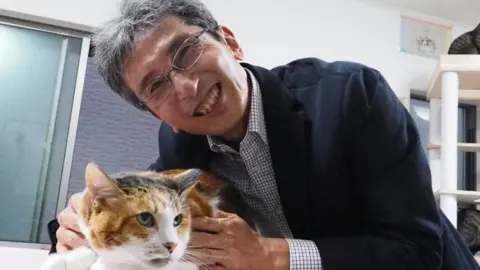
Although couched in science, the study originally started off as a passion project for Professor Sasaki.
He had retired from his university post, but as a cat lover said he wanted to continue working to uncover the orange cat gene in the hope it could "contribute to the overcoming of cat diseases".
He and his team raised 10.6m yen (£55,109) via crowdfunding for the research from thousands of fellow cat lovers across Japan and the world.
One contributor wrote: "We are siblings in the first and third grades of elementary school. We donated with our pocket money. Use it for research on calico cats."
The ARHGAP36 gene is also active in many other areas of the body, including the brain and hormonal glands, and is considered important for development.
The researchers think it is possible that the DNA mutation in the gene could cause other changes in these parts of the body linked to health conditions or temperament.
The ARHGAP36 gene is found in humans and has been linked to skin cancer and hair loss.
"Many cat owners swear by the idea that different coat colours and patterns are linked with different personalities," said Prof Sasaki.
"There's no scientific evidence for this yet, but it's an intriguing idea and one I'd love to explore further."
Latest Stories
-
Seven African referees selected for World Cup 2026 as Ndala, Issa Sy miss out
17 minutes -
Why diaspora investors are using Accra real estate to hedge against global uncertainty in 2026
40 minutes -
GWL urges public support to stem water thefts
41 minutes -
Fire guts 2-storey apartment at Ashaley Botwe
42 minutes -
Come down and account, it’s a constitutional requirement – Martin Kpebu to Ofori-Atta
51 minutes -
The power of the private courtyard: How regalia is redefining resort-style living in Accra
1 hour -
Beyond roads and bridges: Understanding the true role of your MP
1 hour -
UK says Russia ran submarine operation over cables and pipelines
1 hour -
NPRA recovers GH¢27m in 2025, 30% of defaulted pension contributions
1 hour -
Power fluctuations slash Ashanti region water production by 959,000 cubic metres in March
1 hour -
Beyond the festivities: Gomoa must turn visibility into development
1 hour -
DVLA clarifies it is not responsible for Toyota Voxy commercial operations
1 hour -
Calls for Ofori-Atta’s return a non-issue if trial proceeds in absentia – Pius Hadzide
1 hour -
France names Ghana first beneficiary of newly established National Health Compact
2 hours -
US Immigration, extradition outcomes likely to influence each other in Ofori-Atta case – Amanda Clinton
2 hours