

Audio By Carbonatix
Rich countries have pledged to provide at least $300 billion annually to poorer countries by 2035 to aid in their climate change battles.
Despite tripling the previous funding goal, developing countries are underwhelmed by the new agreement reached at the COP29 summit.
The New Collective Quantified Goal on Climate Finance (NCQG) was finalized after intense two-week negotiations and years of preparation, requiring unanimous approval from all countries.
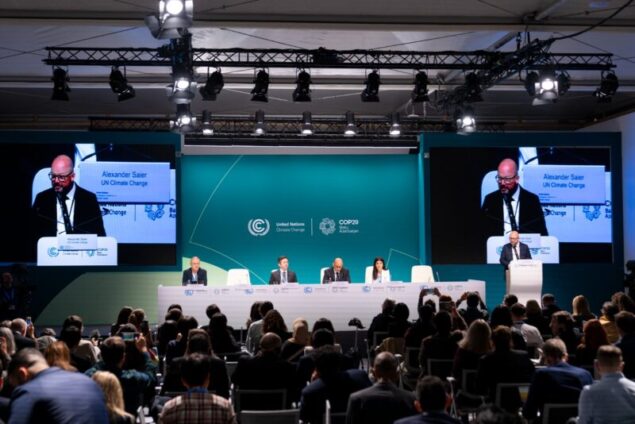
According to UN Climate Change Executive Secretary, Simon Stiell, this new financial target serves as a safeguard for humanity, given the escalating climate-related challenges affecting every nation.
“But like any insurance policy – it only works – if premiums are paid in full, and on time. Promises must be kept, to protect billions of lives."
Simon indicated that it will keep the clean energy boom growing, helping all countries to share in its huge benefits: more jobs, stronger growth, cheaper and cleaner energy for all.
Developing countries had high hopes that developed countries would commit to raising $1.3 trillion annually in climate finance to combat the climate crisis. However, the outcome was a more relaxed agreement to raise $1.3 trillion each year from various sources, including private investments, by 2035.
This decision was met with criticism from countries like India and Nigeria, who felt that the COP29 presidency pushed the deal through without their proper consent, following chaotic last-minute negotiations.
Despite this, the UNFCCC views the new finance goal at COP29 as a significant step forward in global climate action, building on previous achievements such as the Loss and Damage Fund established at COP27 and the global agreement to transition away from fossil fuels at COP28.
COP29 made some progress, including a landmark agreement on carbon markets, which had eluded previous COPs. This will help countries achieve their climate goals more efficiently and make faster progress in reducing global emissions.
Important agreements were also reached on transparent climate reporting and adaptation. However, not all parties were satisfied with the outcome, and there's still a lot of work to be done on crucial issues.
As Executive Secretary of UN Climate Change acknowledged, no country got everything they wanted, and there's still a lot to be accomplished.
"The many other issues we need to progress may not be headlines but they are lifelines for billions of people. So this is no time for victory laps, we need to set our sights and redouble our efforts on the road to Belem,” Simon said.
The finance agreement at COP29 is timely, as countries are expected to submit stronger national climate plans, known as Nationally Determined Contributions (NDCs), next year. These plans must be comprehensive, covering all greenhouse gases and sectors, to keep the 1.5°C warming limit achievable.
Two G20 countries, the UK and Brazil, have signaled their intention to increase climate action in their upcoming NDCs, recognizing that it's in the best interest of their economies and people.
“We still have a very long road ahead, but here in Baku we took another important step forward,” said Simon.
“The UN Paris Agreement is humanity’s life raft; there is nothing else. So here in Baku and all of the countries represented in this room, we’re taking that journey forward together.”
Countries were unable to agree on how to implement the outcomes of last year's "global stocktake", which includes a crucial pledge to transition away from fossil fuels. Instead, they decided to postpone this decision until COP30 next year in Brazil.
Countries did manage to reach an agreement on the remaining sections of Article 6 on carbon markets. This means that all elements of the Paris Agreement have been finalized, nearly a decade after it was signed.
Transparent climate reporting takes major leap forward
Countries made progress on transparent climate reporting, laying the groundwork for stronger climate policies and better identification of financing needs.
A total of 13 countries including Andorra, Azerbaijan, the European Union, Germany, Guyana, Japan, Kazakhstan, Maldives, Netherlands, Panama, Singapore, Spain, and Türkiye submitted their first Biennial Transparency Reports, setting an example for others to follow. All transparency negotiating items were successfully concluded, with countries expressing appreciation for the support and tools provided to enhance transparency reporting.
The UNFCCC's #Together4Transparency initiative hosted 42 events to highlight the importance of transparency in developing climate plans and achieving net-zero goals. The events included high-level sessions, training, and technical expert workshops to prepare countries for their Biennial Transparency Reports.
The UK also pledged £3 million to support REDD+ activities, enhancing transparency and implementation in line with the goal to halt deforestation and forest degradation by 2030.
Latest Stories
-
‘No space for emergencies’ – Dr Bonney warns of systemic collapse as hospitals operate at 300% capacity
15 minutes -
Ghana’s emergency system not equipped for current demands – GRNMA President
25 minutes -
The ‘Golden Hour’ gamble: Deputy Health Minister slams systemic gaps after hit-and-run tragedy
1 hour -
Dr Gideon Boako empowers 2,200 Tano North SHS candidates, pledges full boarding kits
1 hour -
Emergency care failures unacceptable – Deputy Health Minister
2 hours -
Gender Minister follows up on Bulemi case with visit to Accra Psychiatric Hospital
2 hours -
Ghana’s emergency care crisis: Dr. Asiedu Sarpong calls for preventative approach to healthcare reform
2 hours -
NPP faces internal pressure as group opposes second term for incumbent general secretary
2 hours -
Old Tafo MP leads legal team to appeal cases of wrongfully jailed persons in Kumasi
2 hours -
Turned away to die: Emergency doctor provides painful blow-by-blow account of her brother’s death over ‘no-bed syndrome’ in 3 hospitals
2 hours -
Former Western North Minister Joojo Rocky Obeng donates Police holding facility to boost security in Aowin enclave
2 hours -
Season 4 of The Career Trail returns on April 4
2 hours -
Health Ministry announces nationwide recruitment of health professionals from April 16
2 hours -
“He could have been saved” – Sister of hit-and-run victim laments delayed emergency care
2 hours -
GCTU, CELLTEL forge strategic partnership to drive digital transformation in higher education
2 hours