

Audio By Carbonatix
The Bank of Ghana has refuted the World Bank's assertion that it is responsible for the increasing rate of inflation in the country.
According to the Central Bank, it cannot be blamed for the rising inflation which has affected various goods and services.
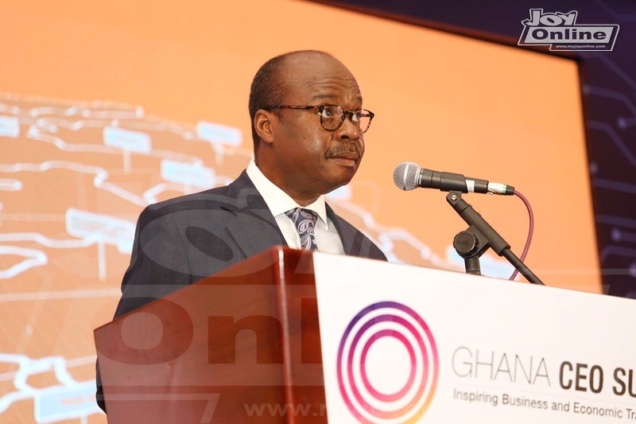
Announcing a monetary policy increment on Thursday, thus a 200 basis points increase to 24.5 percent, the Governor of the Bank of Ghana, Dr Ernest Addison, explained that the rising inflation rate is not a result of delay in tightening the monetary policy rate.
He said Ghana is amongst the first countries to tighten its monetary policy rate, therefore the assertion that it delayed in doing so, hence the rise in inflation, is not acceptable.
"They're of the other view that the monetary policy tightening is the way to go. Except that we're late by their assessment, which I also disagree with because if would recollect, we started this policy tightening as far back as November 2021. It wasn't in January that we got locked out of the market", he added.
The comments by the BoG Governor, follow a recent World Bank report which indicated that failure of the Central Bank to tighten its monetary policy on time, is the cause of the country's rising inflation which has consequently affected the economy.
Per the report, the country's debt to GDP is expected to hit 104% by the end of the year.
This means if Ghana's total productivity is measured over a one year period, it cannot cater for its external debts; as a deficit of some 4% would be required.
In its findings, the World Bank further noted that the depreciation of the Cedi as well as the increasing rate of inflation and government's fiscal deficits are to blame for the prevailing economic situation.
It added that, inflation is the major contributory factor, but could have been curbed if the Central Bank had tightened its monetary policy earlier.
But the Governor of the Central Bank has disagreed with this assertion. Dr Addison therefore noted that he is hopeful about the measures being put in place to salvage the economy, as far as inflation is concerned.
Meanwhile, government has also assured of its commitment to revive the economy.
Latest Stories
-
NPP won’t force candidates to step down – Miracles Aboagye
5 minutes -
Black Stars: Building in the sinking sands
6 minutes -
Low inflation on paper, high cost of living: How Presidents Mahama and Trump are facing stark economic reality
14 minutes -
NPP will negotiate with popular non-politicians to secure winnable candidates – Miracles Aboagye
19 minutes -
Only 5% of Ghanaians can afford housing without support – Gov’t
19 minutes -
Nigeria launches rescue after military plane crashes with 32 aboard
25 minutes -
GES digitalisation already exists; restore discontinued platforms – Adutwum spokesperson
26 minutes -
Police launch manhunt for 7 after deadly Bunkprugu violence
28 minutes -
GTEC directs UDS to immediately cease unauthorised mode of delivering accredited LLB programme
31 minutes -
We must address the role of boys in impregnating young girls, not just blame girls – Kobby Kyei
33 minutes -
Mahama grants presidential pardon to 863 convicted persons
44 minutes -
Tema Central MP assaulted my driver – Ebi Bright alleges
60 minutes -
Gbande’s arrest directive confirms NPP’s claims of selective justice – Miracles Aboagye
1 hour -
US to announce $150 million for Alaska power lines as Vance campaigns in Senate battleground
1 hour -
Two CHPS compounds, educational facilities under construction in Keta – MP
1 hour