

Audio By Carbonatix
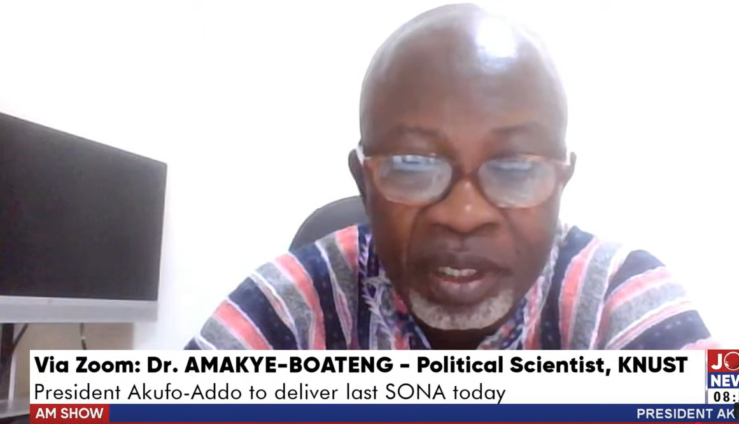
A political scientist at the Kwame Nkrumah University of Science and Technology (KNUST), Dr Amakye -Boateng has criticised the outgoing government for its failure to effectively implement decentralisation policies.
Speaking on the AM Show on JoyNews, Dr Boateng emphasised the need for significant reforms to empower local governance structures and improve grassroots development.
Dr Boateng highlighted past promises to allow the election of Metropolitan, Municipal, and District Chief Executives (MCEs and DCEs), which he said were poorly executed. “There was a call for MCEs and DCEs to be elected, and while the government attempted to address it, they included elements that were offensive to Ghanaians," he said.
He pointed out that the government’s failure to empower municipal and district areas has left decentralisation as an idle concept. “Municipalities and districts should have been granted the autonomy to manage their budgets and undertake development projects independently. Instead, the central government continues to make decisions that are simply implemented at the local level. This is not true decentralisation, it’s decentralisation in name only,” Dr Boateng asserted.
To deal with these shortcomings, Dr Boateng proposed that the incoming government allow local government officials to be elected on a non-partisan basis. “We need to break away from partisan politics in electing officers at the municipal and district levels. Individuals should contest based on merit and their ability to deliver, not party affiliation. This would foster genuine accountability and development,” he said.
Dr Boateng also expressed cautious optimism about the leadership of President-elect John Mahama, attributing it to his extensive experience in governance. “John Mahama’s unique journey from rising through the ranks of governance to being president, losing an election, and observing from the sidelines offers him a rare opportunity to correct past mistakes and chart a better path for Ghana,” he remarked.
He urged the incoming administration to learn from the shortcomings of the current government and take decisive action to implement effective reforms. “This is an opportune time for the incoming government to deliver meaningful progress and address the longstanding issues of decentralisation,” Dr Boateng concluded.
Latest Stories
-
Sacking Otto Addo was in Ghana’s best interest – Kurt Okraku
2 hours -
Judge temporarily halts construction of Trump’s White House ballroom
3 hours -
Tech giant Oracle makes ‘significant’ job cuts
3 hours -
Iran will play World Cup games in US – Infantino
3 hours -
World Cup risks being ‘stage for repression’ – Amnesty
3 hours -
Barcelona move difficult to turn down – Cucurella
4 hours -
England beaten by Japan in final match before World Cup squad is named
4 hours -
Newcastle not looking to make Howe change at moment – CEO
4 hours -
Italy fail to reach third straight World Cup after penalty shootout loss to Bosnia
4 hours -
Fire at Ashaiman Tulaku brought under control
4 hours -
WFP, UK Govt push for fortified rice in school feeding to tackle child malnutrition
4 hours -
Tottenham Supporters’ Trust says it cannot support De Zerbi appointment
4 hours -
Gyokeres’ late winner fires Potters’ Sweden past Poland to World Cup
5 hours -
SIC MD denies political interference claims, admits SIGA only ‘encouraged’ state entities
5 hours -
Turkey beat Kosovo to reach first World Cup in 24 years
5 hours