

Audio By Carbonatix
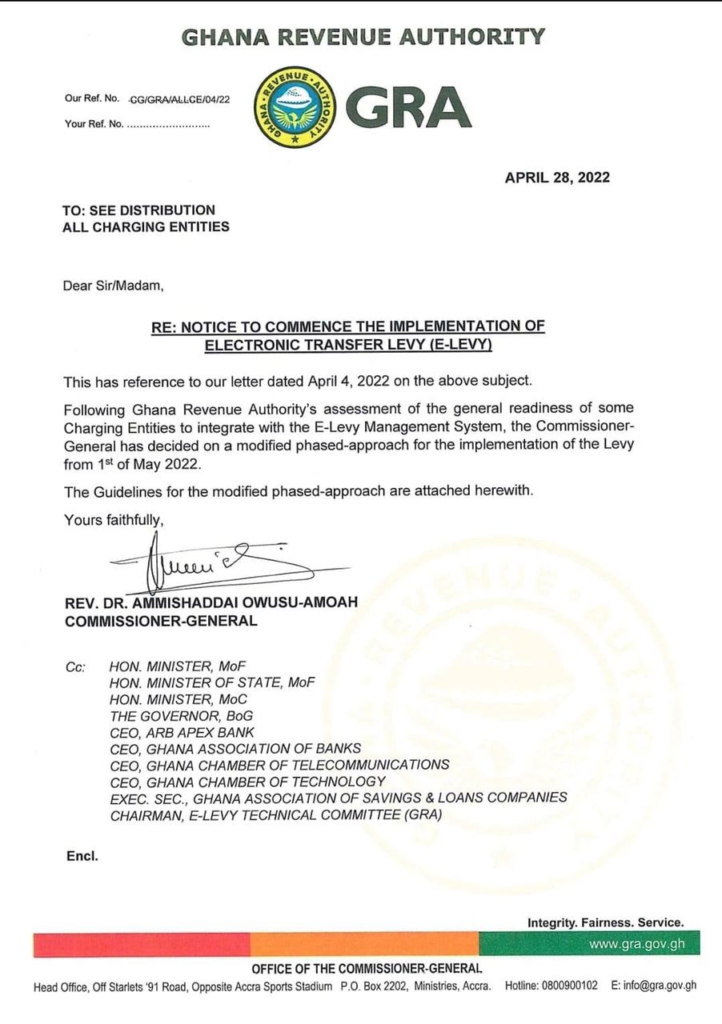
The Ghana Revenue Authority has announced its decision to commence the operationalization of the E-levy from May 1 in a modified-phased approach.
This follows the results of an assessment carried out by the GRA to test the general readiness of some charging entities to integrate with the E-Levy management system.
The new development is a snag in the Authority’s plan to fully implement the E-levy by May 1.
Earlier this week, Ningo-Prampram MP, Sam George Nartey, had stated that the Authority was not ready to implement the Electronic Transaction Levy (E-levy) despite it saying otherwise.
According to him, processes that will ensure the effective run of the controversial tax have still not been completed.
The Ningo-Prampram MP noted that, as it stands, the Application Programming Interface (API) and the security architecture have not been made available to the telecommunications companies (Telcos).
“I can speak on authority that as at close of day as late as 11 pm last night (Wednesday), when the Commissioner-General for the GRA says all the APIs have been given to all Electronic Money Issuers (EMI) is incorrect. At least two APIs are still outstanding,” he said.
“Critical amongst the two is the reversal API. The GRA at the last technical meeting admitted that because all the robustness tests have not been done for the system, there’s a possibility of downtimes where when you place a call to the API to do all the checks before a tax is applied or not applied, and it’s possible that you will not get the checks done in real-time.
He explained that GRA has decided that when such a situation arises “go ahead and apply the tax, even though that transaction is exempt, and then subsequently when the system comes back online we would do a reconciliation and then do the reversal of the 1.5 that was charged.”
He stated that this is likely to create problems, including the likelihood of sparking confusion at Mobile money vending points.
“The communication has gone out there that these category of persons are exempt [and] with instances like this, momo agents will be attacked because consumers will accuse them of trying to steal their 1.5 of the money sent. So you’re exposing the momo agent to possible agent because of a lack of proper communication, ” he said.
He also stated that this also indicates that the implementers are not ready to do any reversal in such instances.
“You have not given any timeline for this reconciliation. So no one knows when the reversal will be done. And critical amongst all is that the APIs that will allow the EMIs and the PSPs to do the reversal has not been given to them. This indicates that the government is not ready to do any reversal for wrong transactions,” he said.
Latest Stories
-
Stakeholders demand action against foreign-led illegal mining in Ahafo Region
1 hour -
Ghana handed tricky draw at 2026 Amputee World Cup
1 hour -
2024 Nyankpala election violence: Youth group petitions authorities over slow probe
1 hour -
Ghana, UNICEF strengthen partnership to advance child protection
2 hours -
Day Two of 3rd Republic Bank-JoyNews Habitat Fair ends with great homeownership offers and financing solutions
2 hours -
Guinness Ghana DJ Awards 2026 Pub Fest celebrates Ghana’s DJ culture as Accra turns up the energy
2 hours -
10th woman found dead in South Africa’s string of killings
2 hours -
French Embassy trains Ghana Police CTU in counter-terrorism operations
3 hours -
UPSA uncovers mass results manipulation involving 178 students, over 500 results compromised
3 hours -
ECG announces planned power outages in parts of Tema from Sept. 29 to October 1
4 hours -
Sylvester Mensah urges Latenu FM to promote trade, export opportunities in Ga
4 hours -
Ga language under threat of decline as children shy away from speaking it – Sylvester Mensah
4 hours -
‘Let every Ga child you raise know the Ga language and story’ – Sylvester Mensah
4 hours -
‘We are not deterred’ – Ablakwa responds to backlash over South Africa evacuation
4 hours -
Day Two: Republic Bank-JoyNews Habitat Fair gains momentum at Junction Mall
5 hours