


Audio By Carbonatix
The Chair of the Research Committee of Tesah Capital, Professor Elikplimi Komla Agbloyor is calling for property tax payment to be embedded into electricity bills, rather than relying on courts or inspectors.
According to him, this is one of the most efficient methods to boost property tax collections.
He disclosed this in an article dubbed “Changing the Narrative: From Persistent Fiscal Deficits to Fiscal Surpluses Part II: Property Taxes”.
He explained that electricity already has near-universal coverage and established enforcement mechanisms, highlighting that ultimately, property owners are responsible for electricity accounts, even when tenants occupy the property.
Under this system, Professor Agbloyor, who is also a Professor of Finance and Risk Management Department of Finance, University of Ghana Business School, said the property tax component is added to the electricity bill, payments are automatically split between Electricity Company of Ghana (ECG) and tax accounts as well as revenue is apportioned between central government and Metropolitan, Municipal, Department and Agencies (MMDAs). “This transforms property tax from a legal enforcement problem into a routine billing process”.
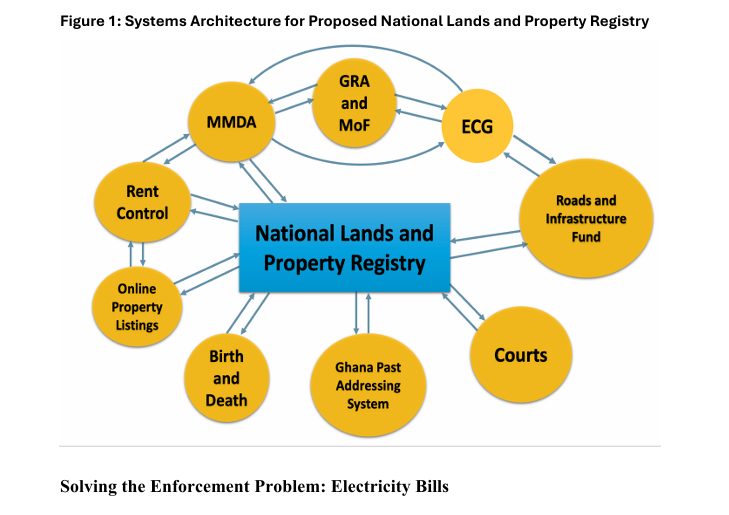
“If we fix the number of properties and rental rates, the compliance rate and the efficiency of collection by ECG or any other means of collection becomes critical. I’m aware of the operational inefficiencies of ECG which can directly impact the realised property tax revenues. Consequently, improving the operational efficiency of ECG is critical. Fortunately, the various stakeholders have a direct interest in ECG operating efficiently and could consequently push for more efficiency at ECG which benefits the entire country”, he added.
Sharing Revenue and Restoring Trust
To align incentives, Professor Agbloyor said property tax revenue should be shared.
These are 60% to MMDAs and 40% to central government.
According to him, the central government’s share should be ring-fenced into a Roads and Infrastructure Fund.
“One reason citizens resist taxes is the perception that revenues disappear into general budgets and that the funds may be siphoned away by corrupt politicians. Visible earmarking for roads and local infrastructure can help rebuild trust in the fiscal social contract”, he mentioned.
Using conservative assumptions, he pointed out that baseline estimates suggest annual property tax revenue of approximately GH¢14.5 billion.
“Region-level estimates based on the number of housing units and conservative rental benchmarks show that Greater Accra and Ashanti dominate, as expected, but every region contributes meaningfully.”, he added.
Latest Stories
-
We can tackle multiple priorities – Sam George defends Anti-LGBTQ Bill push
32 minutes -
Statement: Ghana Chamber of Mines’ Response to Claims in Joe Jackson’s “Ananse Stories about the Economy of Ghana”
33 minutes -
GES opens 2026 teacher recruitment for licensed B.Ed graduates
35 minutes -
Ghana must value skilled trades, build resilient learners — Ibn Chambas
43 minutes -
Ghana must rethink education around relevance, resilience and responsibility — Ibn Chambas
46 minutes -
Prince Harry faces defamation lawsuit from charity he co-founded
48 minutes -
South Korea deploys thermal cameras to track escaped zoo wolf
50 minutes -
Calls for royal meeting with Epstein survivors grow ahead of US visit
53 minutes -
Ibn Chambas advocates blend of technology and human values in education
55 minutes -
UMA improves healthcare access in Asutifi North with GH₵700k ‘Kim Taylor Legacy’ Walkway
60 minutes -
Scholarships Authority and Fanaka University offer sponsorship for procurement and supply chain studies
1 hour -
Bisa Kdei drops new single ‘Go N Look’ featuring Medikal
1 hour -
Benin facing rising terrorism in north as French military presence faces growing criticism
1 hour -
UEW Public Lecture Series 2026: Education debate ‘about the soul of Ghana’s future’ — Dr Ibn Chambas
1 hour -
EU fingerprint and photo travel rules come into force from today
2 hours