

Audio By Carbonatix
It was rolled out with fanfare — hailed as Ghana’s bold answer to rising carbon emissions. But barely a year later, the Emissions Levy is gone. Repealed quietly. Almost unnoticed. And now, new research suggests it may never have worked at all.
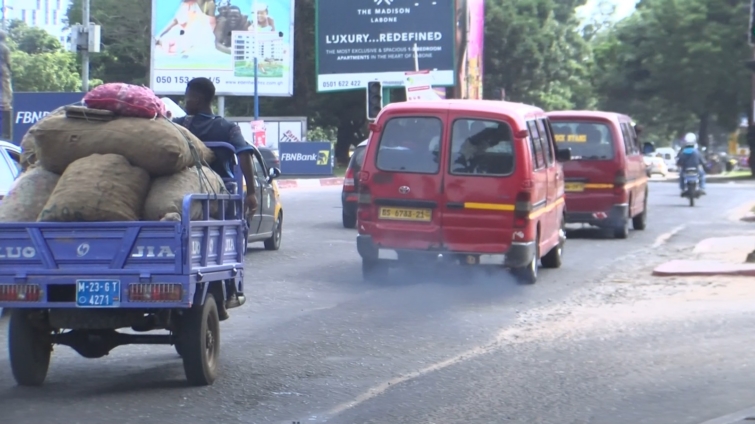
Each year, at least 32,000 Ghanaians die from exposure to fine particulate matter, according to the Health Effects Institute. The deadliest sources of this pollution remain stubbornly familiar: vehicle exhaust and open burning.
By 2018, Accra’s central business district alone was emitting more than four million tonnes of carbon dioxide — far beyond what city planners had anticipated.
Alex Johnson, Director of Transport at the Accra Metropolitan Assembly, says the scale of emissions came as a shock.
“In 2018, when we first launched our climate action plan, the projection was to achieve a reduction that sees emission levels at about 4 million metric tons in 2035. But by 2021, when Google, Environmental Insights Explorer made some of these data resources available, we realized that we were already clocking 4 million metric tons of emissions within a certain sector of the Accra space, especially towards the CBD.” – Alex Johnson, Director of Transport at the Accra Metropolitan Assembly.
Associate Professor of Environmental Health Sciences at the University of Massachusetts, Amherst, Dr. Raphael Arku said the warning signs were already clear.
“We have discovered that there are about 4 to 6 major sources that are polluting the air in Accra. It includes traffic, waste burning, gas particles, and even construction, among other things, contributing. Even sea salt, because Accra is along the ocean.”
Government’s response was the Emissions Levy
Passed in December 2023 and implemented in February 2024, the levy imposed annual charges of GH₵ 75 to GH₵300 on petrol and diesel vehicles, depending on engine size. Officials said it would cut emissions and fund environmental action.
But skepticism followed almost immediately. Drivers questioned its purpose.
“The government could have engaged the ordinary drivers on this as well,” a driver said. A passenger also said that “we as passengers have little to say on this issue because we have no choice.”
From lawmakers in Parliament, especially the minority.
“They have signed on to an IMF conditionality which compels government to raise the threshold of the revenue as a percentage of GDP to a certain level and so they are looking at every means to tax the people of Ghana” – John Jinapor (who at the time was a member of the Finance Committee in Parliament).
And even from clean air advocates, who questioned the levy’s real intention.
“If you want to use the emissions levy as a tool to reduce pollution, the way you target it is different. What I think we were trying to introduce in Ghana, in my humble opinion, and this is my personal opinion, I thought was more of a revenue generation tool.” – Desmond Appiah.
Many argued that the levy — though framed as an environmental measure — functioned more as a revenue pipeline than a true deterrent to pollution.
So when Parliament repealed the levy in 2025, it came as little surprise. What did surprise many, however, was what the data revealed next.
Atmospheric scientist at Columbia University, Dr. Daniel Westervelt, who has spent years tracking Ghana’s pollution trends, set out to measure the levy’s real impact during the single year it was in force.
His findings were blunt.
“We didn't find a whole lot of specific policies that were targeting air pollution, but we did find things like this emissions levy, which wasn't maybe designed purely to tackle air pollution, but had it as one of the possible co-benefits,” Dr Westervelt said.
Using satellite data and ground-level sensors, Westervelt found the levy delivered almost nothing. Transport-related pollution remained virtually unchanged — with no measurable drop in fine particulate matter, even outside the harmattan season.
“We do have what we're calling the Gridded Africa Surface Pollution Dataset, or GRASP for short. And it also goes back all the way to the year 2005 up to the end of 2024. We compared February 2024 through the rest of 2024 to previous years. So we compared February 2024 to February 2023 to February 2022 to February 2021, etc.
"That way, you can sort of control for the fact that there are seasonal changes in the PM 2.5. The other thing that we did is we looked at it in different months. So it's not just February. It's all the months of the year.
"So we looked at, for example, June of 2024 and compared that to June of 2023, 21, 22, etc. So we were able to actually look at non-harmattan periods as well to see if there were any changes that would be completely independent of the harmattan. And even in those cases, there weren't any statistically significant changes in PM 2.5 that could be attributed just to the emissions levy.”
Over the period, vehicle numbers continued to rise, fuel consumption did not slow, and no behavioural shifts were recorded among drivers.
On the streets of Accra, some drivers told JoyNews the levy never changed how they drove, serviced their engines, or thought about pollution.
“There was no need for the levy. The smoke is nothing,” one driver said.
“Government should give our money back,” another added.
“You see somebody’s exhaust fumes, the way the smoke is coming out, you yourself, you will not like” – another driver at the Circle bus terminal said.
“How can you say that you are collecting air pollution tax? How? No!,” another driver said.
Meanwhile, research shows tailpipe emissions in Accra have remained largely unchanged for nearly two decades, according to Dr. Raphael Arku, Associate Professor of Environmental Health Sciences at the University of Massachusetts, Amherst.
“What we have found is that the proportion that is coming from traffic remains the same. It hasn't changed over the last 20 years. So, how much traffic is contributing to air pollution in Accra has remained stable.”
Fresh research from PSS Urbania, led by Dr. Joseph Ayitio, is now helping to map pollution hotspots across parts of Accra — revealing where exposure is highest.
“Across the 30 MMDAs, the very common causes of pollution, which I'm sure would not be shocking to you, had to do with transportation, which was a major contributor to the kind of quality, poor quality that is emitted, that contributes to poor air quality. And then burning of firewood and open burning of rubbish was another major activity that was identified across most of the local authorities. Across the 52 sites, most sites had levels below the EPA and then the World Health Organization levels, except four major sites. And these were Ayawaso- North, South and Lada Dadekotopon Municipality.” – Dr. Joseph Ayitio.
Researchers insist the solution is still within reach — but only if Ghana targets the real sources.
“Those responsible can target these two sources: traffic, biomass burning and then waste burning. When we do that, we can cut down air pollution levels by 50% or even more than 50% in Accra,” said Dr Arku.
“So certain African countries have put into place, you know, restrictions on how old and sort of polluting the vehicle that you can import from Europe or the US or Canada or, you know, another wealthy country.
"They've put some restrictions on that to help, you know, reduce the local pollution from these sorts of dirty old cars. Other things would be, you know, enhancing the level of public transportation. This would mean buses, trains, even things like bicycles and electric scooters and all those kinds of things. Those are sort of the new emerging frontier of clean travel.
"And then the last thing that I would say really has nothing to do with vehicles, but cleaner cooking fuels. And the challenge with the cleaner cooking fuels is they have to be affordable. As I was kind of mentioning earlier, folks that are cooking with wood or charcoal are doing so because it's cheap.” – Dr. Daniel Westervelt
The repeal of the Emissions Levy ends a chapter — but not the crisis.
Clean-air advocates say a new conversation must begin: not about taxing emissions, but about actually reducing them.
This story was a collaboration with New Narratives. Funding was provided by the Clean Air Fund, which had no say in the story’s content.
Latest Stories
-
After more than 14 years at Atletico Madrid, what next for Simeone?
2 hours -
Conquering the World – Building on the foundations laid by Otto Addo
2 hours -
[Watch Live] Kwaw Kese, Kwami Eugene, Tinny, Keche and others thrill fans at Gomoa Easter Carnival
2 hours -
Gomoa Easter Carnival: Experts charge indigenes to own festival to ensure sustainability
4 hours -
Gomoa Easter Carnival: Edem Agbana and Joy Prime fans shower festival with huge endorsements
5 hours -
Gov’t to overhaul free zones into manufacturing hubs for local production – Trade Minister
6 hours -
Ghana losing $2.5bn yearly from raw exports – Trade Minister reveals
6 hours -
Mahama unveils plans for Kwahu Airport, Convention Centre
6 hours -
World’s oldest leader, Paul Biya to get a deputy for first time in 43-year rule
6 hours -
Search for missing US airman continues as Trump threatens ‘hell’ if Iran does not reach deal
6 hours -
US says it has arrested relatives of late Iranian general Qasem Soleimani
6 hours -
La Liga: Real Madrid’s title hopes hang in the balance as Mallorca snatch stoppage-time winner
7 hours -
FA Cup: Haaland hat-trick powers Man City past Liverpool into semi-finals
7 hours -
FA Cup: Chelsea thrash Port Vale to reach Wembley semi-final
7 hours -
Gov’t to boost tourism in coastal communities through infrastructure, sanitation – Vice President
7 hours