

Audio By Carbonatix
At Kwame Nkrumah University of Science and Technology (KNUST), the College of Engineering is known for rigor. Yet, within that demanding environment, some students distinguish themselves not only through academic performance, but through leadership, initiative, and a willingness to apply engineering principles to real-world problems.
One such individual is Felix Koku Seyram Adabla, a graduate of KNUST’s Department of Electrical and Electronic Engineering.
Between 2015 and 2019, Felix Adabla pursued a B.Sc. in Electrical and Electronic Engineering, graduating with First Class Honors. Over the course of his undergraduate studies, he received the Excellent Student Award in the College of Engineering, securing his spot in the Dean's list, for two consecutive academic years, a recognition reserved for students demonstrating sustained academic excellence.

Beyond grades, Felix Adabla’s time at KNUST was marked by consistent leadership and service within the engineering community. He served as a Tutor under the Academic Committee, where he supported junior students in foundational engineering subjects such as basic mechanics.
In addition, he held the position of Deputy Chairman of the Engineering Volunteering Committee, contributing to the coordination of student-led initiatives aimed at professional development and community engagement.
These roles reflected a broader pattern: Felix Adabla was repeatedly entrusted with responsibilities that required organization, mentorship, and accountability—qualities that extended into his most defining undergraduate undertaking.
Leading an Engineering Solution with Local Materials
In his final year, Felix Adabla was selected as Group Leader for a four-member engineering team tasked with delivering a capstone project that combined theory, design, and implementation.
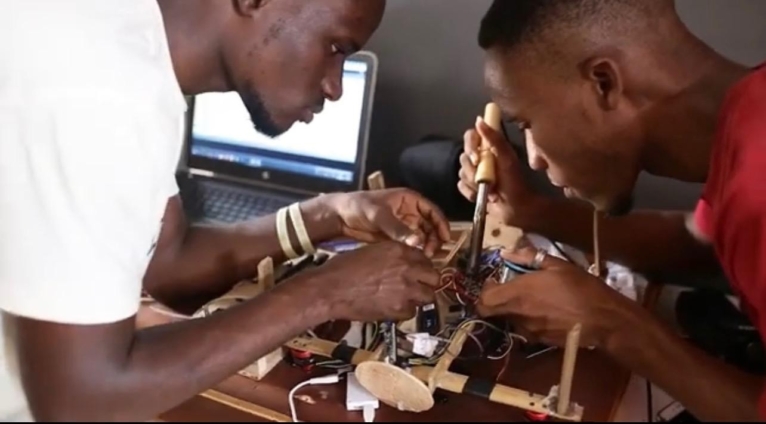
Alongside Emmanuel Ortsin, Derrick Agbenya, and Conrad Codjoe, he led the conceptualization and development of a bamboo-structured unmanned aerial vehicle (UAV) intended to supplement agricultural health monitoring for local farmers.
The project challenged conventional approaches to drone design by prioritizing affordability, accessibility, and the use of locally available materials.
Under faculty supervision within the Department of Electrical and Electronic Engineering, the team explored how bamboo; commonly viewed as unsuitable for precision engineering, could be adapted into a functional aerial platform.
As group leader, Felix Adabla coordinated system architecture, electrical integration, testing, and iterative refinement. The work required balancing aerodynamics, control systems, power electronics, and material constraints, while ensuring that the final prototype remained viable in low-resource settings.
Video documentation of the project shows the drone in its implementation stage through to its operation, demonstrating successful flight tests and system stability despite the unconventional structural materials.
The bamboo drone project earned recognition within academic circles at KNUST as an example of applied engineering ingenuity. It also reinforced Felix Adabla’s reputation as a student capable of translating engineering theory into functional systems.
Recognition and Transition
At KNUST’s 2019 graduation ceremony, Felix Adabla’s academic achievements and leadership were publicly acknowledged, drawing notable acclaim from peers and faculty.
The moment marked the culmination of an undergraduate journey defined not by isolated success, but by sustained contribution across academics, leadership, and innovation.
Looking back, Felix Adabla’s undergraduate years reveal a clear pattern: consistent academic excellence, repeated selection for leadership roles, and early engagement with engineering problems of societal relevance. These foundations would later inform his transition into advanced research and professional engineering practice beyond the university.
Latest Stories
-
President Mahama is not sincere with Ghanaians on LGBTQ bill matter – Hassan Tampuli
9 minutes -
Gov’t to establish Prison Industrial Hub to equip inmates with income-generating skills – Prison Service boss
28 minutes -
Alhassan Tampuli donates cement, roofing sheets to support storm victims in Gushegu
29 minutes -
Alhassan Tampuli appeals for urgent support for storm victims in Gushegu
31 minutes -
The hypocrisy must stop; pass Anti-LGBTQ+ Bill now – Alhassan Tampuli to Mahama
35 minutes -
Imprisonment should be rehabilitative, not punitive – Ghana Prisons boss at UNGA
57 minutes -
Ga Adangbe traditional priests petition Mahama over McDan aviation licence revocation
1 hour -
Anti-LGBTQ Bill: NDC’s arrogance is worrying – Hassan Tampuli
1 hour -
Let’s give OSP time to mature, not to scrap it – Hassan Tampuli
1 hour -
Nigeria convicts 386 Islamist militants in mass trials
1 hour -
Djibouti president wins election with 97.8% of vote, state media says
2 hours -
We don’t have mandate to deduct tax from rent allowance of security services personnel – Interior Ministry clarifies
2 hours -
Ablakwa receives Presidential Special Envoy on Reparations to advance global agenda
2 hours -
Christina Koch becomes first woman to travel around the moon on Artemis II
2 hours -
Epstein survivors’ calls to meet King Charles and Queen harder to ignore as US visit approaches
2 hours