

Audio By Carbonatix
The rain had been falling for hours.
By nightfall on June 3, 2015, parts of Accra had become unrecognisable. Water surged through streets and neighbourhoods, swallowing cars, homes, and businesses.
At the Kwame Nkrumah Circle interchange, hundreds of people sought refuge from the floodwaters at a nearby GOIL filling station. They simply needed shelter from the relentless downpour.
Then disaster struck.
An explosion ripped through the station, turning a night of flooding into one of the deadliest urban tragedies in Ghana’s history. By the time the waters receded and the fires died down, hundreds of lives had been lost.
In the aftermath, Ghanaians searched for answers.
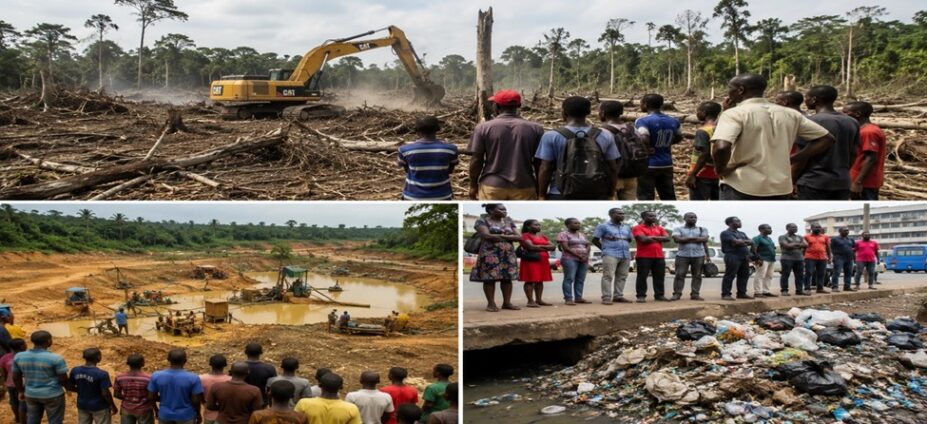
Many pointed to the clogged drains that had long obstructed the city’s waterways. Others blamed poor planning, uncontrolled development, weak enforcement of building regulations, and years of indiscriminate waste disposal. None of these problems were new. Environmental experts had warned about them. City authorities knew about them. Residents saw them every day in gutters filled with plastic waste and drains choked with debris.
Everyone could see the danger.
Nobody seemed responsible for stopping it.
Ten years later, many of the underlying questions remain unresolved. Every rainy season brings renewed warnings about blocked drains, unregulated development, and poor waste management. Every rainy season also brings a familiar expectation that someone else will fix them.
Ghana’s greatest challenges are often discussed in terms of weak institutions, inadequate enforcement, corruption, and political interference. While these factors undoubtedly matter, there is another, less visible force that frequently allows problems to persist: collective silence.
Psychologists call it the “bystander effect”, a phenomenon in which individuals are less likely to intervene when others are present. The assumption is simple: someone else will act. Someone else will speak. Someone else will take responsibility. Ironically, when everyone thinks this way, nobody does.
The concept emerged from studies showing that people often fail to respond to emergencies when they believe others are also witnessing the situation. Responsibility becomes diluted. Action becomes delayed. Problems become normalised. What begins as individual hesitation can evolve into collective inaction.
Of course, the bystander effect alone cannot explain Ghana’s development challenges. Flooding, sanitation, corruption, and environmental degradation are rooted in complex political, economic, and institutional realities. Citizens do not always fail to act because they are indifferent. Sometimes they lack the resources, authority, or confidence that their actions will make a difference.
Yet the concept offers a useful lens through which to understand how responsibility can become diffused across citizens, agencies, communities, and leaders until everyone assumes that someone else will act first.
The recurring flooding in Accra illustrates this dynamic. Residents are criticised for dumping waste into drains. Local assemblies struggle to enforce sanitation bylaws. Developers encroach on waterways. Regulatory agencies issue warnings. Environmental experts publish reports. Politicians promise solutions. Each actor identifies the problem. Each actor acknowledges the risks.
Yet meaningful action often remains elusive.
The result is a cycle that feels painfully familiar. Drains remain clogged. Floodwaters return. Properties are damaged. Lives are disrupted. Public outrage surges for a few days before fading once the waters recede.
In these situations, silence becomes an accomplice.
Citizens frequently complain about poor sanitation, unsafe roads, flooding, corruption, and deteriorating public services. Yet participation in local governance meetings remains low. Reporting mechanisms are underutilised. Community engagement is often limited to conversations on social media. Many people expect solutions to emerge from government alone while overlooking their own role in demanding accountability.
Democracy, however, is not designed to function through spectatorship.
A healthy democracy requires active citizens who understand that responsibility cannot always be outsourced. When citizens disengage, accountability weakens. When communities remain silent, institutions become less responsive. When wrongdoing is tolerated because intervention is perceived as someone else’s duty, the public interest suffers.
Ghana’s development trajectory depends not only on stronger laws and better enforcement but also on cultivating a sense of shared responsibility. Citizens must be willing to report wrongdoing. Public servants must be prepared to challenge unethical conduct. Community leaders must speak when public resources are threatened. Journalists must continue to investigate difficult truths. Civil society organisations must persist in amplifying concerns that others may prefer to ignore.
History repeatedly shows that major societal problems rarely emerge overnight. They grow gradually in environments where warning signs are visible but action is absent.
The forests do not disappear in a day. Corruption does not become entrenched overnight. Public trust does not collapse instantly. Flood disasters do not emerge from a single blocked drain. These outcomes are often the cumulative product of countless moments when individuals, institutions, and leaders choose not to act because they believe someone else will.
Perhaps the most important lesson from the bystander effect is that responsibility cannot be endlessly deferred. Every society reaches a point where waiting for others to intervene becomes part of the problem itself.
For Ghana, that lesson may be more relevant today than ever.
The question is no longer whether someone should act.
The question is whether we are willing to recognise that the “someone” may be us.
Latest Stories
-
Schizophrenia-related disorders lead mental health cases recorded in Ghana
18 minutes -
Dutch authorities enlist Ghana in hunt for fugitive drug lord Bolle Jos
41 minutes -
Ghana housing finance conference adopts communiqué to improve affordable housing access
5 hours -
Special Initiatives Minister urges Wa Technical Institute to enrol more girls as EU-backed solar training lab opens
6 hours -
In the matter of my first year at the Bar
6 hours -
ActionAid Ghana calls for an end to child marriage, greater investment in girls’ rights
6 hours -
Newsfile to tackle World Cup visa scandal, beach demolitions, education strikes, BRICS bid
6 hours -
UK-Ghana Trade & Investment Summit: Trade Resource Centre to help businesses maximise UK-Ghana trade opportunities
6 hours -
Embassy of Denmark celebrates World Maritime Day
7 hours -
Linking LEAP to productive inclusion could cut extreme poverty by 2030 – UNICEF
8 hours -
Trade Ministry backs use of creative arts to rehabilitate prison inmates
8 hours -
Negotiations with government to continue despite strike suspension – GNAT
8 hours -
‘Ghana cannot afford to waste public resources; every cedi has a job’ – Ato Forson
8 hours -
Ghana expects economic boost as World Assemblies of God Congress brings 10,000 delegates to Accra
8 hours -
Joy in Nayilifong as Farouk Aliu Mahama donates 100kVA transformer to improve power supply
8 hours