

Audio By Carbonatix
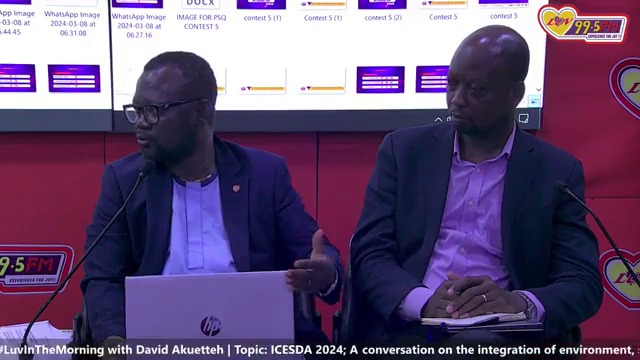
Executive Director for the Centre for Business Incubation, Dr Christian Sewordor Mensah, has observed a low enthusiasm in Ghana’s quest to militate against actions that degrade the environment, bringing about a climate crisis.
According to him, the country’s failure to take drastic measures to achieve the 17 Sustainable Development Goals by 2030 could plunge the economy into food insecurity.
Speaking on Luv FM, Dr Mensah emphasised that collective focus and consideration are needed to take proactive measures for environmental progress.
"If we don't take bold and intentional steps to confront the issues that have been identified and categorised as global challenges, we will soon find ourselves without any food to eat due to the adverse effects of the environment," he said.
He observed environmental challenges, such as illegal mining and destruction of wetlands, pose threats to human existence.
“The society could be drained and ultimately face extinction and encounter challenges that can't be quickly resolved, potentially leading to our demise,” he said.
Dr Mensah made the submission ahead of a three-day international conference that would gather stakeholders in academia and industry to delve into pressing matters about the environment and sustainable development in Africa.
The event dubbed ICESDA2024 is on the theme, “Enhancing Environment, Social, Governance and Sustainability for Africa’s Development.”
The maiden edition would see deliberations and recommended solutions to address environmental and climate challenges in Ghana and on the African continent.
Professor De-graft Owusu Manu of the KNUST says the country's attitude and perception in finding pragmatic solutions to tackle environment and climate destruction are not good enough.
“The recent Akosombo water spillage and the illegal mining menace is affecting us badly. We need solutions to solve these problems. If we don’t take action. There’s going to be problems for our future,” he said.
Advocating for a more robust system to fight the climate menace, the Conference Manager for ICESDA2024, Dr Appiah Kenneth, acknowledged that despite the existence of sanitation and environmental laws, their implementations are faced with setbacks.
“There are laws regarding sanitation, but the real issue lies in the enforcement. Enforcing these regulations requires adequate resources because it is not as simple as just implementing laws. We need to provide the necessary resources to empower those responsible for enforcing such laws,” he said.
Latest Stories
-
Prosecutors seek Tiger Woods’ prescription drug records after Florida arrest
13 minutes -
Five persons arrested for robbing Chinese nationals at Asankragwa
5 hours -
I don’t have evidence of leakage report on fuel contamination – Witness
5 hours -
Netherlands Fire Chief in Ghana to support fire safety reforms and market fire prevention efforts
5 hours -
Mason goes on remand for stealing
5 hours -
Gov’t cuts fuel taxes, deploys buses to curb impact of rising fuel prices
6 hours -
Interior Minister calls for intelligence-driven strategy as Ghana strengthens counter-terrorism efforts
6 hours -
Adenta Circuit Court remands Pastor William Gyimah over viral threats against Vice President
7 hours -
“We’ve implemented changes to prevent a repeat of the AFCON final” – CAF President Motsepe
7 hours -
Gov’t orders deployment of Metro Mass buses to cushion commuters amid fuel price hike
8 hours -
Key Indian state polls begin in test for Modi’s party
8 hours -
Playback: Gomoa Easter Carnival in photos
8 hours -
Gov’t orders removal of fuel taxes to ease pump price hikes
8 hours -
“Whatever the decision of CAS, we will respect it” – CAF President Motsepe after AFCON final meetings in Morocco
8 hours -
Emma Ankrah: When waiting becomes part of treatment – Reflections on hospital care
8 hours