

Audio By Carbonatix
In light of the ongoing global refugee crisis and its implications on refugee education, some refugee and education experts, speaking on the EdTech Monday segment of The Citi Breakfast Show, have recommended the introduction and use of further Edtech solutions to ensure continuous and quality education for displaced youth in Ghana.
They were speaking on the topic of “Using Ed-Tech To Drive Learning For Displaced Youth” during this month's episode of EdTech Monday, a platform to facilitate critical conversation on the use of technology for teaching and learning, an initiative of the Mastercard Foundation in partnership with MEST Africa.
According to a UNHCR report, only 68% of refugees are enrolled in primary school, 34% are in secondary education institutions, and only 5% are in tertiary education.
In Africa, millions of refugee students are struggling to catch up with their education which often happens under extremely tough conditions.
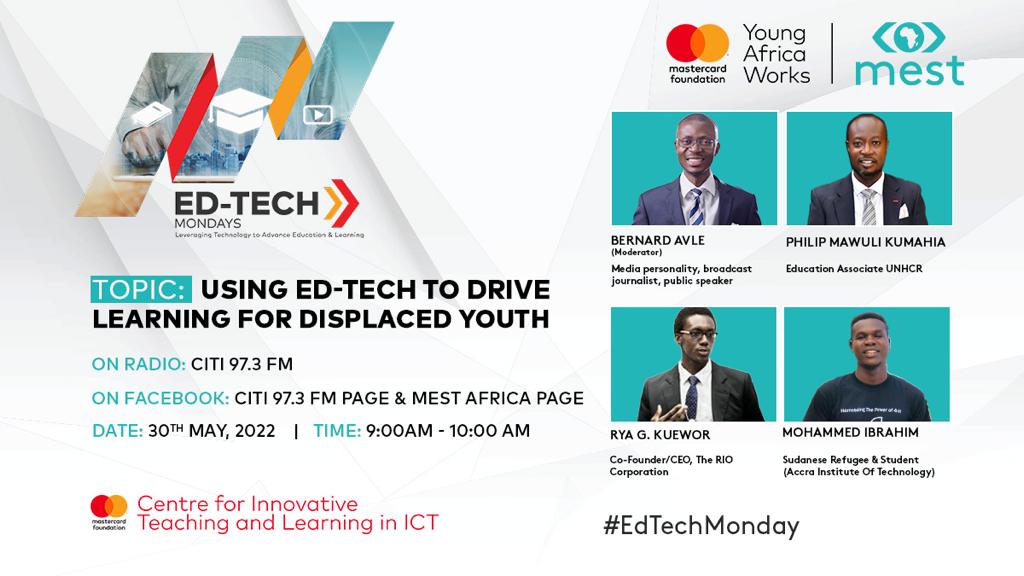
As a solution to this, refugee integration expert, Rya G. Kuewor, has recommended the use of existing edtech platforms such as Coursera, EdX, the UN Refugee Program and other refugee-centered programs and scholarships which have great content from leading Universities and are also flexible for learners.
“We could be leveraging these existing programs and platforms. Over a hundred thousand refugees have taken these courses and they are available on every continent including Africa. We will save a lot of time and effort if we invest in primary technology like mobile phones, internet connection, and computers for refugees, and computer labs for refugee camps, while partnering with these existing platforms like Coursera, EDx, and so on to deliver these courses that allow learners to learn at their own pace instead of having to go 3km to attend school as a child”, said Rya Kuewor.
Philip Mawuli Kumahia, an Education Associate with the United Nations High Commission for Refugees (UNHCR), shared the efforts of the UNHCR in using technology to enhance learning in refugee camps in Ghana.
"When it comes to edtech, in 2017, we provided e-readers to children in the camp schools as well as the host community schools for them to have access to reading. We recognized the fact that edtech solutions are the way. So we have built ICT centers in the camps so that refugees can have access to online learning. All they need is to have access to the internet and computers", said Kumahia.Sharing his own life experience as a refugee in Ghana, 25-year-old Sudanese refugee, Adbul Raman Ibrahim Mohammed, disclosed that his educational journey has not been easy.
When he relocated to Ghana in 2005 at the age of 9, he had to restart at kindergarten because of the language barrier, even though he was originally in class five(5). He is currently studying ICT at the Accra Institute of Technology.
According to him, but for his perseverance, help from the UNHCR, and other benevolent organizations and individuals, his pursuit of higher education would have been a mirage. He urged them to do more to ensure equal educational opportunities across refugee camps in Ghana.
"We heard that there would be a structure built and there will be internet facilities available here, but up till now we don’t see these. Most of the things are not available, especially the technology gadgets like the computers and certain devices that are used to access the internet", Ibrahim Mohammed said.
EdTech Monday is an initiative of the Mastercard Foundation’s Regional Centre for Innovative Teaching and Learning in ICT and part of the Foundation’s strategy to find solutions to Africa’s youth employment by closing the gap in access to quality education, and advancing the integration of technology in education policies and practices across Africa.
To realise this vision in Ghana, the Mastercard Foundation has partnered with MEST Africa, a pan-African technology institution to bring the EdTech Monday show on the last Monday of every month.
Latest Stories
-
CUTS International calls for urgent competition law amid sachet water price hikes
32 minutes -
‘I never did this advert’, AI clones hijack Ghanaian identities for profit
51 minutes -
25-year-old woman battles trauma after surviving deadly Nkwanta attack
1 hour -
Vice President honoured at Tortsogbeza as South Tongu leaders highlight development needs
1 hour -
Kwahu Business Forum 2026: Corporate citizenship, sustaining African businesses take centre stage with KGL as the case study
3 hours -
Trump seeks $152m to reopen notorious Alcatraz prison
5 hours -
Ex-Chelsea player Oscar retires with heart issue
5 hours -
CA Foundation drives constitutional literacy in Kpone Katamanso municipality
5 hours -
GPRTU to hold talks with Transport Ministry over rising fuel costs
5 hours -
CUTS International urges gov’t to halt sachet water price hike pending cost review
5 hours -
Chief Justice: Efficient Judiciary essential to reducing business costs
5 hours -
Bayern grabs 99th-minute winner to cap superb fightback
5 hours -
Ahmed Ibrahim urges Ghanaians to reflect Easter values in nation-building
5 hours -
ECG inefficiencies undermining power supply -Mahama outlines reforms
5 hours -
Lewandowski scores as Barca fight back to defeat Atletico
5 hours