

Audio By Carbonatix
The Africa Sustainable Energy Centre (ASEC) held the 2025 AI for Africa Workshop, where experts highlighted ways Africa could greatly benefit from Artificial Intelligence (AI).
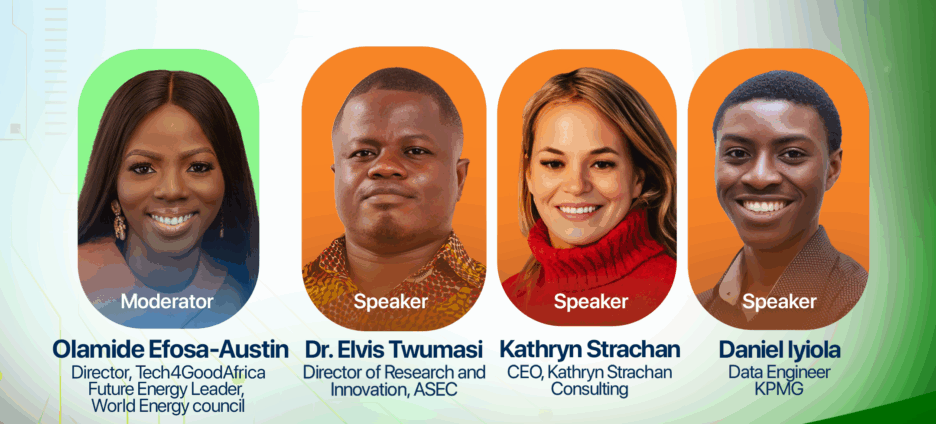
The event, hosted in collaboration with Kathryn Strachan Consulting, brought together ASEC’s Director of Research and Innovation, Dr Elvis Twumasi; Senior Data Engineer at KPMG, Daniel Iyiola; and CEO of Kathryn Strachan Consulting, Kathryn Strachan, to share insights on how the continent could adopt AI to foster growth.
Ms. Strachan, during her presentation, said Africa is uniquely positioned to adopt AI more effectively than the West, which, despite investing billions of dollars, must reconfigure existing systems to integrate the technology.
By contrast, Africa’s lack of infrastructure presents an opportunity to build from a “blank slate” and accelerate AI adoption, she explained.
“One of the things that's going to be needed is the collaboration between private businesses. The U.S. is a very big place, not as big as Africa, but it is a big place that has many different views and religions, and ideologies spread out across a very diverse landscape,” she said.
“So one of the things that we can learn is the coming together of many different people from many different backgrounds to make this possible. Africa is similar in that way, in that many different countries, many different languages, many different views, but one of the challenges that Africa's going to obviously have to overcome is coming together as individual countries, rather than states, to create this infrastructure.”
She added that AI is a “great equaliser” that can level the playing field for African businesses and empower them to compete globally.
On his part, Dr Twumasi urged the continent to leverage its pool of AI-skilled professionals to create opportunities for economic growth, particularly in the informal sector.
He also proposed the creation of AI “sandboxes”, controlled environments where innovators can safely test ideas despite limited infrastructure.
“So, we may not have infrastructure everywhere, but we could develop these sandboxes, which are just controlled areas that could harbour all the new ideas in terms of AI, all the things that we want to do in terms of AI, and all the facilities that are needed,” he said.
“We don't need to build many of them, but a sandbox could resolve some of the issues when it comes to infrastructure challenges in Africa. So, most of the nations in Africa have to look at developing AI sandboxes, as we have for fintech. This will solve our infrastructure challenges if we are to look at that,” he added.
Also speaking at the workshop, Mr. Iyiola highlighted areas in Africa where AI is already being applied, including credit scoring, insurance, and other financial services.
He stressed that for AI expansion to reach other sectors such as agriculture and health, there must be collaboration between governments, regulators, and businesses.
“I know that in Nigeria, for example, there is the AI Collective that is being pushed forth, and the AI strategy that is being pushed out sets that platform for these innovations to grow. So, we need to have the government as an enabler, setting out these policies. We need to have different arms in the chain,” he said.
“The industries, the corporations, the individuals, the SMEs, the small market enterprises, and medium market enterprises, and even the large corporations, and the individuals that are doing this work pull resources together, have some form of collaboration. When bodies are instituted, you can then have this level of collaboration to now bring forth this level of innovation.”
Mr. Iyiola further underscored the need for Africa’s workforce to build new skills such as prompt engineering, data literacy, research, and responsible AI use to navigate the AI-driven economy.
Latest Stories
-
UNIFIL condemns air strikes that injured Ghanaian peacekeepers in Lebanon
8 minutes -
Assembly member shot as armed robbery wave grips Agona East District
32 minutes -
Armed robots take to the battlefield in Ukraine war
1 hour -
AI-generated Iran war videos surge as creators use new tech to cash in
1 hour -
Kufuor calls for intellectual revolution to fix Ghana’s structural cracks
3 hours -
This Saturday on Prime Insight: Experts to tackle Mahama’s land transit ban on rice and ORAL progress
4 hours -
‘Tragic event’: Israeli Ambassador reacts to missile attack on Ghanaian soldiers in Lebanon
4 hours -
Huge US bomber lands at UK air base
4 hours -
Chief Imam urges unity, democratic commitment as Ghana marks 69th Independence Anniversary
5 hours -
Eternal vigilance: Akufo-Addo reflects on the price of liberty on independence day
5 hours -
Introducing Regalia Residence: Accra’s new luxury standard
5 hours -
Emirates restores flights as airspace reopens, moves toward full global operations
5 hours -
Widows’ bodies in exchange for land: A call to the state and traditional authorities
5 hours -
Ghanaian faces 20 years in US prison after $100m global romance scam bust
5 hours -
4 foods to help improve your vision
7 hours