

Audio By Carbonatix
Facebook has blocked Australian users from sharing or viewing news content on the platform, causing much alarm over public access to key information.
Australians woke up on Thursday to find the Facebook pages of all local and global news sites - as well as some key government sites - had been blocked.
The government said the ban threatened the tech giant's "credibility".
Facebook's move is in response to a proposed law in Australia which would make tech giants pay for news content.
Tech giants like Google and Facebook have argued the law doesn't reflect how the internet works, and unfairly "penalises" their platforms.
Those outside of Australia are also unable to read or access any Australian news publications on the platform.
The Australian government has said it is proceeding with the law, which passed parliament's lower house on Wednesday.
"Facebook needs to think very carefully about what this means for its reputation and standing," Communications Minister Paul Fletcher told the ABC.
On Thursday, many Australians were also unable to access the pages of key agencies including police and emergency services, health departments and the Bureau of Meteorology.
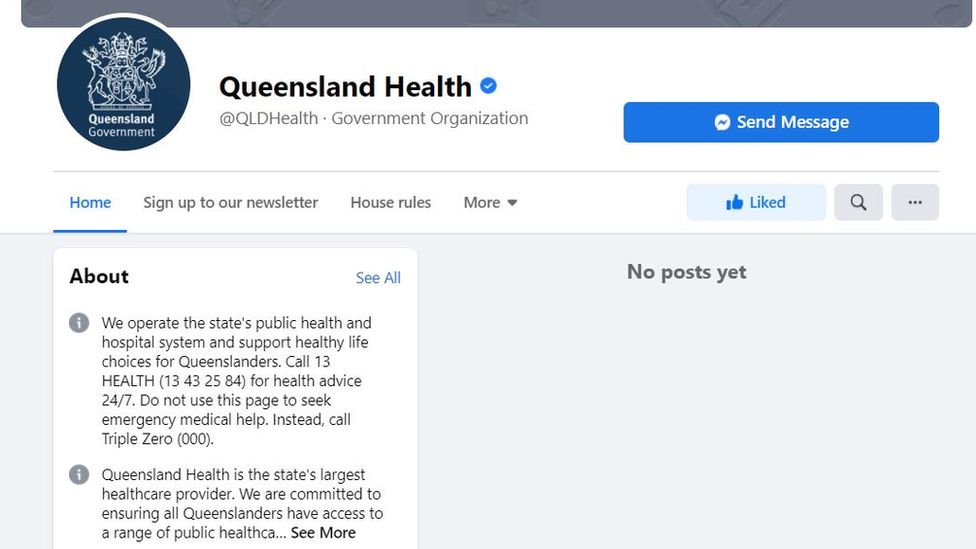
It sparked an immediate backlash, with many Australians angry about their sudden loss of access to trusted and authoritative sources.
"Facebook is acting like an oppressive government, severely restricting and censoring the flow of information to Australians," said Elaine Pearson from Human Rights Watch.
Treasurer Josh Frydenberg tweeted that he had had a "constructive" discussion with Facebook chief executive Mark Zuckerberg on Thursday.
"He raised a few remaining issues with the government's news media bargaining code and we agreed to continue our conversation to try to find a pathway forward," he said.
Facebook's announcement came hours after Google agreed to pay Rupert Murdoch's News Corp for content from news sites across its media empire.
What did Facebook say?
Facebook announced its new policy in a blog post on Wednesday, saying the proposed legislation had left it "facing a stark choice: attempt to comply with a law that ignores the realities of this relationship, or stop allowing news content on our services in Australia".
"With a heavy heart, we are choosing the latter," it said.
Under its new rules, Facebook said Australian users would not be able to read or share news content on the platform, while Australian news publishers would be restricted from sharing or posting any content on Facebook pages.
"Globally, posting and sharing news links from Australian publishers is also restricted," it said.
Australian users immediately reported being unable to see or share news, and the pages of major outlets such as ABC and the Sydney Morning Herald are now showing no posts.
The blog post on Wednesday, by Facebook's Australia and New Zealand managing director William Easton, said the social media company helped Australian publishers earn about AU$407m ($316m; £228m) last year through referrals.
Mr Easton wrote that the proposed legislation "seeks to penalise Facebook for content it didn't take or ask for".
"We hope that in the future the Australian government will recognise the value we already provide and work with us to strengthen, rather than limit, our partnerships with publishers," he said.
The American Economic Liberties Project, a Washington-based anti-monopoly group also criticised the move.
"By censoring Australian publishers to maintain its advertising revenue, Facebook has shown it is a threat to democracies worldwide," research director Matt Stoller said in a statement.

Facebook wants to call the shots

Australia is not a big market for Facebook. And Facebook says news isn't a big driver of revenue for the company. So why does it care so much about this law?
This is far more about the principle. Other countries have been looking at what is happening in Australia. There's speculation that Canada, even the EU could follow Australia's lead - something Facebook wants to avoid.
Facebook does already pay for some news. It's entered into commercial deals with media companies in the UK, for example.
What Facebook wants to do, however, is call the shots.
Its executives do not want governments to step in, telling them they have to pay for news - and even setting the price.
Facebook, then, has decided to show that there are consequences for governments if they want to take muscular action against Big Tech.
But that could backfire spectacularly. That Facebook can essentially switch off Australian news on its platform is already being criticised as anti-democratic - even authoritarian - in some quarters.
Latest Stories
-
Cutting rates while draining liquidity: Is the Bank of Ghana contradicting itself—or getting it right?
4 minutes -
The future of hospital care and ultimately death of people waiting for urgent care in Ghana
5 minutes -
Dame & Partners file professional misconduct petition against police officer
5 minutes -
Declining interest rates and tightening liquidity needed to support gradual economic recovery – US-based Economist
8 minutes -
What is wrong with us? When we desilt drains only for the rain to return the filth
10 minutes -
Graduates with disabilities stage protest over job exclusion
14 minutes -
At Nobi Agriculture, scale and systems redefine the possibilities of farming in Ghana
15 minutes -
Königsdörffer receives late call-up as Inaki Williams and Thomas-Asante withdraw
19 minutes -
Colombian military plane crash kills at least 66
26 minutes -
Sanitation is a major factor in evaluating MMDCEs – Florence Kuukyi
28 minutes -
7 dead from illegal mining at Ntobroso
30 minutes -
EU High Representative to sign first-ever security and defence partnership with African country
32 minutes -
Doctors facing occupational hazards due to no-bed crisis — Dr Asare Offei
37 minutes -
One Constituency, One Ambulance not working effectively due to ‘No-Bed Syndrome’ – Titus Beyuo
40 minutes -
Black Queens recall will boost Milot Pokuaa’s confidence – Mercy Tagoe-Quarcoo
48 minutes