

Audio By Carbonatix
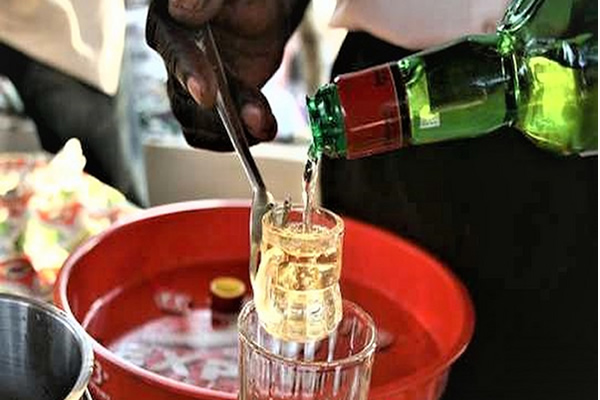
“Akpeteshie” is a locally-brewed alcoholic beverage. In the wake of the COVID-19 pandemic, some Ghanaians have resorted to its use as a hand sanitiser.
Reported shortage of hand sanitisers on the market compels some people to use "akpeteshie’’ undiluted while others use it in home-made hand sanitiser formulations.
How does alcohol work to stop the spread of viruses and bacteria?
It is effective in killing different types of germs, including both viruses and bacteria, because it unfolds and de-activates their proteins.
This can be likened to removing braids, with the inactive proteins as the individual hair strands.
The process, known as “denaturation”, will cripple and often kill the germ because its proteins will unfold and stick.
Can "akpeteshie’’ then be an effective alternative to hand sanitiser?
The answer, according to Prof. Godfred Darko of the KNUST Chemistry Department, is “No”.

At best, the locally-brewed gin can slow down the growth of viruses and bacteria but not kill them completely.
Coronavirus, a type of which causes COVID-19, is transmitted usually via airborne droplets, resulting in symptoms like nasal obstruction, sneezing, runny nose, cough and shortness of breath.
While hand sanitisers need at least, 60 per cent of alcohol to kill bacteria and viruses, "akpeteshie’’, on average, contains 40 to 45% alcohol.
For "akpeteshie’’ to have 60 per cent alcohol, it must be distilled but that cannot be done at home without the proper laboratory equipment.
Prof Darko explained: "Those who are using 'akpeteshie' should rather go to the labs and get properly-labelled alcohol. In the labs, we have special set-up to re-distill your 'akpeteshie’ to give it a higher concentration. It is not possible to do this at home."
There are other claims for the use of alcoholic bitters; in addition to alcohol, they contain herbs. Anecdotally, these herbs are said to kill germs.
Prof. Darko explained that the constituents of these bitters are not known.
He urges caution, as COVID-19 is caused by a new virus whose lifestyle is not well established yet. The substances in these bitters could speed up the growth of the virus.
He says once the facts are not known yet, people must refrain from making assumptions.
“In most of these bitters, there is debris. This could act as a substrate for the growth of some micro-organisms so I wouldn’t advise that people use bitters. I would rather advise that people use running water and soap to wash their hands. If not available, they should use certified, properly prepared hand sanitisers and not just anything prepared for them,” Prof Darko stressed.
According to him, absolute alcohol should be 95% or more. It can be diluted to 70% with water and effectively used as an alternative.
He says people can also opt to prepare hand sanitiser at home, with alcohol as a base, an agent for killing bacteria, a soothing agent for the hands and an agent to hold all the components together.
“You take the alcohol as your base. You are going to add water but all the time check that your alcohol level is about 70% of the total volume that you have prepared. You could add a bacterial agent, for example, triclosan, that will support the alcohol in killing the bacteria. Then you also need a soothing agent. In this lab we use glycerine. If you don’t mix well, the components will settle apart so we also add EDTA,’’ he explained.
"The most important thing is to make sure that alcohol is, at least, 70% of the mixture you make. Depending on how thick you want your hand sanitiser to be, you add a 'thickener' such as PolyAcrylic Acid known on the market as Carbomer or Carbopol. You can use any polymer that dissolves in water. You could also use either agar or aloe vera gel. However, the thickener does not add to the efficacy of the hand sanitiser,” Prof. Darko emphasized.
With the craze for hand sanitisers, it is important to note that the best option for hand hygiene is thorough washing of hands with soap under running water.
In situations where handwashing is not practical, Ghanaians can only hope market women would heed the government’s plea to reduce the price of hand sanitisers to make them affordable to all.
Latest Stories
-
Chisora beaten by Wilder in captivating bout
26 seconds -
One dead, six maimed as bloody land feud tears Krachi Nchumuru apart
25 minutes -
Missing service member rescued by US forces after jet downed in Iran, Trump announces
47 minutes -
Gomoa Easter Carnival: Sarkodie, Kuami Eugene, Tinny, set festival ablaze as Day 3 ends on high note
1 hour -
“Feels amazing” – Antoine Semenyo reveals after Manchester City dismantle Liverpool
2 hours -
Mahama calls for emergency cabinet meeting over rising fuel prices
2 hours -
Asante Gold reports US$345million loss for 2025
3 hours -
‘It’s not easy’ – Mother of late Dr Omane Boamah breaks silence
4 hours -
Gov’t making progress in clearing $1.7bn power debt – Mahama
4 hours -
Justice is the engine of growth – Chief Justice
5 hours -
Meet us halfway – Trade Minister tasks private sector with AfCFTA success
5 hours -
After more than 14 years at Atletico Madrid, what next for Simeone?
6 hours -
Conquering the World – Building on the foundations laid by Otto Addo
6 hours -
[Playback] Sarkodie, Kwami Eugene, Tinny, Keche and others thrill fans at Gomoa Easter Carnival
6 hours -
Gomoa Easter Carnival: Experts charge indigenes to own festival to ensure sustainability
7 hours