

Audio By Carbonatix
Finance Minister, Ken Ofori-Atta has expressed disappointment with the recent downgrading of the country’s Long-Term Local – and Foreign-Currency Issuer Default Ratings (IDRs) from ‘CCC’ to ‘CC’.
This is the second time in 2022 that the rating agency has downgraded Ghana’s creditworthiness.
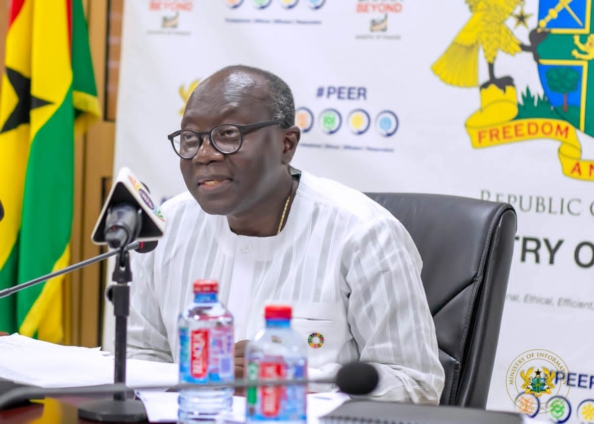
The Minister in an address on the country’s economic status on Wednesday reacted to the recent downgrade and said it is unfortunate for the country’s economy as the country would lose foreign investors in that regard.
“The issue of Fitch downgrade is unfortunate. In their email to us, they referred to the Bloomberg article that influenced their decision. It sort of further depresses the bonds on the international market and results in additional losses to investors.”
Ken Ofori-Atta is, however, optimistic that the ratings will compel the government to initiate economic programmes that would enable the economy bounce back and return to some positive ratings.
“Once we got downgraded to triple C, we are also expecting that economic programme that is being worked on which will be the basis for the IMF discussions would help us to come back to some strong matrices so that we will be able to get some ratings revised over that period.
“We are confident that returning some sort of access to the capital markets is going to take some time, two to three years and so during that period we will work on our ratings also to be able to get back,” he said.
It could be recalled that on September 23, Rating agency, Fitch downgraded Ghana’s credit worthiness.
The downgrade, Fitch said, reflects the increased likelihood that Ghana will pursue a debt restructuring given mounting financing stress, with surging interest costs on domestic debt and a prolonged lack of access to Eurobond markets.
“There is a high likelihood that the International Monetary Fund support programme currently being negotiated will require some form of debt treatment due to the climbing interest costs and structurally low revenue as a percentage of Gross Domestic Product”.
“We believe this will be in the form of a debt exchange and will qualify as a distressed debt exchange under our criteria”, it explained.
“However, we believe there could be an incentive to spread a debt restructuring burden across domestic and external creditors and therefore do not have a strong basis to differentiate between Foreign- and Local-Currency ratings at this time,” it concluded.
Latest Stories
-
US Court backs extradiction of former MASLOC CEO Sedina Tamakloe-Attionu’s to Ghana
15 minutes -
Seven arrested as NAIMOS dismantles illegal mining camp, seizes firearms at Boin River
17 minutes -
Fire erupts at Madina Ritz Junction, destroys multiple wooden structures and containers
31 minutes -
Daniel-Kofi Kyereh returns from long-term injury, registers assist for Freiburg U23
43 minutes -
Knifeman calling himself ‘Lucifer’ slashes three at NYC’s Grand Central
59 minutes -
Brands are built from within to without
59 minutes -
Matriculants urged to pursue excellence as gov’t reaffirms support for Maritime education
1 hour -
See the areas that will be affected by ECG’s planned maintenance on Monday, April 13, 2026
1 hour -
GPL 2025/26: Salim Adams double fires Medeama back to summit after Kotoko rout
1 hour -
Two robbery suspects convicted following violent gold dealer attack in Obuasi
1 hour -
Supreme Court @150: Fanfare meets reflection as nationwide activities roll out
1 hour -
Padel for Parkinson’s cycling event promotes awareness at University of Ghana
2 hours -
GPL 2025/26: Samuel Tetteh brace fires Nations FC past Basake Holy Stars
2 hours -
Ghana’s oil trade position close to net neutral in near term – Fitch
2 hours -
IMANI Africa President urges greater awareness and support for Parkinson’s Disease patients
2 hours