


Audio By Carbonatix
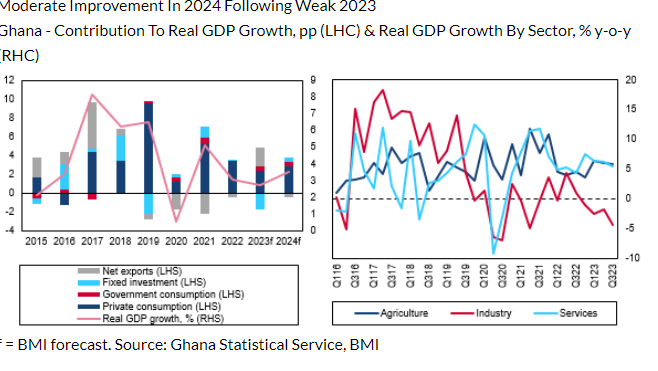
Fitch Solutions has revised Ghana’s Gross Domestic Product (GDP) growth rate in 2024 to 3.5%, from the earlier forecast of 3.7%.
This is however higher than the expected 2.7% growth rate in 2023, but lower than the pre-Covid-19 pandemic average of 5.0%.
According to the UK-based firm, it expects that the Ghanaian economy will enter a recovery phase in 2024, driven by stronger private consumption.
“We expect that the Ghanaian economy will enter a recovery phase in 2024, driven by stronger private consumption”.
“Soaring consumer price inflation over 2022-23 – due to the sharp sell-off of the Ghanaian cedi – weakened purchasing power of households and weighed on domestic consumption. However, we expect that price growth will moderate from an average of 40.3% in 2023 to 17.8% in 2024, driven by statistical base effects and more favourable exchange rate dynamics, it pointed out.
Indeed, it said the government will make progress regarding the restructuring of Ghana’s external debt under the G20 Common Framework in the coming quarters.
It added that a more expansionary fiscal stance will inject additional demand into the economy.
Growth in final quarter of 2023 to remain subdued
It further stated that growth in the final quarter of 2023 will remain subdued.
This is because Ghana’s purchasing managers’ index (PMI) for October and November remained broadly in line with quarter 3, 2023 – averaging 51.1 – pointing to only a slight expansion in the manufacturing sector (PMI values above 50 represent an expansion).
Meanwhile, both consumer and business confidence remained subdued going into quarter 4, 2023, suggesting that a notable recovery in domestic demand is unlikely at the end of 2023.
National accounts data published by Ghana Statistical Service shows that economic growth decelerated sharply to just 2.0% year-on-year in quarter 3, 2023 – from 3.2% in the preceding quarter – marking the weakest outturn since quarter 3, 2020 when the economy contracted by 3.5% due to the Covid-19 pandemic.
The slowdown in growth was primarily caused by a deeper contraction in the secondary sector – as a result of a downturn in the oil and gas industry – and weaker conditions in the services industry.
Latest Stories
-
ASFC 2026: Ghana U15 girls set up Burkina Faso final after win over Zambia
3 minutes -
The passport question: Why Ghana must let its best abroad come home to serve
15 minutes -
We will be losing twice if these commodities expire at the port – CSOs Coordinator warns
23 minutes -
Setting up national champions to fail: the case of Ibrahim Mahama and E&P
23 minutes -
Rwanda’s capital embraces urban farming as development squeezes rare land
25 minutes -
Argentina passes bill loosening protection of its glaciers
25 minutes -
Sammi Awuku to question GMA in Parliament over vessel linked to alleged drug trafficking
38 minutes -
Trapped miner rescued from flooded Mexican tunnel after 14 days
47 minutes -
NPRA to prosecute employers over unpaid Tier 2 Pension contributions — Deputy CEO warns
52 minutes -
ACCPA calls for Africa’s strategic repositioning at NUS, Singapore
1 hour -
Oil prices rise as concerns grow over ‘fragile’ US-Iran ceasefire
1 hour -
Four people die trying to board boat in Channel crossing attempt
1 hour -
Crude production hits 6-year low—PIAC calls for urgent investment plan
1 hour -
NPP revises internal election guidelines to strengthen transparency and inclusiveness
2 hours -
NACOC set to issue licences to qualified applicants for cannabis cultivation – Deputy Director-General
2 hours