

Audio By Carbonatix
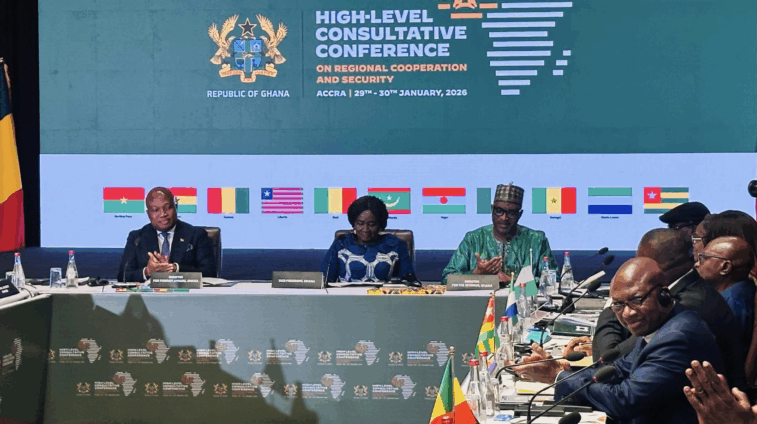
Vice President Professor Naana Jane Opoku-Agyemang has warned that fragmented and uncoordinated security responses in West Africa and the Sahel are no longer sustainable.
She is therefore calling for stronger preventive, intelligence-led and cooperative approaches to confront the region’s growing security challenges.
Prof. Opoku-Agyemang said the evolving threat landscape, marked by terrorism, violent extremism, organised crime and cyber insecurity, demanded collective action that linked security, foreign policy and development agendas in a coherent and practical manner.
She was addressing a ministerial meeting of the High-Level Consultative Conference on Regional Cooperation and Security in Accra.
The convening will culminate in a Summit of Heads of State and Government on Friday, January 30, 2026.
The High-Level Consultative Conference is discussing security and related challenges affecting the region, including terrorism, violent extremism, transnational organised crime and maritime insecurity in the Gulf of Guinea.
It aims to provide a platform for leaders to review existing peace, security and governance initiatives, renew coordinated regional approaches and strengthen collaboration through sustainable mechanisms.
The Vice President said Ghana’s President placed a high value on the conference, given the urgency of forging a shared understanding of the region’s security challenges.
Prof. Opoku-Agyemang said the ministerial session occupied a central place in the consultative process, noting that it was the platform where technical assessments must be translated into clear policy direction and where national priorities must be aligned to inform regional choices.
She observed that contemporary security threats were increasingly transnational and interlinked, cutting across borders, institutions and traditional policy silos.
According to her, violent extremism, terrorism, organised crime, cyber threats and persistent youth unemployment were mutually reinforcing challenges that could not be effectively addressed through isolated national responses.
The Vice President said experience within and beyond the region had shown that fragmented approaches were inadequate to deal with the complexity of today’s threats.
She stressed that effective regional cooperation depended on timely information sharing, joint analysis and coordinated responses, adding that acting together and proactively helped countries to identify risks early and reduce the cost of responding after crises had already escalated.
She described prevention as a practical necessity rather than an abstract ideal, urging ministers to ensure that regional initiatives were designed for implementation.
She said clear roles and responsibilities, strong institutional frameworks and alignment with national priorities were essential if cooperation was to move beyond rhetoric to deliver tangible results.
Prof. Opoku-Agyemang cautioned that, without institutional coherence and credibility, even well-designed policies would struggle to have an impact on the ground.
She said sustained progress depended on ownership and institutions' capacity to translate political decisions into concrete action.
The Veep urged participants to balance ambition with realism, ensuring that conference recommendations reflected the scale of the challenges while remaining grounded in institutional capacity and national contexts.
“Our diversity is a strength, but it must be anchored in a shared commitment to regional stability and progress,” she said, expressing confidence that with political dedication, coordinated efforts and a focus on practical results, the region could strengthen its foundations and move steadily towards peace and prosperity.
Mr Samuel Okudzeto Ablakwa, Minister for Foreign Affairs, painted a stark picture of the human cost of insecurity in the region, revealing that terrorism was claiming an average of about 44 lives every single day in West Africa and the Sahel.
Mr Ablakwa said the region now accounted for between 47 and 59 per cent of all recorded global terrorist incidents, indicating that the epicentre of global terrorism had shifted from the Middle East to West Africa and the Sahel.
He said over the past 15 years, terror attacks in the region had increased by more than 1,200 per cent, while deaths linked to such attacks had risen by nearly 3,000 per cent.
The Minister described the figures as a grim daily reality for communities across the region and said the statistics required urgency and coordinated regional action.
Mr Ablakwa said the security challenges confronting the region were interconnected and transnational, ranging from violent extremism in the Sahel and piracy in the Gulf of Guinea to trafficking across porous borders and other forms of organised crime.
He stressed that no country could confront the threats alone and described the absence of a clearly agreed regional mechanism to address trans-border security challenges as unacceptable.
The Foreign Affairs Minister said intelligence cooperation must extend beyond a narrow focus on kinetic threats to encompass the economic, social and governance pressures that extremists and criminal networks exploit, including climate stress, food insecurity, youth unemployment and weak border communities.
He called for a new culture of trust, transparency, and actionable intelligence sharing, noting that fragmentation and suspicion had undermined collective security efforts in the past.
Mr Ablakwa proposed four guiding principles for renewed cooperation: trust among states, mobilisation of resources within the continent, integration of security, development, and governance, and foresight through credible, regionally owned early-warning systems.
Latest Stories
-
Gov’t making progress in clearing $1.7bn power debt – Mahama
1 hour -
Justice is the engine of growth – Chief Justice
2 hours -
Meet us halfway – Trade Minister tasks private sector with AfCFTA success
3 hours -
After more than 14 years at Atletico Madrid, what next for Simeone?
3 hours -
Conquering the World – Building on the foundations laid by Otto Addo
3 hours -
[Watch Live] Kwaw Kese, Kwami Eugene, Tinny, Keche and others thrill fans at Gomoa Easter Carnival
3 hours -
Gomoa Easter Carnival: Experts charge indigenes to own festival to ensure sustainability
4 hours -
Gomoa Easter Carnival: Edem Agbana and Joy Prime fans shower festival with huge endorsements
6 hours -
Gathering of Royals 2026: Empowering women, boosting tomato production
6 hours -
Gov’t to overhaul free zones into manufacturing hubs for local production – Trade Minister
7 hours -
Ghana losing $2.5bn yearly from raw exports – Trade Minister reveals
7 hours -
Mahama unveils plans for Kwahu Airport, Convention Centre
7 hours -
World’s oldest leader, Paul Biya to get a deputy for first time in 43-year rule
7 hours -
Search for missing US airman continues as Trump threatens ‘hell’ if Iran does not reach deal
7 hours -
US says it has arrested relatives of late Iranian general Qasem Soleimani
7 hours