

Audio By Carbonatix
French President Emmanuel Macron formally acknowledged France's role in violent repression during Cameroon's struggle for independence in a letter signed on July 30 but only disclosed on Tuesday.
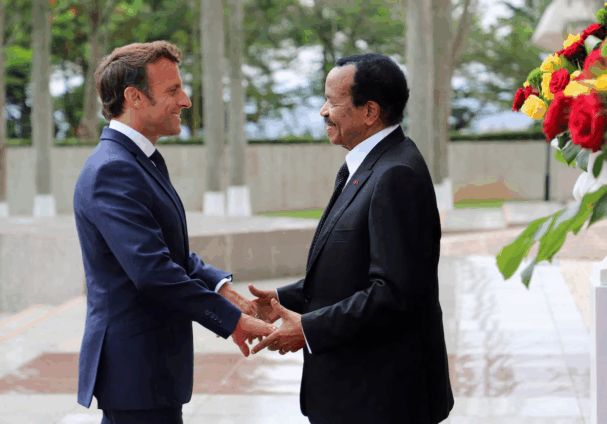
The letter, addressed to Cameroonian President Paul Biya, follows the findings of a joint Franco-Cameroonian commission that investigated France's role and involvement in the fight for independence between 1945 and 1971.
The Cameroon government did not immediately reply to a Reuters request for comment.
Cameroon was a German colony until it was split between Britain and France after World War I. Under United Nations trusteeship, the French-administered area gained independence in 1960, while the southern British Cameroons voted to join French Cameroon in a federation in 1961.
"The commission's historians clearly established that a war took place in Cameroon, during which French colonial authorities and military forces committed various forms of violent repression in several regions of the country, a war that continued beyond 1960 with France's support for actions taken by the independent Cameroonian authorities," Macron said in the letter.
Macron also acknowledged France’s responsibility in the deaths of independence leaders Ruben Um Nyobè, Paul Momo, Isaac Nyobè Pandjock and Jérémie Ndéléné, who were killed between 1958 and 1960 during military operations conducted under French command.
The French president pledged to open archives, support historical initiatives, and create a joint working group to implement the commission’s recommendations, aiming to reconcile historical memory and strengthen Franco-Cameroonian ties.
Starting with 17th-century outposts and expanding in the 19th century, France built a vast colonial empire, notably in Africa, lasting until the 1960s decolonisation.
The letter follows previous steps by Macron to confront France’s colonial legacy, including acknowledgements of French responsibility in the 1994 Rwandan genocide and the Algerian War.
These gestures come amid shifting dynamics in France’s relationships with African nations, at a time when its presence in parts of the continent, particularly the Sahel, is being increasingly contested.
Latest Stories
-
MLS bans Yeboah & Jones for betting offences
1 hour -
He called me traitor 50 times – Mourinho sent off after celebrating goal
1 hour -
Eni Aluko wins Joey Barton libel case over X posts
1 hour -
Ten players from Jamaican club denied entry to US
1 hour -
Some banks move to sell assets of PBC over GHC 300 million debt
2 hours -
Uefa fears impact of Premier League spending rules
2 hours -
EU to sign historic defence pact with Ghana in global security pivot
2 hours -
Liverpool lose to Galatasaray in Slot’s 100th game in charge
2 hours -
Iran begins laying mines in Strait of Hormuz, sources say
2 hours -
Joey Barton refused bail after ‘attack at golf club’
2 hours -
GH¢68.7bn gov’t arrears bombshell: Parliament orders probe over suspected fraud
2 hours -
The public display of students’ academic results in basic schools: A case against a damaging practice
2 hours -
GOIL jumps GH¢0.21, MTN Ghana surges past GH¢6.30 in record-breaking GSE session
2 hours -
NAIMOS disrupts illegal mining activities at Gwira Banso-Eshiem
3 hours -
Ashesi hosts Kensei Kai Foundation’s maiden Inter-University Karate Camp
3 hours