


Audio By Carbonatix
France and nations from Africa's Sahel region have agreed to step up military co-operation to fight the jihadist insurgency there.Forces will be placed under one umbrella and efforts focused on tackling the Islamic State group, they said after a summit in Pau in France.They also urged the US to maintain its support amid reports it might lessen its military presence in Africa.Jihadist attacks on civilians and troops have been on the increase.This is despite the presence of thousands of troops from both the countries affected and France.Last year saw the highest annual death toll due to armed conflict in the region since 2012. Emmanuel Macron hosts leaders of the G5 group in PauFrance will send an additional 220 troops to supplement the 4,500 already in the region, he said.Ahead of the talks, the leaders attended a memorial service for 13 French soldiers - seven from Pau - who died in a helicopter collision in Mali last month.It was France's deadliest military loss in a single day in about four decades.The nations appealed to the US to continue its "crucial" logistical support. Mr Macron said he would try to persuade President Donald Trump to stay as "if the Americans decided to leave Africa, this would be very bad news for us".The New York Times reported last month the Pentagon was considering reducing troop levels in Africa or even withdrawing completely.There had been tension ahead of the summit, with Mr Macron and Defence Minister Florence Parly saying the Sahel nations needed to say clearly that French troops were wanted, while condemning anti-French feelings on the ground.
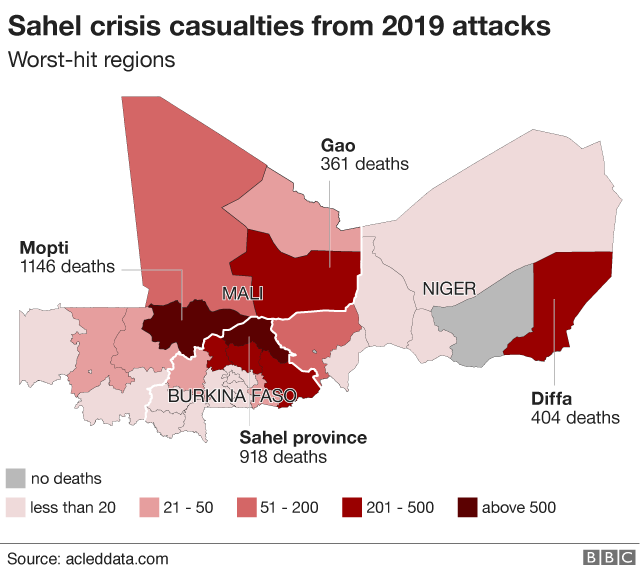 The security crisis in the region started in 2012 when an alliance of separatist and Islamist militants took over northern Mali, triggering a French military intervention to oust them.A peace deal was signed in 2015 but was never completely implemented and new armed groups emerged and expanded to central Mali, Burkina Faso and Niger.Some are linked to al-Qaeda and others the Islamic State (IS) group. They have taken advantage of porous borders to raise money through extortion, and weapons and people trafficking.
Who was meeting in Pau and what was agreed?
Six leaders met in the south-western French city, French President Emmanuel Macron hosting heads of Niger, Mali, Burkina Faso, Chad and Mauritania, the G5 group.The nations agreed to a joint command structure - Coalition for the Sahel - to tackle the insurgency."We have no choice. We need results," Mr Macron said.
Emmanuel Macron hosts leaders of the G5 group in PauFrance will send an additional 220 troops to supplement the 4,500 already in the region, he said.Ahead of the talks, the leaders attended a memorial service for 13 French soldiers - seven from Pau - who died in a helicopter collision in Mali last month.It was France's deadliest military loss in a single day in about four decades.The nations appealed to the US to continue its "crucial" logistical support. Mr Macron said he would try to persuade President Donald Trump to stay as "if the Americans decided to leave Africa, this would be very bad news for us".The New York Times reported last month the Pentagon was considering reducing troop levels in Africa or even withdrawing completely.There had been tension ahead of the summit, with Mr Macron and Defence Minister Florence Parly saying the Sahel nations needed to say clearly that French troops were wanted, while condemning anti-French feelings on the ground.What is happening in the Sahel?
The Sahel is the name for the region that stretches south of the Sahara from the Atlantic Ocean in the west to the Red Sea in the east, or from southern Mauritania to Eritrea.Its western and central areas have been a frontline in the war against Islamist militancy for almost a decade.But the jihadist fighters have recently stepped up their campaignLast week, 89 soldiers from Niger were killed in the latest attack.The security crisis in the region started in 2012 when an alliance of separatist and Islamist militants took over northern Mali, triggering a French military intervention to oust them.A peace deal was signed in 2015 but was never completely implemented and new armed groups emerged and expanded to central Mali, Burkina Faso and Niger.Some are linked to al-Qaeda and others the Islamic State (IS) group. They have taken advantage of porous borders to raise money through extortion, and weapons and people trafficking.Who is fighting the jihadists?
The French have 4,500 soldiers and there are another 12,000 UN peacekeepers in Mali called Minusma.The joint G5 Sahel countries have an estimated 5,000-strong force but some troops are under-trained and poorly equipped.The US has two drone bases in Niger.DISCLAIMER: The Views, Comments, Opinions, Contributions and Statements made by Readers and Contributors on this platform do not necessarily represent the views or policy of Multimedia Group Limited.
DISCLAIMER: The Views, Comments, Opinions, Contributions and Statements made by Readers and Contributors on this platform do not necessarily represent the views or policy of Multimedia Group Limited.
Latest Stories
-
NPP leaders converge at party headquarters ahead of NEC meeting on polling station elections
11 minutes -
Fuel prices may rise in Ghana despite global drops – Duncan Amoah
14 minutes -
‘No one is above the law’- Volta Chiefs condemn EOCO over handling of Council of State member case
15 minutes -
AMA creates alternative pedestrian routes at Kaneshie after footbridge closure
18 minutes -
Ghanaians were misled- NPP accuses NDC of politicising Anti-LGBTQ bill
19 minutes -
Photos: Mahama receives full state welcome in Paris ahead of talks with French President Macron
40 minutes -
Deputy Health Minister endorses Women in Medicine Fellowship
41 minutes -
Duncan Amoah pushes for Consumer Protection Bill amid VIP fare hike
53 minutes -
LMWG backs Damang lease award to E&P, demands transparency and results
58 minutes -
Volta Chiefs condemns EOCO over alleged disregard for court ruling in Council of State member case
59 minutes -
Matthew Perry’s stepmother says ‘Ketamine Queen’ should get maximum sentence
59 minutes -
Northern Regional Police Command intensifies anti-drug operations, arrests 217 suspects
1 hour -
The architect of a healthier Ghana: Mahama’s vision and legacy in primary healthcare
1 hour -
Israel carries out large wave of air strikes across Lebanon
1 hour -
BBC upholds complaints over racial slur in Baftas broadcast
1 hour