

Audio By Carbonatix
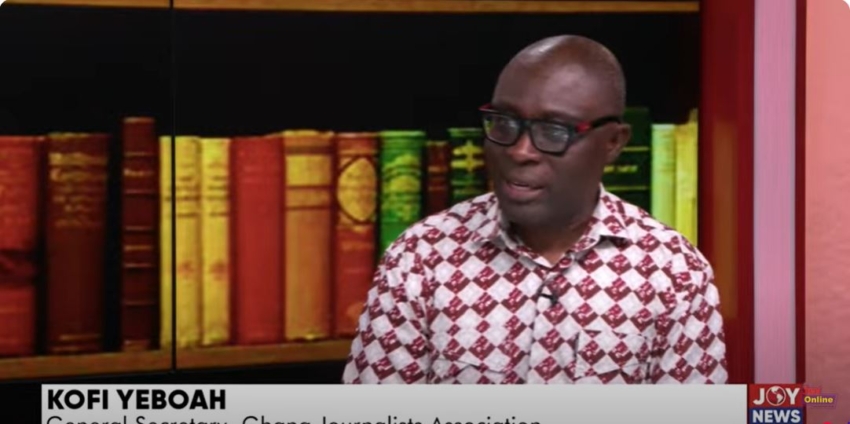
The General Secretary of the Ghana Journalists Association (GJA), Mr. Kofi Yeboah, has called for an end to the criminalisation of free speech in Ghana, describing it as inconsistent with the spirit and letter of the 1992 Constitution.
His comments come in the wake of the recent jailing of a blogger for publishing false news about the dollar, while a Member of Parliament for Bolga Central, Isaac Adongo, who made a similar public claim, has not faced prosecution. The incident has sparked renewed debate over Section 208 of the Criminal and Other Offences Act, 1960 (Act 29), which criminalises the publication of false news likely to cause fear and alarm to the public.
Speaking on JoyNews' The Law on Sunday, he said: “Our position is that we cannot—and we should not—criminalise free speech,” Mr. Yeboah said.
“The example you gave, where a blogger was jailed for 30 days while an MP walked free for a similar offense, only confirms what we’ve always maintained: even where the law is applied, it is done selectively. Otherwise, why wouldn’t the MP also be arrested and prosecuted under the same law?” he questioned.
He criticised what he described as the biased and selective application of the law, particularly by the police, who he believes disproportionately target media professionals.
“In our humble view, if you look at the 1992 Constitution and interpret it as a whole, it leans strongly toward protecting and guaranteeing freedom of speech and expression,” he said.
He cited Article 21(1)(a), which guarantees freedom of speech and expression, and Article 21(1)(f), which upholds the right to information.
Mr. Yeboah also pointed to Chapter 12 of the Constitution, which promotes media freedom, and Article 163, which enjoins state-owned media to provide fair opportunities for the presentation of divergent views and dissenting opinions.
“All these provisions are geared toward deepening democracy and encouraging civic engagement. If this is truly the aim of our Constitution, why then should we seek to silence free expression through criminal prosecution?” he questioned.
He further argued that misinformation should be countered through civil remedies, public corrections, or regulatory sanctions rather than punitive criminal action.
Latest Stories
-
Education must preserve identity and drive innovation – Special Prosecutor
48 minutes -
Corruption raises bank risk, weakens diversification benefits, research finds
2 hours -
The Apostolic Church-Ghana bans ‘you may kiss your bride’ during marriage ceremonies
4 hours -
Ɔdadeɛ 95 marks reunion with GH₵200k Solar Project at PRESEC-Legon
4 hours -
AI is the new phase of the digital age, and Africa must be ready or risk being left behind – Dr Bawumia warns at LSE Africa Summit
4 hours -
Ghana’s Gold Reserve Policy Reversal: An Analytical Review of Costs, Timing, and Governance
5 hours -
Joyce Blessing blesses Adom TV Fufu Party patrons with thrilling performance
6 hours -
Toasehene commissions community centre, urges traditional leaders to prioritize development
6 hours -
ECG to replace transformers in parts of Accra to improve power supply
6 hours -
Photos: Two brothers who perished in the tragic Tema aircraft crash laid to rest
7 hours -
Pamela Bridgewater Project urges stakeholders to join outreach programme on teenage pregnancy
8 hours -
Shot on duty: A Ghanaian journalist’s five-year struggle for recovery
8 hours -
Rainstorm rips off Kassena-Nankana West District block
8 hours -
Fans gather in their numbers for 2026 Adom TV Fufuo Party
8 hours -
When reporting becomes a risk: The growing digital war on journalists in Ghana
8 hours