

Audio By Carbonatix
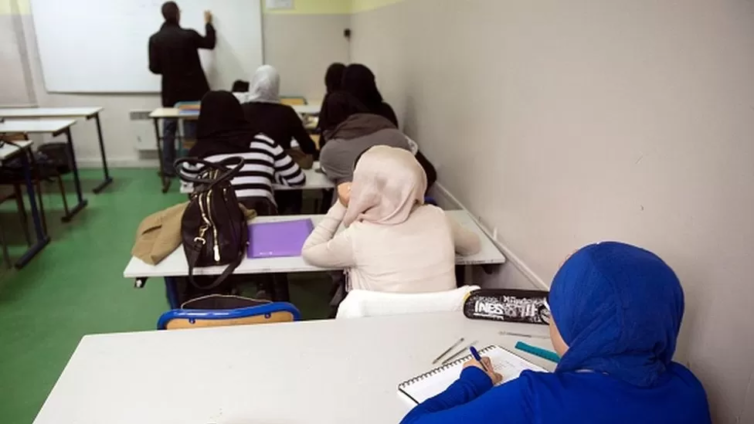
The French education minister has said that nearly 300 pupils arrived at school on Monday wearing the abaya, the long Muslim robe which was banned in schools last week.
Most of the girls agreed to change into other clothes.
According to official figures, 298 girls - mainly aged 15 or more - turned up at school in the banned garment.
Under instructions laid down by the ministry, there followed in each case a period of dialogue with school staff.
Most girls then agreed to dress differently and were able to start classes.
However, 67 girls refused to comply and were sent home.
A further period of dialogue with their families will now ensue. If that fails, they will be excluded.
Set against the 12 million school boys and girls who started term on Monday, the government believes the figures show that its ban has been broadly accepted.
However, a legal challenge by a group representing some Muslims goes before the courts later today.
At the end of August, the education minister announced that pupils would be banned from wearing the loose-fitting full-length robes worn by some Muslim women in France's state-run schools at the start of the new school year on 4 September.
France has a strict ban on religious signs in state schools and government buildings, arguing that they violate secular laws.
Wearing a headscarf has been banned since 2004 in state-run schools.
The move comes after months of debate over the wearing of abayas in French schools.
The garment is being increasingly worn in schools, leading to a political divide over them, with right-wing parties pushing for a ban while those on the left have voiced concerns for the rights of Muslim women and girls.
In 2010, France banned the wearing of full-face veils in public, provoking anger in France's five million-strong Muslim community.
France has enforced a strict ban on religious signs at schools since the 19th Century, including Christian symbols such as large crosses, in an effort to curb any Catholic influence on public education.
Reflecting its changing population, it has updated the law over the years to include the Muslim headscarf and Jewish kippa, but abayas have not been banned outright until now.
Latest Stories
-
Boxing: Abdul Ahmed wins WBA Africa Cruiserwight title after dispatching Nigeria’s Eradeye
1 minute -
Nearly 2,000 displaced, schools damaged as windstorm wreaks havoc in Gushegu
20 minutes -
Ghana’s Derrick Kohn to work under Marie-Louise Eta as she becomes first woman to coach men’s Bundesliga team
24 minutes -
Accra Open Championships conclude with strong performances ahead of African Championships
32 minutes -
Ghana to begin camping with 12 athletes after Accra Open Championships – Bawa Fuseni
53 minutes -
Anthony Joshua declines showdown with Tyson Fury but admits they ‘probably’ clash next
1 hour -
Tyson Fury dominates Makhmudov, calls out Joshua next
1 hour -
I have supported highway authority financially to fix roads in my constituency – A Plus
3 hours -
US, Iran fail to reach peace agreement after marathon talks in Pakistan
3 hours -
ECG kicks off Phase Two of transformer upgrades at Lashibi; brief outages expected
3 hours -
Port crises loom as 11,000 drivers threaten four-day strike
4 hours -
A source of excellence across generations – Vice President Opoku-Agyemang lauds Mfantsipim
5 hours -
(Photos) Mfantsipim School launches historic 150th anniversary
6 hours -
Knights and Ladies of Marshall group backs Catholic Bishops’ stance on anti-LGBTQ+
6 hours -
Bright Simons: All the Filla in the Ibrahim Mahama/E&P – Gold Fields Saga
7 hours