

Audio By Carbonatix
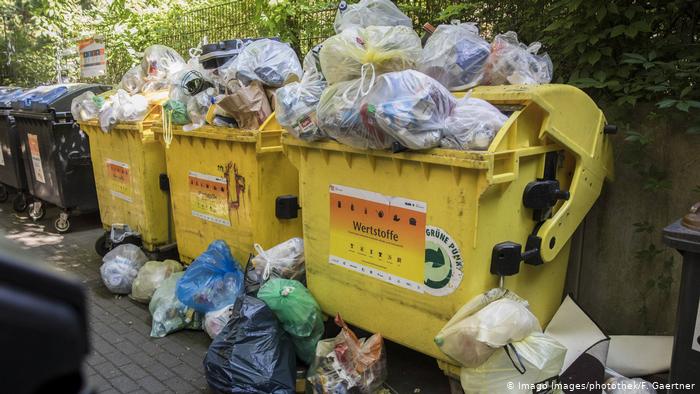
Germany’s packaging waste has risen 18% in the past decade, despite appeals against ready-to-go items. Manufacturers should simplify wrappings and containers to boost recycling, urges Germany’s environment agency.
German Environment Agency (UBA) Chief Dirk Messner on Tuesday called for consumers to enjoy their coffee in reusable cups and end the "flood” of packaging littering public spaces.
"Recyclable cups, for example for coffee, must become the norm, and whoever takes away meals should do so in recyclable containers," he said. "It is best to use immediately recycled raw materials for production."
The latest UBA data — from 2018 — attributed 228 kilograms (503 lbs) of packaging to each of Germany's 83 million residents, counting waste along the complete manufacturing-and-sales chain.
Overall, the agency estimated that Germany's packaging consumption had increased by 17.9% since 2010.
Private individuals generated 47% of Germany's packaging waste. That amounted to 108 kilograms per capita, or 8.9 million tons nationwide.
That was 20.6% more than packaging consumed privately in 2010, said the UBA, blaming trends toward smaller doses and re-sealable foodstuff wrappings.
These functioned with elaborate seals, however, leading to higher material usage.
The UBA also cautioned that its sampling predated the coronavirus crisis, but surmised that future data on 2020 would reflect more packaged takeaways from eateries.
Germany recycling 'champion'
On the "good news" flipside, the agency said more than two-thirds (69%) of Germany's packaging waste in 2018 ended up being recycled — thanks to German propensity to deposit waste in color-coded "wheelie" bins and trash boxes.
The rest was used "energetically" meaning it was incinerated at waste fuel plants to capture residual power.
"Even though Germany continues to be one of the pioneers in the recycling of packaging, there is still room for improvement," urged the UBA.
Least recyclable at only 25% were wooden products. Almost half of plastics (47%), including wrappings around foodstuffs, were recycled.
Top recycling marks went to steel — from tin cans, for example — at 92%; aluminum at 90%, paper and cardboard at 88% and glass on 83%.
What is being done to increase recycling?
In line with an EU push for "circular economies" and its European Packaging Directive, Germany in 2019 adopted a packaging law requiring higher recycling quotas.
Those legislated quotas — differing somewhat in calculation from the UBA's 2018 data — now require industry to recycle 58.5% of plastic packaging, rising to 63% in 2022.
The UBA said its calculation methods, when it filed 2020 data in the future, would be adjusted to comply the EU Packaging Directive to account for contamination in plastics that make portions unfit for recycling.
Latest Stories
-
GPRTU to await President’s fuel tax cut before finalising fare adjustment
2 minutes -
ECG Billing concerns raise questions about Transparency and Consumer Trust
7 minutes -
Three years on, Tongu flood victims still wait as chief pleads for help
18 minutes -
Middle East tensions drive fuel surge, but local costs hurt more — GPRTU
21 minutes -
What a Shock! When “Party People” stop being Party People
21 minutes -
Government clears debt as Suame Interchange project set to resume – Roads Minister
29 minutes -
GPRTU gives government 48 hours to cut fuel taxes before pushing for fare hike
31 minutes -
Pepsodent deepens impact with nationwide schools programme as part of World Oral Health Day activities
37 minutes -
Cabinet approves $250m AI centre to boost tech innovation
45 minutes -
Today’s front pages: Wednesday, April 1, 2026
51 minutes -
ACEP urges incentives for private fuel storage as prices surge in Ghana
52 minutes -
From recognition to reinvention: Marking one year of Dr Philip Oti-Mensah’s era at UMB
2 hours -
Restoring a national institution: The leadership blueprint behind NIB’s revival
2 hours -
Trust, but verify – Mary Addah warns against blind support for OSP
3 hours -
If we scrap it, what do we replace it with? – Mary Addah defends OSP trust surge
3 hours