

Audio By Carbonatix
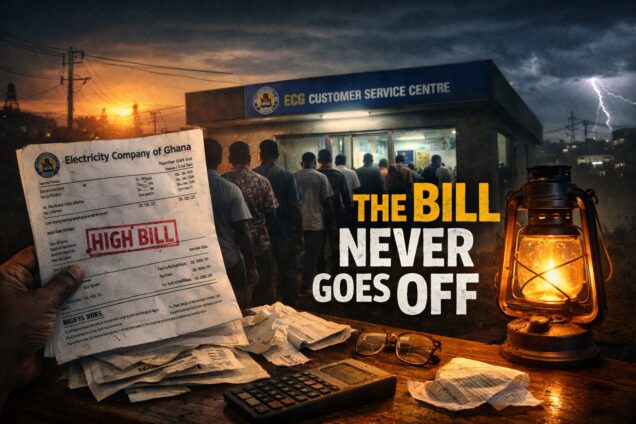
Ghana’s electricity consumers are increasingly raising concerns over billing practices by the Electricity Company of Ghana (ECG), with many describing recent charges as inconsistent with actual consumption.
One recent case illustrates the depth of the concern.
Over a three-month period, a consumer deliberately reduced electricity usage in his household. With his wife abroad and children in boarding school, the home remained largely unoccupied. He left home early each morning and returned late each evening, consciously limiting power consumption.
Despite this, he received the same bill consistently each month.
In an effort to eliminate reliance on the grid entirely, he installed a solar hybrid system. However, even after this transition, the billing pattern remained unchanged.
The experience prompted him to file a formal complaint with the Public Utilities Regulatory Commission, where the matter is currently awaiting resolution.
This case is not isolated.
Across several communities, customers have reported unusually high postpaid bills, even in situations where usage has been minimal or properties have remained unoccupied for extended periods.
These concerns are reigniting debate around estimated billing, a system used in the absence of regular meter readings. While ECG maintains that estimated billing is a necessary mechanism under certain operational constraints, consumers argue that it lacks transparency and often produces figures that are difficult to verify.
Energy analysts note that billing accuracy is not merely a technical issue but a fundamental component of trust between service providers and consumers. When customers are unable to reconcile their usage with billed amounts, confidence in the system begins to erode.
There are also broader economic implications.
At a time when households and businesses are already navigating rising living costs, unexpected increases in utility bills place additional financial pressure on consumers. Small businesses, in particular, may struggle to absorb these costs, potentially affecting pricing, operations, and sustainability.
Calls are growing for ECG to enhance transparency by improving meter reading processes, investing in smart metering technology, and providing clearer explanations of how estimated bills are calculated.
Consumer advocacy groups have also urged regulatory bodies to intensify oversight and ensure that billing practices align with established standards of fairness and accountability.
Ultimately, the issue underscores a critical question: can Ghana’s power distribution system deliver not just electricity, but trust?
As discussions continue, the focus will remain on whether ECG can address these concerns and restore confidence among its customers.
Jimmy Aglah is a media executive and writer, and the founder of Republic of Uncommon Sense, a platform dedicated to sharp, thought-provoking commentary on governance, society, and everyday life.
The Uncommon Sense Playbook: Thinking Clearly in Noisy Times
A practical guide for leaders and independent thinkers navigating complexity with clarity and logic.
Latest Stories
-
Wontumi not yet confirmed among Mahama’s pardoned convicts – Palgrave
13 seconds -
6 Ghanaian victims of human trafficking arrested in Zambia cybercrime raid – Foreign Affairs Ministry
3 minutes -
Big Dawood leads clean-up, tree-planting campaign to tackle Accra’s sanitation challenges
4 minutes -
Government to launch new legal frameworks on social protection and gender equity
17 minutes -
CSA Ghana opens NCSAM 2026 with call for stronger cybersecurity collaboration
24 minutes -
Yellow Fever deaths in Sissala East worrying – MP
25 minutes -
PAC flags GH¢5.2bn financial irregularities in 2025 audit report
29 minutes -
PAC steps down 2 special audit reports into Ghana’s US Embassy, 13th All African Games
35 minutes -
Yellow Fever outbreak kills 7 in Sissala East
42 minutes -
Techiman-Krobo Nursing Training principal to remain at post despite calls for her removal
45 minutes -
Ghana cautions citizens over fraudulent jobs luring them to Zambia for cybercrime
47 minutes -
ECG network fault leaves several Lower Manya communities without power
50 minutes -
Banda targets tourism boom with new facilities
52 minutes -
Gender Minister urges dialogue as teachers’ strike threatens School Feeding Programme
60 minutes -
Diminutive SHS 1 student in viral video is 16, not underage – Adanwomase SHS clarifies
1 hour