

Audio By Carbonatix
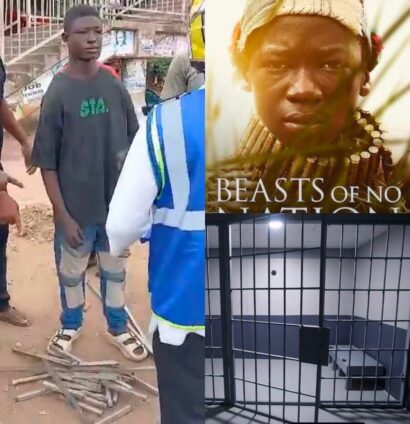
Once upon a time, in the Republic of Uncommon Sense, a little boy stood before Hollywood cameras and became famous.
His name was Emmanuel Nii Adom Quaye.
The world called him Strika.
He appeared in Beasts of No Nation, alongside Idris Elba and Abraham Attah, playing a child soldier in a film about children swallowed by circumstances larger than themselves.
The cameras rolled.
The critics applauded.
The world moved on.
And apparently, so did we.
Years later, Strika reappeared before cameras.
But there was no director shouting, “Action!”
No Idris Elba.
No Netflix.
No red carpet.
Just a footbridge at Kwashieman, some pieces of metal, angry residents and a young man reportedly trying to convert public infrastructure into scrap.
My people, life can rewrite a screenplay without consulting the producer.
Reports now say Strika has been sentenced to prison following the incident.
And suddenly Ghana has remembered him again.
Wonderful country.
When he was struggling, silence.
When videos emerged of him apparently drifting through difficult circumstances, concern for a few days.
When he reportedly worked as a security guard earlier this year, life continued quietly.
But immediately he touched government railing, everybody reported for national duty.
“Jail him!”
“Rehabilitate him!”
“Where is the justice?”
“Seven years is too much!”
Within hours, Facebook had constituted itself into the Supreme Court, Court of Appeal, Psychiatric Association and Commission on Human Rights.
Ghanaians are very efficient when the office has no appointment letter.
But beneath the jokes lies something uncomfortable.
Stealing or destroying public property cannot be excused simply because the accused once acted in a famous movie.
That railing does not belong to the government in some distant abstract sense. It belongs to the old woman using the bridge, the schoolchild holding the side for balance, and the taxpayer whose taxes may eventually replace what someone sells for scrap.
Compassion must not become permission.
But punishment must also not become blindness.
Because when a young man with such an extraordinary beginning ends up cutting metal from a footbridge, society should ask a question beyond:
“How many years shall we give him?”
We should also ask:
“How exactly did he get here?”
Reports about Strika's life since Beasts of No Nation describe a troubling journey involving instability and repeated returns to difficult circumstances. People close to the production have spoken publicly about his background and the challenges surrounding his welfare after the film.
That does not erase personal responsibility.
But neither does personal responsibility erase social failure.
Perhaps that is the tragedy.
We are very good at discovering troubled young people when they commit offences.
Before then, everybody is busy.
The rehabilitation centre is waiting for a budget.
The social worker is waiting for logistics.
The mental-health system is waiting for attention.
The family is overwhelmed.
The entertainment industry has moved to the next star.
But the prison?
Ah.
The prison has vacancies.
And so the boy who once portrayed a child swallowed by war may now become a young man swallowed by another institution.
There is an almost cruel symbolism in it.
In Beasts of No Nation, Strika carried ammunition.
At Kwashieman, he allegedly carried scrap metal.
Different props.
Same haunting question:
Who was looking after the boy when the cameras stopped rolling?
Justice must protect society.
If Strika committed an offence, there must be consequences.
But justice should also possess enough imagination to distinguish between the hardened criminal who has made crime an enterprise and the broken young man whose offending may be part of a much deeper collapse.
Prison may punish him.
The question is whether punishment alone will repair him.
Because someday he will come out.
And if he enters prison as Strika and emerges seven years later as Strika Pro Max, then the Republic will have successfully punished the offence while manufacturing the next one.
Perhaps the saddest part of this story is that Beasts of No Nation ended years ago.
Yet somehow, for Strika, the cameras may have stopped…
but the battle never did.
And this time, Ghana is not watching a movie.
Jimmy Aglah
Strika #BeastsOfNoNation #IdrisElba #JusticeAndRehabilitation
Latest Stories
-
Black Star Experience announces national choral music contest to discover new Ghanaian talent
7 minutes -
Melcom serves 1,000 meals to children in selected orphanage homes
8 minutes -
Miracles Aboagye questions Mustapha Gbande’s authority to direct EOCO arrest of Manhyia South MP
9 minutes -
My music is a true reflection of who I am – Nigerian singer Ladé
9 minutes -
Activa International Insurance Ghana reinforces culture of compliance and customer protection
15 minutes -
Mining must prove its impact, not just publicise it — Chamber of Mines
25 minutes -
NDC disqualifies Dzifa Gunu from La Dadekotopon contest
32 minutes -
Togbe Afede XIV opposes proposed 5-year presidential term
35 minutes -
World Vision targets 90 percent universal WASH access in Asunafo North, Asutifi North
53 minutes -
I told EOCO to arrest Manhyia South MP – Mustapha Gbande
1 hour -
2028 election will be a combination of strategy and ‘buga’ – Miracles Aboagye
1 hour -
Bombs preventing rescue of kidnapped youths, Nigerian police say
1 hour -
Flydubai co-pilot planned to crash plane into Tel Aviv airport or building, reports say
1 hour -
National security must be built beyond Accra – Muntaka
1 hour -
Ghana bans preaching on buses with jail terms for offenders
1 hour