

Audio By Carbonatix
Ghana risk a European Union (EU) ban on fish importation if the country does not take the necessary steps to sanitise its fishing space.
Already, the country has received two yellow cards from the EU -one in 2013 and another in 2021- and should the problem persist by 2026, the country will receive a red card.
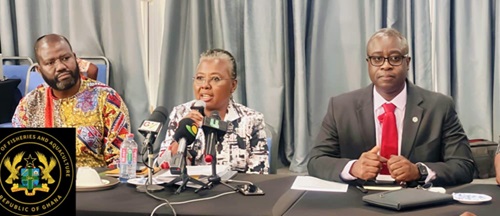
This was made known by the Chairman of the Parliamentary Select Committee on Food, Aquaculture and Cocoa Affairs, Dr Godfred Seidu Jasaw, at a stakeholders’ meeting in Accra on Friday.
The meeting was to finalise a draft Fisheries bill that will help bring sanity to the country’s fishing space.
He said on both occasions, the country was singled out for yellow card warning for illegal, unreported and unregulated fishing.
To this end, he said the draft bill, which was now with the committee of parliament, has made satisfactory inputs but still needed stakeholders in the industry to help finalise it so that Ghana can pass the EU specifications and not receive a red card in 2026.
Value chain
The Minister of Fisheries and Aquaculture, Emelia Arthur, in a welcome address, said three million people in the country depended on the fishery value chain, saying a ban would, therefore, have dire consequences.
Also, she said the country was one of the biggest markets for fish importation into the EU market and a red card would affect export revenues.
She, therefore, said a law was needed to regulate and sanitise the country’s fishing space.
The bill, she said, has, therefore, been laid before parliament under a certificate of emergency.
Mrs Arthur said when finalised, the bill would further be presented to the EU and the Food and Agriculture Organisation (FAO) for contributions before it is passed.
Stakeholders expressed their concerns, saying fish was an important resource in the country that needed to be properly managed.
They said the country had international obligations to manage the resource well.
Some called for the penalisation of captains of vessels that get involved in illegalities in the country’s waters.
They said such captains should not just be repatriated to their home countries but be made to face the full rigours of the country’s laws to serve as a deterrent to others.
Bill
The Fisheries and Aquaculture bill, which elapsed with the last parliament and, therefore, is undergoing consideration in the present parliament, has 167 clauses and 170 sections.
The bills will deal with issues, including inland fishing management, aquaculture issues, offences and penalties.
Latest Stories
-
Dad unlawfully killed daughter in Texas shooting, coroner rules
32 minutes -
Anas wins 7 – 0 as SC unanimously rejects attempts to reverse judgment in his favour
43 minutes -
The cocoa conundrum: Why Ghana’s farmers are poor despite making the world’s best chocolate
2 hours -
Powerful cyclone kills at least 31 as it tears through Madagascar port
2 hours -
GoldBod summons 6 gold service providers over compliance exercise
3 hours -
Power disruption expected in parts of Accra West as ECG conducts maintenance
3 hours -
Police investigate alleged arson attack at Alpha Hour Church
3 hours -
Heavy Sunday downpour wrecks Denyaseman SHS, schools, communities in Bekwai Municipality
3 hours -
Ridge Hospital is in critical condition – GMTF Boss appeals to corporate Ghana
4 hours -
Introduce long term measures to tackle challenges in cocoa sector – IERPP to government
4 hours -
Agricultural Economist proposes blended financing model to support cocoa sector
4 hours -
NPP MP warns against reducing producer price as government rolls out cocoa reforms
5 hours -
Tano North MP urges halt to grain exports over food glut
5 hours -
Farmers hopeful as government moves to expedite cocoa payments
5 hours -
Tensions at Agbogbloshie market women oppose AMA drain cleaning exercise, items confiscated
5 hours