

Audio By Carbonatix
The Economist Intelligence Unit (EIU) says Ghana and six African countries have enormous amounts of debt relative to Gross Domestic Product (GDP) and their governments will grapple with debt-servicing burdens that would eat up a substantial share of their revenue in 2023.
Tunisia, Egypt, Congo-Brazzaville, Zambia, Zimbabwe and Mozambique are the other African countries.
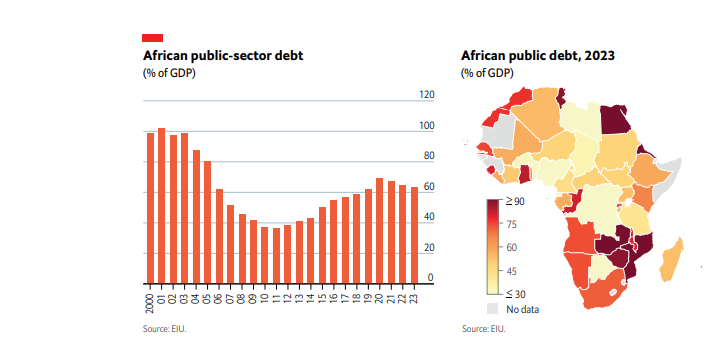
In its Africa Outlook 2023 Report, the EIU said the public-sector debt/GDP ratio will remain above 60% for Africa in 2022 and 2023 and some African countries will far exceed this level.
“The need to service and roll over large amounts of debt at a time when domestic and international borrowing costs are on the rise will weigh heavily on some countries in 2023 and things could get even more painful in 2024 when more capital repayments fall due”, it mentioned.
“African governments have ramped up their borrowing—domestically and internationally — and public sector debt ratios (relative to GDP) have pushed back towards the highs, last seen in the early 2000s just before the enormous debt restructuring of 2005, implemented under the umbrella of the heavily indebted poor countries (HIPC) initiative”, it explained.
More African nations to head towards external debt distress
The EIU also said more African states will head towards external debt distress in 2023 and 2024.
“African states are required to repay about US$75bn of external borrowing (medium- and long-term capital repayments that fall due) in 2023 and a similar amount in 2024. Foreign creditors have offered pandemic-related debt relief and relatively low—by historical standards—interest rates in recent years, but these lines of international financial support have come to an end”.
It further said the debt-servicing burden will become more painful because of higher interest rates, weaker currencies against the US dollar and softer capital inflows, while rolling over existing debt or accruing new debt will become much more of a challenge.
Already, it added many African states have found it difficult to issue new Eurobonds in 2022 and yields in secondary markets—which indicate where future refinancing costs are headed—have risen sharply.
“A widespread external debt crisis across the continent seems unlikely, but some highly leveraged states will face acute financing difficulties and a very uncertain period”, it concluded.
Latest Stories
-
Cholera aid for African countries stalled by Iran conflict
60 minutes -
The Oscars are leaving Hollywood
1 hour -
Too watery, too risky – Why Ghanaian traders prefer Burkina tomatoes
1 hour -
We buy from Burkina because ours rot fast – Tomato traders defend import dependence
2 hours -
Nigeria’s giant oil refinery fails to prevent record gasoline prices
2 hours -
CAF to make changes to regulations after Afcon final fiasco
2 hours -
Council of State member demands EOCO boss apologise or face lawsuit, petitions Mahama for his dismissal
3 hours -
Otto Addo sacked!
3 hours -
‘We are tomato sufficient – Agribusiness chief pushes back on Burkina Faso export shock
4 hours -
AfDB says Africa’s growth risks were tilted to downside even before Iran conflict
4 hours -
Egypt’s Sisi says only Trump can stop war, warns oil could top $200
5 hours -
Tems is most streamed African artist globally with over 40 million monthly Spotify listeners
5 hours -
Afreximbank raises $2bn with its biggest-ever syndicated loan
5 hours -
Sinner raises Alcaraz stakes with historic ‘Sunshine Double’
5 hours -
Why set up an anti-corruption agency while shielding GoldBod at the same time? – IERPP queries gov’t
5 hours