

Audio By Carbonatix
The United States Government says its partnership with Ghana is entering a new phase focused on trade expansion, strategic investment, health sustainability, and stronger security cooperation.
It comes as Washington recalibrates its engagement with Africa to emphasise mutual benefit and reduced aid dependency.
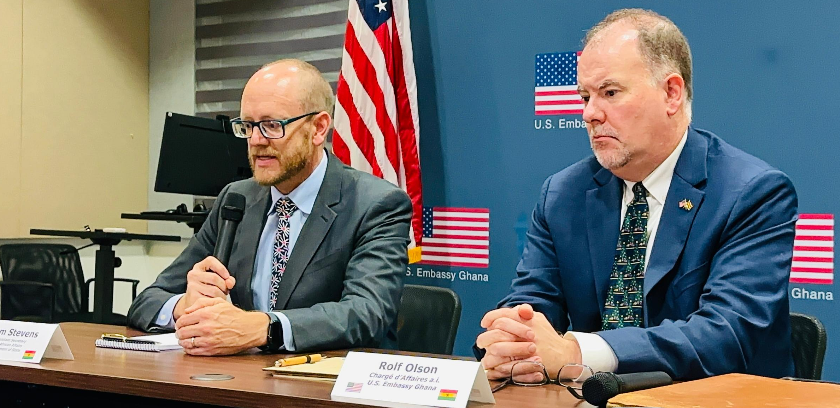
The Deputy Assistant Secretary for West Africa at the U.S. Department of State’s Bureau of African Affairs, Will Stevens, said Ghana remained a priority partner in West Africa, citing consistent high-level engagement, growing trade volumes, and strong alignment with U.S. policy objectives under the current American administration.
Speaking at a policy interaction in Accra, Mr Stevens said the U.S.-Ghana trade relationship had grown significantly in recent years, increasing from about US$2 billion to between US$3.5 billion and US$4 billion, with most Ghanaian exports enjoying tariff exemptions into the American market.
He said key Ghanaian exports such as oil and cocoa were not subject to the 15 percent baseline tariff applied globally, placing Ghana among countries facing the lowest tariff barriers in U.S. trade.
“That reflects the strength of our relationship and the balanced nature of trade between our two countries,” Mr Stevens said, adding that the U.S. hoped to see Ghanaian markets open further to American goods to ensure reciprocity in a partnership between equals.
On the future of the African Growth and Opportunity Act (AGOA), he explained that the U.S. administration was seeking a one-year clean renewal of the legislation to allow time for the development of a new trade framework that responds to current global economic realities.
Mr Stevens stressed that trade, rather than aid, was increasingly at the centre of U.S. engagement with Africa, supported by targeted government tools that could unlock private sector investment.
He cited the Lobito Corridor initiative as a model of effective public-private partnership, involving the U.S. Development Finance Corporation, the Export-Import Bank, the World Bank, and private investors, to drive regional integration through rail, logistics, technology, and infrastructure.
“These are the kinds of projects where U.S. government engagement can be catalytic, making it possible for private sector investment to flow at scale,” he said, and expressed hope that similar models would be expanded across West Africa.
On investment, Mr Stevens underscored the U.S. commitment to building local capacity, noting that Newmont Corporation, the single largest taxpayer in Ghana, is run by a Ghanaian national despite being an American company.
“That is exactly what we mean by investing in host-country nationals and national leadership,” he said.
He described it as a practical demonstration of partnership rather than dominance.
Mr Stevens said the U.S. was negotiating a bilateral Memorandum of Understanding with Ghana to define a clear path for future health financing following the integration of USAID functions into the State Department.
He said health had been the largest area of U.S. assistance to Ghana for many years, particularly in malaria and HIV/AIDS programmes, and that Washington recognised the risks of abruptly cutting support.
Under the proposed framework, he said the U.S. would maintain full funding for health programmes in 2026, followed by a gradual transition towards greater domestic financing over time, in line with Ghana’s own vision for health sector sustainability.
“This reflects our recognition that stopping assistance suddenly would be detrimental, but also that long-term responsibility for healthcare rests with national governments,” Mr Stevens said, adding that President John Dramani Mahama’s views on the issue closely aligned with U.S. thinking.
Mr. Stevens also addressed reports suggesting that Ghana was barred from certain forms of U.S. assistance due to sovereign debt defaults, clarifying that the matter related to legacy arrears with the U.S. Export-Import Bank.
He said the two governments were actively negotiating bilateral debt restructuring and that discussions had been productive, with several payments already made by Ghana in recent months.
“As long as there is a bilateral default, the law restricts additional government-to-government financing, but we are hopeful that this will be resolved soon,” he said.
Mr. Stevens praised Ghana’s cooperation on migration and security, saying the country had played a constructive role in supporting U.S. efforts to enforce immigration laws while respecting due process.
He said Ghana’s responsiveness and openness had made it “easy to do business” with the country and reinforced its standing as a trusted U.S. partner in the region.
The Chargé d’Affaires of the U.S. Embassy in Ghana, Rolf Olsen, described bilateral cooperation as “extraordinary,” particularly in the area of law enforcement and the rule of law.
He said Ghana’s extradition of nine individuals to the United States within a year was a remarkable demonstration of judicial cooperation and political commitment, noting that most of the cases involved cybercrime and large-scale financial fraud targeting vulnerable victims.
“Cybercrime does not respect borders, and the level of collaboration we have seen from Ghanaian authorities has been very strong, very efficient, and very effective,” Mr Olsen said, commending the work of Ghana’s security and justice institutions.
Mr Olsen lauded Ghana’s broader engagement with the U.S. on security, migration, and governance, expressing confidence in the government’s ability to manage complex international obligations responsibly.
He said the depth of cooperation reflected shared values and mutual respect, adding that the U.S. remained proud to stand with Ghana as a key democratic and strategic partner in West Africa.
Latest Stories
-
A source of excellence across generations – Vice President Opoku-Agyemang lauds Mfantsipim
30 minutes -
(Photos) Mfantsipim School launches historic 150th anniversary
54 minutes -
Knights and Ladies of Marshall group backs Catholic Bishops’ stance on anti-LGBTQ+
2 hours -
Bright Simons writes: All the Filla in the Ibrahim Mahama/E&P – Gold Fields Saga
2 hours -
Monetise Idiocy In Ghana
2 hours -
The Ghanaian prophet and the mysterious death of his scottish wife Charmain Speirs
3 hours -
Nearly 400 sentenced in Nigeria for links to militant Islamists
3 hours -
Ghana’s recovery supported by gold strength despite global oil price pressures – Standard Bank Research
4 hours -
Methodist Church hails Mfantsipim@150; calls for “fresh consecration” to excellence
4 hours -
‘Excellence is our inheritance’ – Nana Sam Brew-Butler hails Mfantsipim’s 150-year reign in leadership
4 hours -
Kwaku Azar writes: A-G vs OSP
4 hours -
Mfantsipim–Adisadel rivalry built excellence, not division – Sam Jonah
5 hours -
Vice President launches Mfantsipim’s 150 years of shaping Ghana’s greatest mind
5 hours -
I assure Otumfuo, Mahama will join him to commission KNUST Teaching Hospital by end of this year – Haruna Iddrisu
6 hours -
Barcelona dominate derby to extend La Liga lead
6 hours