

Audio By Carbonatix
A former Canadian Minister of Industry in charge of digitalisation, Science, and Technology and President of the Treasury Board, Canada, Tony Peter Clement, has advised developing nations to adopt Ghana's ambitious digitalisation agenda.
According to him, the government of Ghana has succeeded in using the digital revolution, ensuring accountability and transparency in all sectors of the local economy.
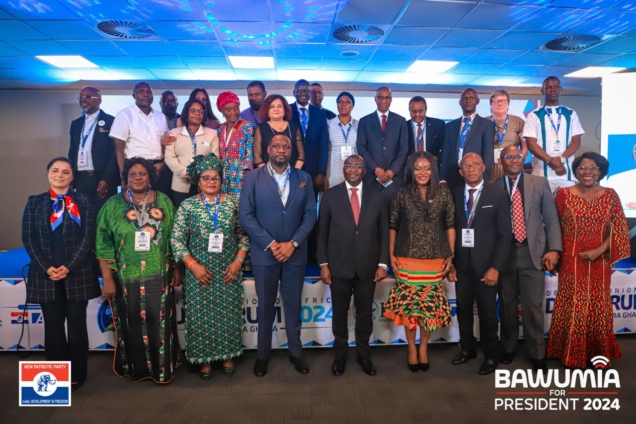
Mr Clement was addressing the Democrat Union of Africa (DUA) Forum 2024, held in Accra, where he spoke on the Topic "Leveraging AI as a tool to build stronger campaign coalitions."
He referenced the Mobile Money Interoperability and the biometric national identification systems as some of the prudent measures that have strengthened Ghana's economic growth.
He underscored the need for developing nations to go the extra mile and bridge the rural and urban digital divide and also enhance cyber security.
Tony Peter Clement further pushed for effective public-private partnerships in accelerating Ghana's digital revolution.

Mobile Money Interoperability
Vice President Dr Mahamudu Bawumia in May 2018 officially launched the Mobile Money Interoperability system through the Ghana Interbank Payment and Settlement Systems Limited (GhlPSS).
The system deepens financial inclusion and promotes cashless transactions in Ghana, which serves as a viable vehicle for financial intermediation, through which businesses and individuals can accept mobile money from other network users seamlessly.
The system is eliminating the complexities and inconveniences associated with transfers across the various mobile money networks operating in the country.
These challenges include difficulties in opening bank accounts, high costs in maintaining a bank account relative to customers’ income levels, and financial literacy.
The system creates convenience and ropes mobile money users into the financial ecosystem and further enables customers to transfer funds from one mobile money wallet to another across all networks.
The system reduces the cost of initiating transactions across networks as customers no longer need the services of a third-party payment provider.
Customers can send and receive money directly from each other irrespective of the network they are on; allowing them more convenience and security.
Latest Stories
-
Prince Harry faces defamation lawsuit from charity he co-founded
23 seconds -
South Korea deploys thermal cameras to track escaped zoo wolf
2 minutes -
Calls for royal meeting with Epstein survivors grow ahead of US visit
5 minutes -
Ibn Chambas advocates blend of technology and human values in education
7 minutes -
UMA improves healthcare access in Asutifi North with GH₵700k ‘Kim Taylor Legacy’ Walkway
12 minutes -
Scholarships Authority and Fanaka University offer sponsorship for procurement and supply chain studies
15 minutes -
Bisa Kdei drops new single ‘Go N Look’ featuring Medikal
21 minutes -
Benin facing rising terrorism in north as French military presence faces growing criticism
22 minutes -
UEW Public Lecture Series 2026: Education debate ‘about the soul of Ghana’s future’ — Dr Ibn Chambas
23 minutes -
EU fingerprint and photo travel rules come into force from today
50 minutes -
Anti-LGBTQ+ Bill: Ghanaians demand expedited passage, not dialogue – Ntim Fordjour to Mahama
58 minutes -
EU airline industry warns of fuel shortages if Strait of Hormuz stays closed
1 hour -
White House staff told not to place bets on prediction markets
1 hour -
Auctioneers petition Prez Mahama over ‘interference’ in public auctions
1 hour -
GEA, Mastercard Foundation drive market access for MSMEs at Kwahu Business Forum
1 hour