

Audio By Carbonatix
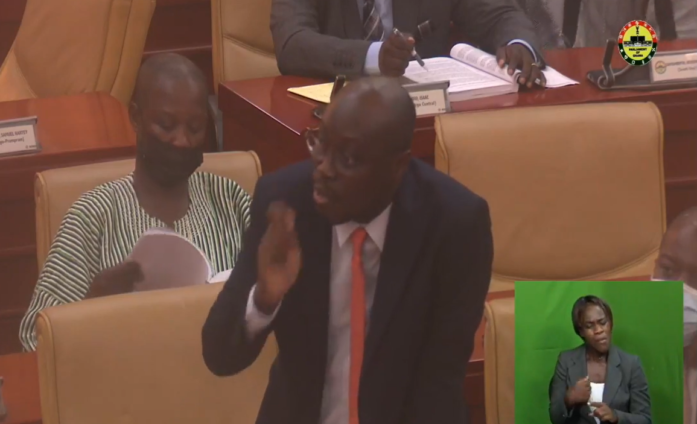
The Ranking Member on Parliament’s Finance Committee, Dr Cassiel Ato Forson says the country’s economy is suffering from “an unfortunate economic condition”.
Contributing to the debate on the 2022 budget, on Tuesday, Dr. Forson diagnosed the ailment as a ‘Stagflation with Acute Debt Overhang Syndrome (SADOSES)'.
He explained that high unemployment, coupled with rising inflation, has crippled the economy and could intensify if the Akufo-Addo government continues to neglect the problem.
“Unemployment is rising at an alarming rate and becoming a national security crisis because of the negligible impact of real sector growth on employment generation,” he said on Tuesday.
He added that, “this “slow and jobless” real sector growth is an acute debt overhang. As of September, 2021, Ghana’s Total Public Debt stood at GH₵341.8 billion of which GH₵221 billion representing 65% of GDP, have been accumulated in the last four and half years. According to the 2022 budget, between January- September, 2021, the Government of Ghana collected GH₵37 billion in Tax Revenue (App 2A, pg. 227), of which 92% (GH₵34.4 billion) was used for debt servicing alone - interest payment (GH₵25.4 billion) + amortization (GH₵9 billion). This clearly is a case of an acute debt overhang.”
In treating the ‘ailment’, the Ajumako-Enyan-Esiam legislator said the country has to choose between foreign assistance and local policies.
“Our government has decided that we treat the malaise ourselves, with local medication (homegrown policies). What is crucial is the right medication and the right dosage; and if care is not taken, Ghana will be going straight into the Highly Intensive Care Unit (HICU),” he argued.
Touching on government’s decision to introduce an electronic levy, the Ranking Member described it as “a super regressive tax”.
He stressed that it will worsen the hardship of the average Ghanaian.
“We are aware that most traders and ordinary Ghanaians use Mobile money wallet as savings account, therefore, any attempt to impose a tax on mobile money transactions will be a tax on savings, - a disincentive to save - which should never be encouraged.”
Latest Stories
-
GPRTU in Savannah Region to protest alleged eviction in Damongo
29 minutes -
Re: Reinsurance does not replace process — A response to the SIGA–SIC defence
43 minutes -
Gender Ministry supports Harriet Amuzu in ongoing abuse case
56 minutes -
AG joins plaintiff to scrap OSP ?: We should be mindful of the mischief in this – Bobby Banson
1 hour -
Samson Lardy Anyenini questions willingness of Attorneys-General to prosecute political colleagues
1 hour -
It is only fair the OSP is heard in Supreme Court case – Bobby Banson
1 hour -
Asiedu Nketia resumes Ashanti tour, second leg kicks off on Sunday
1 hour -
NLA denies salary cut claims, threatens legal action over reports
1 hour -
BoG Governor honoured for stabilising cedi, improve inflation
1 hour -
Kyebi Easter Homecoming 2026: A resounding success!
2 hours -
RNAQ divorce ruling: What the noise is hiding
2 hours -
Trade Minister applauds GUTA as a pillar of economic growth; Prez Mahama honoured
2 hours -
President’s brother’s takeover of Damang Mines is ‘untidy’ – Alhassan Tampuli
3 hours -
It’s not true that gov’t decided not to renew the lease for Gold Fields – Bobby Banson
3 hours -
Ghana to boost tomato production with 60-hectare irrigated farms and processing initiatives
3 hours